

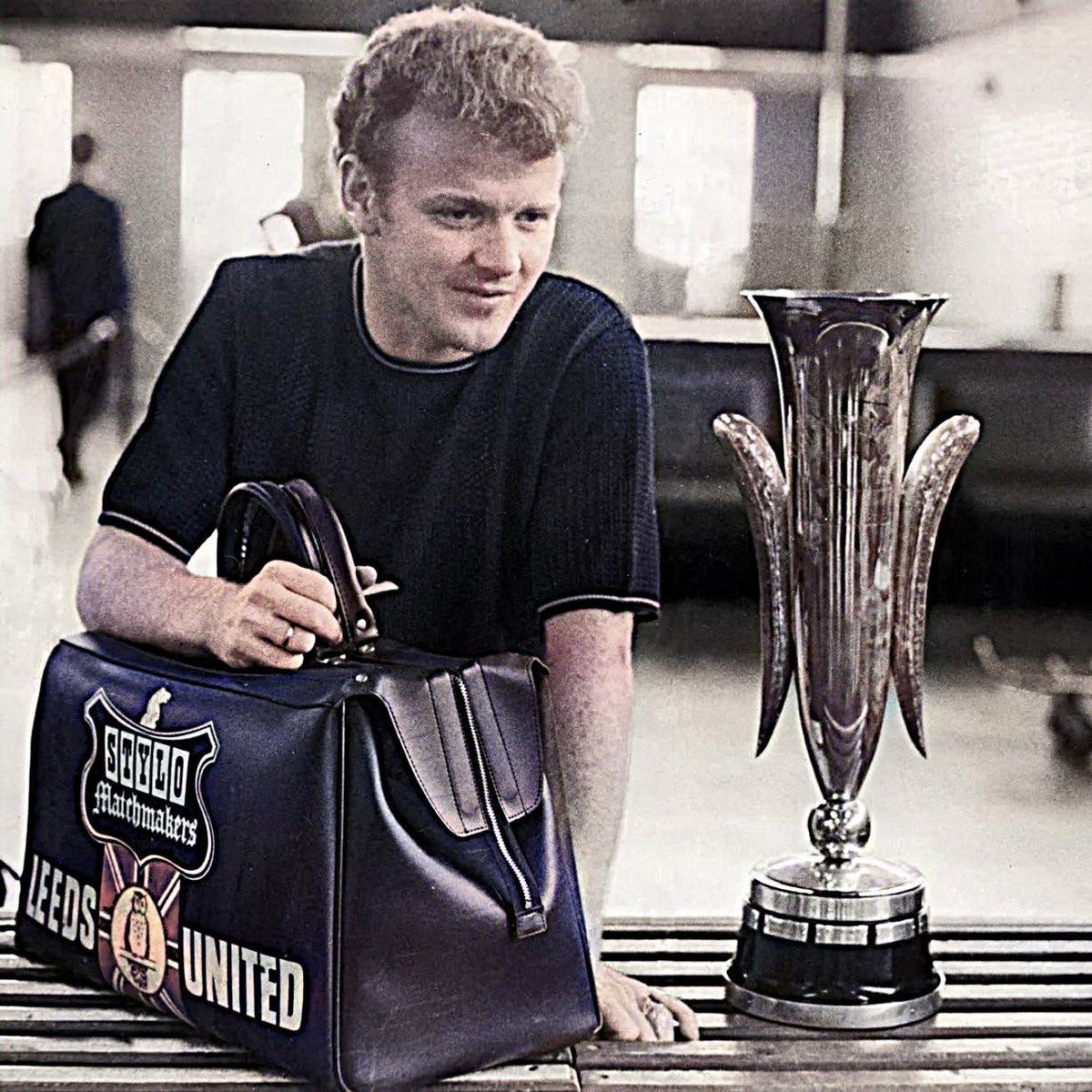
There is an old photograph of Don Revie holding a camera.
In front of him stands Bobby Collins, the Scottish midfielder who helped change Leeds United forever.
Collins is wearing Stylo Matchmakers football boots.
At first glance, it looks like a simple publicity picture.
It is much more than that.
It captures the moment when three stories began to meet.
The rise of Leeds United.
The birth of Stylo Matchmakers.
And the transformation of football boots from basic equipment into something players could be known for wearing.
Before Pelé.
Before George Best.
Before Kevin Keegan.
There was Leeds United.
And there was Don Revie.
The Leeds connection began before the glory


When Revie became Leeds United player-manager in 1961, the club was not yet the giant remembered today.
Leeds were trying to escape the Second Division.
Elland Road had ambition, but little certainty.
Revie knew the club needed more than tactics.
It needed standards.
It needed discipline.
It needed players who could change the mood of an entire dressing room.
In March 1962, he signed Bobby Collins from Everton.
Revie later described him as his best-ever signing.
Collins became captain and helped drive Leeds back into the First Division. In 1965, he was named Footballer of the Year after Leeds finished runners-up in both the league and the FA Cup.
He also became the first major professional footballer at the heart of the Stylo Matchmakers story.
The relationship was not created in a distant advertising office.
Revie was involved.
Collins was involved.
Leeds United was involved.
The surviving photographs of Revie taking pictures of Collins in the boots are among the most important images in Stylo Matchmakers history.
They show that Stylo did not force its way into football through noise.
It entered through trust.
Stylo’s own archive identifies the Collins shoot as the brand’s first football marketing campaign and dates the relationship to 1966.
The advert that changes the story
A surviving Stylo Matchmakers advertisement features Bobby Collins and lists his achievements.
Footballer of the Year.
Scotland international.
Captain of Leeds United.
League runner-up.
FA Cup finalist.
Then comes the line that matters most.
The advertisement says Collins played in Stylo Matchmakers boots, “as do the rest of the Leeds United team.”
That single sentence changes the history.
It tells us the Leeds relationship was not simply an individual deal with Collins.
Stylo Matchmakers was being worn across the team.
It also places the relationship in the mid-1960s, almost a decade before the 1974 Billy Bremner campaign that is sometimes treated as the beginning.
Bremner became the defining Leeds face of Stylo.
But he was not the beginning.
The beginning was Revie.
The beginning was Collins.
The beginning was a young company earning its place inside a football club that was about to dominate English football.
More than a free pair of boots
Modern football supporters are used to sponsorship announcements.
A logo appears.
A press release follows.
Everyone pretends to be excited.
Then the contract ends and both sides quietly delete the photographs.
The Stylo relationship with Leeds was different.
Evidence survives of Stylo Matchmakers bags carrying the Leeds United name. Some examples were personalised for individual players.
That matters.
It suggests an organised team-supply relationship, not a handful of boots handed out for a photograph.
Stylo was becoming part of the working equipment around Leeds United.
Boots.
Bags.
Player identification.
Matchday preparation.
This was a proper football relationship before football had built a small army of sponsorship executives to describe one.
Stylo did not merely stand beside Leeds.
It travelled with Leeds.
Leeds gave Stylo credibility
The timing was perfect.
Revie’s Leeds became one of the strongest and most feared sides in Europe.
They won the League Cup and Inter-Cities Fairs Cup in 1968.
They became champions of England in 1969.
They won another Fairs Cup in 1971.
They lifted the FA Cup in 1972.
Then came the second league title in 1974.
Leeds were relentless.
They could pass.
They could fight.
They could control a match and then control the argument afterwards.
They were respected by their own supporters and disliked almost everywhere else.
That usually means a team is doing something right.
Stylo Matchmakers was worn during that rise.
The brand became connected to players who did not need marketing departments to manufacture character for them.
Bobby Collins.
Billy Bremner.
Norman Hunter.
Paul Reaney.
Paul Madeley.
Eddie Gray.
Terry Yorath.
Allan Clarke.
Peter Lorimer.
Trevor Cherry.
These were not influencers dressed as footballers.
They were footballers.
That difference gave Stylo credibility.


Billy Bremner became the symbol
If Collins opened the door, Billy Bremner became the enduring face of the relationship.
Bremner represented Leeds better than anyone.
He was skilful enough to control a game and hard enough to survive one.
He led the side through its greatest years.
He was not physically imposing.
He did not need to be.
His authority came from how he played.
By 1974, Bremner had become a major named Stylo Matchmakers player.
The relationship later inspired the Heirship Seventy Four, a modern boot created in tribute to that era.
But the importance of Bremner went beyond a model name.
He gave Stylo an identity.
The boots became associated with courage, leadership and football played without apology.
Pelé gave Stylo global prestige.
George Best gave it glamour.
Bremner gave it steel.
One of Britain’s leading football brands
A surviving Stylo Matchmakers advertisement from 1974 carried a simple message:
Players from Britain’s top teams succeed in Stylo Matchmakers.
It featured three clubs.
Leeds United.
Liverpool.
Celtic.
That was not accidental.
These were three of the strongest football institutions in Britain.
Three clubs with enormous support.
Three clubs with demanding cultures.
Three clubs that expected to win.
Stylo was not presenting itself as a fashionable outsider.
It was placing itself at the centre of serious football.
Leeds sat beside Liverpool and Celtic because Leeds had become one of the clubs that defined the age.
And Stylo was part of that picture.
The brand’s wider archive also records that the full squads of Leeds, Liverpool and Celtic wore its distinctive boots during the period.
The relationship survived Revie
Don Revie left Leeds to manage England in 1974.
His departure ended an era, but it did not end the Stylo relationship.
Leeds continued to be associated with Stylo during the brief reign of Brian Clough and under Jimmy Armfield.
The connection remained visible around a squad containing Bremner, Hunter, Reaney, Madeley, Clarke, Eddie Gray, Frank Gray, Terry Yorath, Trevor Cherry, Joe Jordan and Gordon McQueen.
Stylo’s archive identifies both Eddie Gray and Terry Yorath in the Leeds squad wearing the boots during the 1975–76 period.
In 1975, Leeds reached the European Cup final against Bayern Munich.
It was the last great European journey of Revie’s team, even though Revie was no longer there.
Terry Yorath played in all eight of Leeds’ European Cup matches during that campaign, including the final in Paris.
The safe historical claim is not that every Leeds player wore Stylo in every match.
Football boot arrangements were rarely that neat.
The stronger claim is also the honest one.
Stylo Matchmakers was worn extensively across the Leeds United squad during the club’s greatest era.
That is enough.
The truth does not need extra polish.
It already shines.
Why Leeds mattered more than any celebrity
Stylo Matchmakers later became famous for its association with some of the biggest names in football.
Pelé.
George Best.
Kevin Keegan.
Trevor Francis.
Denis Law.
But Leeds United gave the brand something different.
Leeds gave Stylo its football foundations.
The club gave Stylo access to a serious dressing room.
Revie gave it authority.
Collins gave it early professional credibility.
Bremner gave it identity.
The team gave it visibility through one of the most successful periods in English football history.
This was not celebrity endorsement in the modern sense.
There was no carefully edited launch video.
No dramatic countdown.
No player pretending that a new pair of boots had changed his spiritual journey.
Stylo earned its place by becoming useful to footballers.
That was the marketing.
A Yorkshire football story
There is also something important about geography.
Stylo came from Yorkshire business.
Leeds United was becoming the great Yorkshire football power.
The relationship belonged to the same industrial world.
It was practical.
Direct.
Ambitious.
Nothing needed to be dressed up.
The boots had to perform.
The players had to win.
The business had to keep up.
It was a relationship built in the north of England before football became permanently distracted by luxury launches and corporate vocabulary.
Stylo Matchmakers was not created to look good in a boardroom.
It was created to survive a football match.
At Leeds United, that was a useful quality.


Backed by the men who had worn them
When I revived Stylo Matchmakers in 2017, the Leeds United connection was not simply something taken from old advertisements and photographs.
We had the backing of Eddie Gray and Terry Yorath.
That mattered.
Both men had been part of the great Leeds United era.
Both had worn Stylo Matchmakers boots.
They did not need a marketing presentation explaining what the brand had meant inside that dressing room.
They had lived it.
Eddie Gray understood the history because he had helped create it.
Terry Yorath also supported what we were trying to do before his death in January 2026.
His backing now means even more.
Terry had played almost 200 matches for Leeds, won the league title and represented the club in the European Cup final.
But numbers only explain part of the man.
He belonged to a generation that understood the shirt, the dressing room and the responsibility that came with playing for Leeds United.
For Terry and Eddie to support the revived Stylo Matchmakers gave the project something money cannot manufacture.
Authenticity.
These were men from the original Leeds side recognising that the brand deserved to be remembered.
They had worn the boots when Leeds were champions of England and one of the strongest teams in Europe.
We were not borrowing their history.
They were confirming ours.
Terry died aged 75 following a short illness in January 2026. He remained one of the most respected figures from the club’s great era.
The return to Elland Road
More than 50 years after the original relationship began, the revived Stylo Matchmakers returned to Elland Road.
After bringing the brand back in 2017, I was invited to Leeds United and interviewed at the stadium for beIN Sports with Richard Keys and Andy Gray.
For me, it was not simply a media appearance.
It was a return to the place where Stylo’s football story had begun.
The original relationship had been built through Revie, Collins, Bremner and the Leeds squad.
Stylo had later disappeared from the top level of the game.
The boots became collectors’ pieces.
Much of the story was in danger of being forgotten.
Then Stylo returned.
And eventually, it returned to Leeds.
Football has a habit of completing circles when nobody is looking.
The Factory at Elland Road
The Stylo Matchmakers factory stood by Elland Road.
The children knew it.
They searched the bins for rejected boots. A bad stitch. A marked panel. A pair the factory could not sell.
To Stylo, they were defects.
To a Leeds kid, they were gold.
The boots came from the same streets as the players, the supporters and the noise from the ground.
Stylo was not made beside football.
It was made inside it.
The real legacy
Stylo Matchmakers should not be remembered merely as an old boot brand that happened to be worn by famous players.
That undersells it.
The brand was part of the early development of football endorsement in Britain.
It worked with managers.
It supplied teams.
It created player relationships.
It appeared in national football advertising.
It built an identity around the men wearing the product.
And at the centre of that story was Leeds United.
The club did not merely provide famous photographs.
It gave Stylo Matchmakers legitimacy.
Leeds showed that the boots belonged at the highest level.
That is why this history still matters.
Not because everything was better in the past.
It was not.
The pitches were worse.
The tackles were criminal.
The bathwater probably required a tetanus injection.
But the relationships felt real.
The players carried the boots into matches that mattered.
The product had to earn its reputation on the pitch.
And Stylo Matchmakers earned it with Leeds United.
Pelé gave Stylo the world.
George Best gave it glamour.
Kevin Keegan gave it another dynasty.
Billy Bremner gave it steel.
Eddie Gray and Terry Yorath carried its history into another generation.
But Leeds United gave Stylo Matchmakers football.