

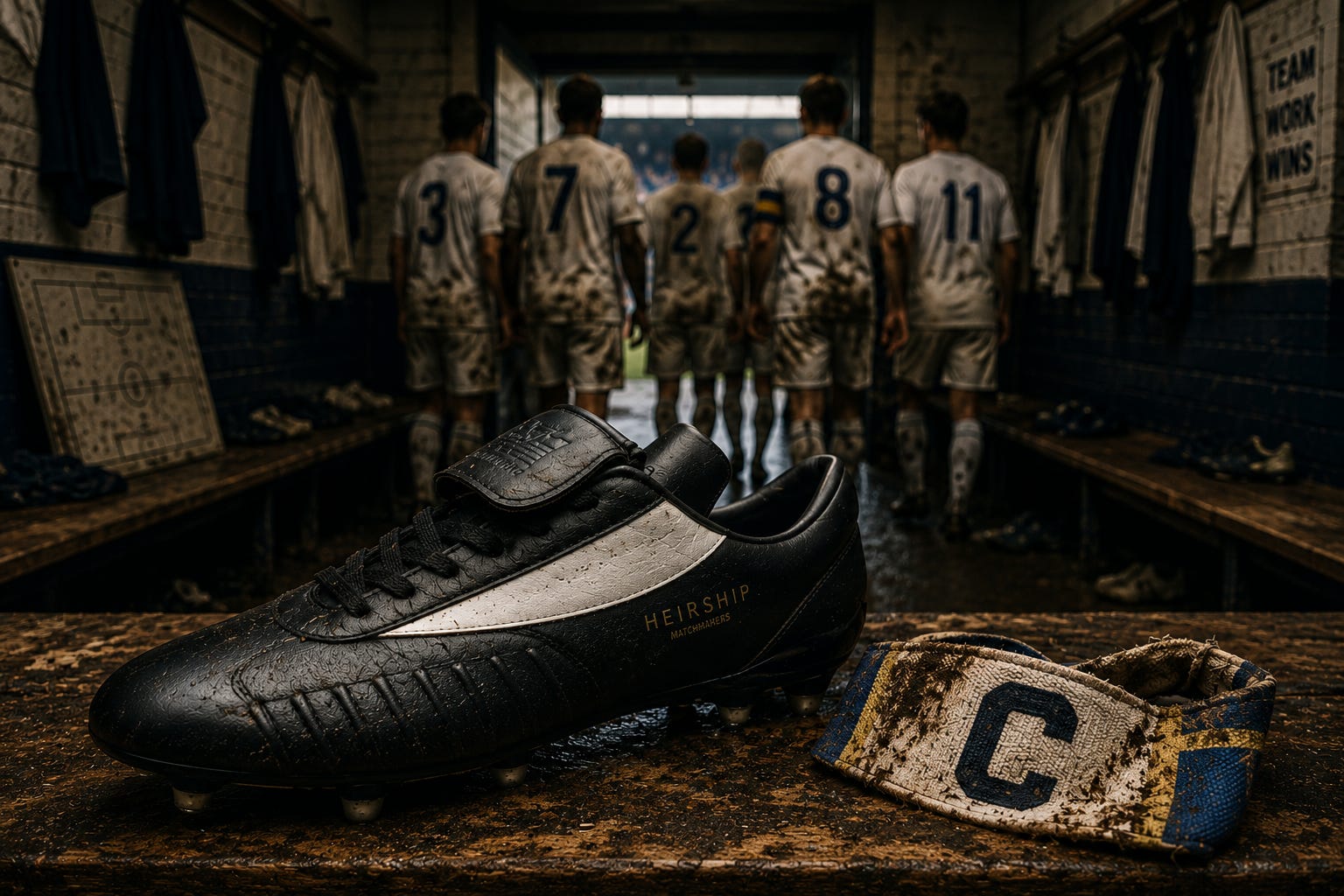
Football has become very good at teaching young players how to look like footballers.
The latest boots.
The right colourway.
The personal logo.
The carefully edited highlights.
It is less fashionable to talk about the things that actually make a player valuable.
Listening.
Running without the ball.
Passing when somebody else has the better chance.
Doing your job when nobody is watching.
The boot can help.
It cannot do any of that for you.
The black-boot lesson
For generations, academy players understood the meaning of black boots.
It was never really about colour.
It was about humility.
You arrived.
You listened.
You learned.
You became part of the team before trying to become the star of it.
Sir Alex Ferguson supported that culture at Manchester United. Young players were expected to earn the right to stand out. Potential did not place them above the group.
That philosophy had deeper roots.
Sir Matt Busby built Manchester United around discipline, responsibility and collective purpose. Yet he also understood that exceptional players could not be produced on a conveyor belt.
George Best needed freedom.
Denis Law needed instinct.
Brian Kidd needed confidence.
Busby allowed personality to exist inside the team.
Never above it.
That distinction is everything.
You still had to deliver
Bright boots were once called banana whoppers.
A player could wear them.
But he had better be able to play.
The colour placed a target on him. His first touch was watched more closely. A misplaced pass looked worse. An opponent needed no invitation to remind him that fancy boots meant nothing once the whistle went.
That was football’s crude but honest test.
You could express yourself.
You could stand out.
But you still had to deliver for the team.
The pitch did not care what was on your feet.
Pink boots are not the problem
There is nothing wrong with pink boots.
There is nothing sacred about black ones.
Some players genuinely feel better when they wear something distinctive. Confidence matters, and the right pair of boots can contribute to it. The best modern boots can also be light, comfortable and technically excellent.
The problem is not colour.
The problem begins when appearance is confused with achievement.
Today, professional football is covered in pink, orange, gold and fluorescent boots. We are told they represent individuality.
Yet thousands of players often wear the same colourways, produced by the same handful of companies and launched through the same coordinated campaigns.
Sometimes what looks like rebellion is only another uniform.
A £250 boot cannot teach awareness.
It cannot make you track a runner.
It cannot tell you when to shoot and when to pass.
It cannot give you courage when the team is losing.
Most importantly, it cannot make you a good teammate.
Talent is not greatness
Modern football marketing loves the lone superstar.
One player.
One boot.
One moment.
One slogan.
Real football is more demanding.
A player can possess extraordinary individual ability and still fail to become great.
A footballer who never passes, never works and never improves those around him is not yet a great player.
He is gifted.
There is a difference.
George Best played alongside Denis Law and Bobby Charlton.
Kevin Keegan had Liverpool around him.
Pelé did not win World Cups alone.
Every great forward needed somebody to win the ball.
Every winger needed somebody to make the run.
Every goalscorer needed somebody to create the chance.
Every great side depended on players doing work that would never appear in the highlights.
A brilliant player in a poor team can still produce brilliant moments.
But moments are not the same as greatness.
Greatness begins when individual talent becomes useful to other people.
The player made Stylo
Stylo Matchmakers understands that.
Our boots were worn by George Best, Denis Law, Brian Kidd, Kevin Keegan and many more.
But Stylo was never the vanity brand of one player.
It was a major football name.
It crossed clubs, generations and dressing rooms. It was built through footballers wearing the product in real matches, not through choreographed launches and rented attention.
Matt Busby supported Stylo Matchmakers and allowed leading Manchester United players to wear the boots.
That mattered.
He believed in the team, but he did not believe every player had to become identical.
Best could be Best.
Law could be Law.
Kidd could be Kidd.
Their individuality worked because it lived inside a proper football team.
The boots became famous because of the players.
The players became great because of far more than the boots.
A conversation I never forgot
Years ago, I was introduced to the owner of Pro:Direct Soccer.
He told me he had heard of Stylo Matchmakers, but said our boots reminded him of the Stanley Matthews brand.
Stanley Matthews was one of the greatest footballers England ever produced. There is no disrespect in being mentioned alongside him.
But I remember feeling that the comparison missed the scale of Stylo.
Stylo Matchmakers was not built around one man.
It was worn by major footballers across different clubs and generations. It was part of the wider fabric of British football.
The comment felt dismissive.
It also stayed with me because it showed how easily a significant piece of football history can be reduced when it sits outside the modern retail machine.
The market teaches visibility
Football boots have become absurdly expensive.
Parents are expected to spend £200 or more on footwear that may be outgrown, damaged or replaced by another colourway within months.
Each release is presented as a revolution.
Often, the biggest change is the paint.
Part of the price pays for materials and development.
A large part also supports endorsements, advertising, influencers, launch campaigns and the machinery needed to make last month’s boot feel obsolete.
At the same time, football retail has become heavily concentrated.
Sports Direct dominates much of the high street. Pro:Direct has built enormous influence online. A small number of businesses and multinational brands now control much of what players see.
That does not make every large retailer bad.
Scale can offer convenience, stock and competitive prices.
But it creates a system where visibility can be mistaken for quality.
The biggest brand appears everywhere, so young players assume it must be the best.
The most expensive boot receives the loudest campaign, so parents assume the price must be justified.
The market does not merely sell products.
It teaches people what to value.
The illusion of choice
Players are shown hundreds of boots.
Different colours.
Different professional endorsements.
Different slogans.
Yet much of the apparent choice comes from the same few companies.
An independent brand does not need to be formally excluded.
It can simply be left off the shelf.
Buried online.
Denied visibility.
The consumer still sees a crowded market, but the shop window is controlled by very few hands.
It is not a cartel in the legal sense.
But it can feel like a closed system in which independent brands are invited to compete on a pitch owned by their opponents.
That matters because the largest company is not automatically the best.
The most visible boot is not automatically the best made.
And the highest price does not guarantee the greatest value.
Sometimes a company owns more of the shop window.
That is not the same as owning the truth.
What black boots really meant
The old black-boot policy carried a lesson that remains valuable.
Do not confuse attention with achievement.
You may have been the best player at school.
You may have an agent.
You may have followers.
You may own the newest boots.
None of that places you above your teammates.
First, learn the game.
Learn to listen.
Learn to lose.
Learn to recover.
Learn to make somebody else play better.
Then earn the right to stand out.
Football needs personalities.
It needs dribblers, leaders and risk-takers. It needs players willing to attempt something others cannot see.
But individuality without responsibility becomes vanity.
Eleven talented individuals do not automatically create a team.
The winger must recover.
The striker must press.
The midfielder must cover.
The defender must communicate.
The substitute must stay ready.
The star must pass when somebody else has the better chance.
Not everybody gets the photograph.
Everybody contributes to it.
What Stylo stands for
Stylo Matchmakers is proud of its history.
We are proud that great players wore our boots.
But we will not insult those players by claiming the boots made them great.
Their ability did.
Their courage did.
Their work did.
Their teammates did.
We can make a proper football boot.
We can use strong materials.
We can shape it for comfort.
We can build it for real pitches and real players.
But we cannot give somebody vision.
We cannot give them character.
We cannot make them understand the game.
That work belongs to the player.
And no player completes it alone.
The deepest work in football is often invisible.
It is the run that creates space for somebody else.
The tackle that prevents the chance.
The pass before the assist.
The decision to help rather than be seen.
The players who last are rarely those most desperate to be looked at.
They are the ones their teammates learn to rely upon.
Wear black boots.
Wear pink boots.
Wear banana whoppers.
Wear whatever helps you feel comfortable and confident.
Just remember what matters.
The colour of the boot does not make the player.
The logo on the box does not make the boot.
The price does not guarantee quality.
And one brilliant individual does not make a great team.
The game remains the only honest judge.
Talent gets you noticed.
Teamwork makes you matter.