

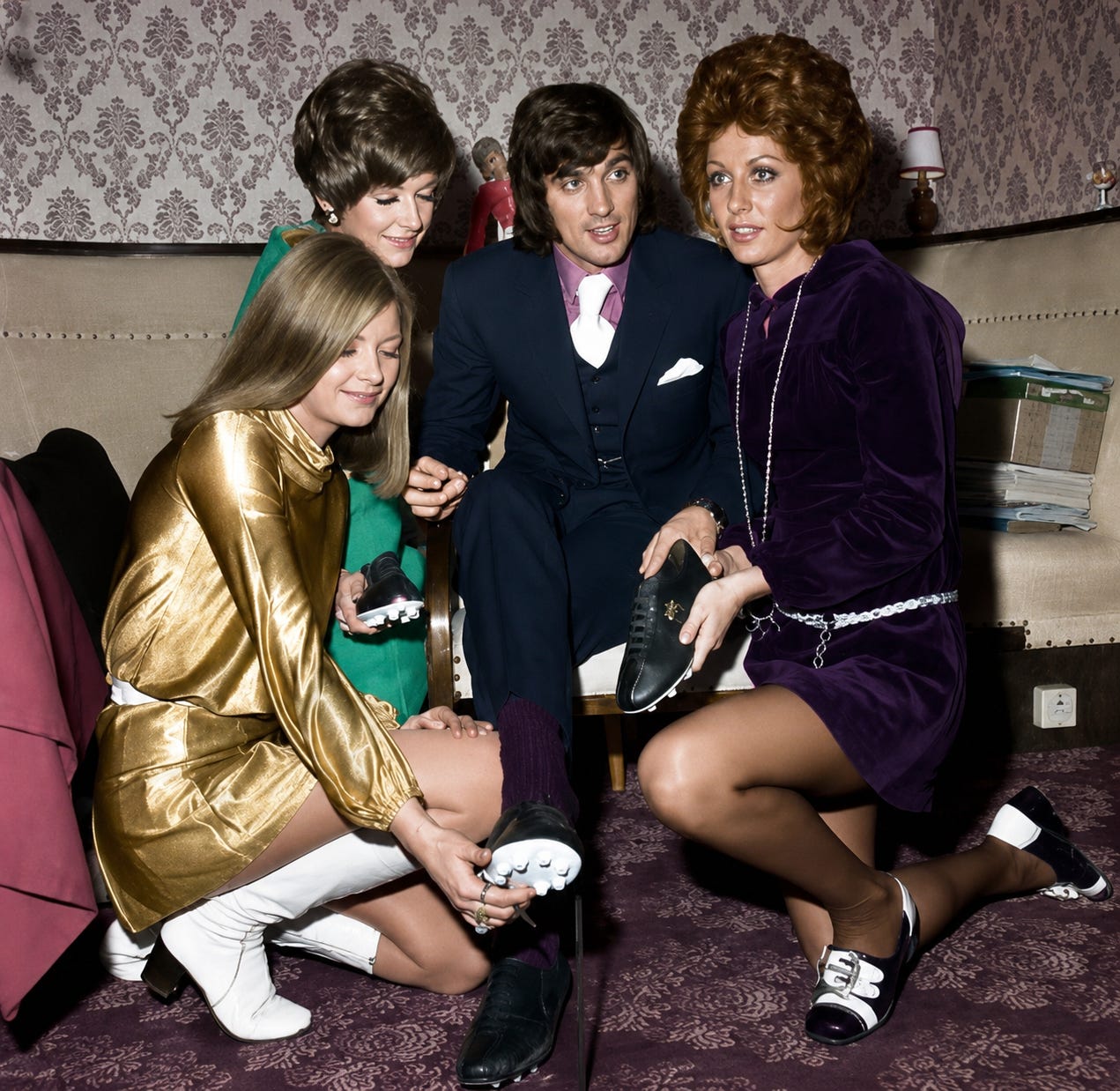
There are football boot sponsorships.
Then there is George Best signing for Stylo Matchmakers at the Playboy Club in London.
It sounds almost too perfect.
A British football boot brand.
The most exciting footballer in Britain.
The Playboy Club.
Park Lane.
London.
No launch film.
No social-media campaign.
No marketing department talking about “authentic storytelling”.
Just George Best.
Stylo Matchmakers.
And a deal.
That was football before football became frightened of personality.
The Playboy Club
The location matters.
London’s Playboy Club opened at 45 Park Lane in 1966 and quickly became part of Swinging London.
Actors went there.
Musicians went there.
Celebrities went there.
George Best belonged in that world.
Most footballers did not.
That was the difference.
Footballers were still largely expected to train, play, go home and perhaps appear in the local paper advertising a furniture shop.
Best crossed the line.
He became something football had barely seen before.
A player.
A celebrity.
A fashion figure.
A cultural phenomenon.
And according to the Stylo Matchmakers story, that was where George Best signed for us.
At the Playboy Club.
Of course he did.
Before Beckham. Before Ronaldo. There was Best.
Football likes pretending the celebrity footballer is a modern invention.
It isn’t.
George Best wrote the template.
In 1966, aged just 19, he helped tear Benfica apart in Lisbon as Manchester United won 5–1.
Portugal called him El Beatle.
That tells you everything.
He had the hair.
The clothes.
The cars.
The confidence.
But most importantly, he had the football.
That part sometimes gets lost.
Forget the nightclubs.
Forget the girlfriends.
Forget the quotes.
You are still left with one of the most gifted footballers Britain ever produced.
Balance.
Acceleration.
Two feet.
Courage.
Goals.
Best attacked defenders.
He did not perform tricks twenty yards away from them.
He went at them.
Again.
And again.
And again.
On terrible pitches.
Against defenders who could kick him almost without consequence.
Then he got back up and asked for the ball.
Wembley, 1968
Manchester United against Benfica.
European Cup Final.
Wembley.
Ten years after Munich.
The game went into extra time at 1–1.
Best took the ball around the goalkeeper and scored.
United won 4–1.
They became the first English club to win the European Cup.
Best was 22.
That year he won the Ballon d’Or.
Twenty-two.
Already European champion.
Already European Footballer of the Year.
Already one of the most famous sportsmen in Britain.
Then came Stylo Matchmakers.
Stylo understood something early
Stylo Matchmakers was never supposed to be timid.
Founder Paul Ziff understood the power of great footballers before athlete endorsement became an industry of its own.
Stylo worked with Pelé. George Best. Kevin Keegan. Billy Bremner.
That list tells you the ambition.
Stylo did not want a respectable little corner of the market.
It wanted the best.
George Best appeared in Stylo Matchmakers advertising around the turn of the 1970s and became one of the faces most closely connected with the brand.
This wasn’t heritage added fifty years later by a marketing agency.
George Best actually wore Stylo.
The relationship was real.
Look at the boots
This is the bit I love.
George Best did not need fluorescent boots.
He didn’t need a new colourway every fortnight.
He provided the colour.
The boots could be black.
Simple.
Elegant.
Fast.
Exactly as football boots should be.
Stylo later promoted boots connected with Best using soft leather, lightness and flexibility.
That made sense.
His game depended on touch.
Movement.
Acceleration.
Changing direction.
Feeling the ball.
There was nowhere for a bad boot to hide.
And Stylo did not need twelve pages of pseudo-science to explain them.
George Best wore them.
Watch George Best play.
There was your product demonstration.
The perfect Matchmaker
This is why the partnership worked.
George Best and Stylo Matchmakers were not two random names thrown together by an agency.
There was a match.
The clue was always in our name.
Matchmakers.
Best represented individuality inside a team sport.
Stylo represented a British football brand prepared to stand apart.
He was football’s great non-conformist.
Stylo was prepared to challenge the giants.
It fitted.
Modern endorsement is obsessed with reach.
Followers.
Engagement.
Algorithms.
George Best needed none of it.
Instagram didn’t exist.
George was Instagram.
He walked into a room and people looked.
He walked onto a football pitch and 50,000 people looked.
That was influence.
Don’t reduce him to the mythology
George eventually made 470 competitive appearances for Manchester United and scored 179 goals.
But numbers still don’t really explain him.
Football statistics tell you who scored.
They struggle to measure the player who makes a crowd stand up before anything has happened.
Best had that.
Ball arrives.
Crowd rises.
Defender retreats.
Something is coming.
Few players ever possess that power.
George did.
His later life was more difficult.
Alcohol caused enormous damage.
His United career ended far earlier than his talent suggested it should have.
There is no reason to romanticise that.
But there is also no reason to allow it to swallow the footballer.
Too often Best’s story becomes drinking anecdotes and one-liners.
That’s lazy history.
Before the mythology came the genius.
Before the bars came Belfast.
Before everything went wrong, an awful lot went spectacularly right.
He changed what a footballer could be
Best’s importance goes beyond Manchester United.
He expanded the idea of the footballer.
Footballer.
Fashion figure.
Advertising personality.
Celebrity.
Cultural figure.
Today that combination is normal.
In the 1960s it was revolutionary.
You can draw a line from Best through Cantona and Beckham to Cristiano Ronaldo and the modern global football superstar.
The commercial game eventually caught up.
George got there first.
And that is why the Playboy Club signing matters.
It isn’t merely a glamorous old story.
It captures a moment when football was moving into popular culture.
George Best was leading it there.
And Stylo Matchmakers was beside him.
That history belongs to Stylo
This is the part that matters to me.
We didn’t borrow George Best decades later because retro football became fashionable.
He was there.
He wore the boots.
He appeared in the advertising.
He became part of the brand.
Pelé wore Stylo Matchmakers.
George Best wore Stylo Matchmakers.
Kevin Keegan wore Stylo Matchmakers.
Billy Bremner wore Stylo Matchmakers.
That isn’t manufactured heritage.
You either have that history or you don’t.
Stylo has it.
But history is useless if all you do is stare at it.
When I brought Stylo Matchmakers back, I never wanted to build a museum.
History should give you permission to do something next.
George Best represents exactly the kind of player Stylo should still stand for.
Not necessarily the safest.
Not necessarily the most followed.
Not somebody invented by a marketing department.
A footballer with identity.
Courage.
Style.
A player people would pay to watch.
George was a Matchmaker before anyone needed to explain what the word meant.
George Best, Matchmaker
George Best died in 2005, aged only 59.
The football never did.
Put the old footage on.
Watch the body movement.
Watch the acceleration.
Watch defenders guessing.
Watch him get kicked.
Watch him get up.
Then look down.
Black football boots.
Stylo Matchmakers.
They belong in the picture.
Not as decoration.
As part of the story.
A British brand looked at the most exciting footballer in Britain and understood exactly what it was seeing.
George Best looked at Stylo and said yes.
And somewhere inside the Playboy Club in London, those two worlds came together.
Football.
Fashion.
Celebrity.
Rebellion.
Stylo Matchmakers.
George Best.
You could hardly invent a more appropriate place for the deal.
George Best did not need football to make him interesting.
Football gave him the stage.
Stylo Matchmakers gave him the boots.
George did the rest.