

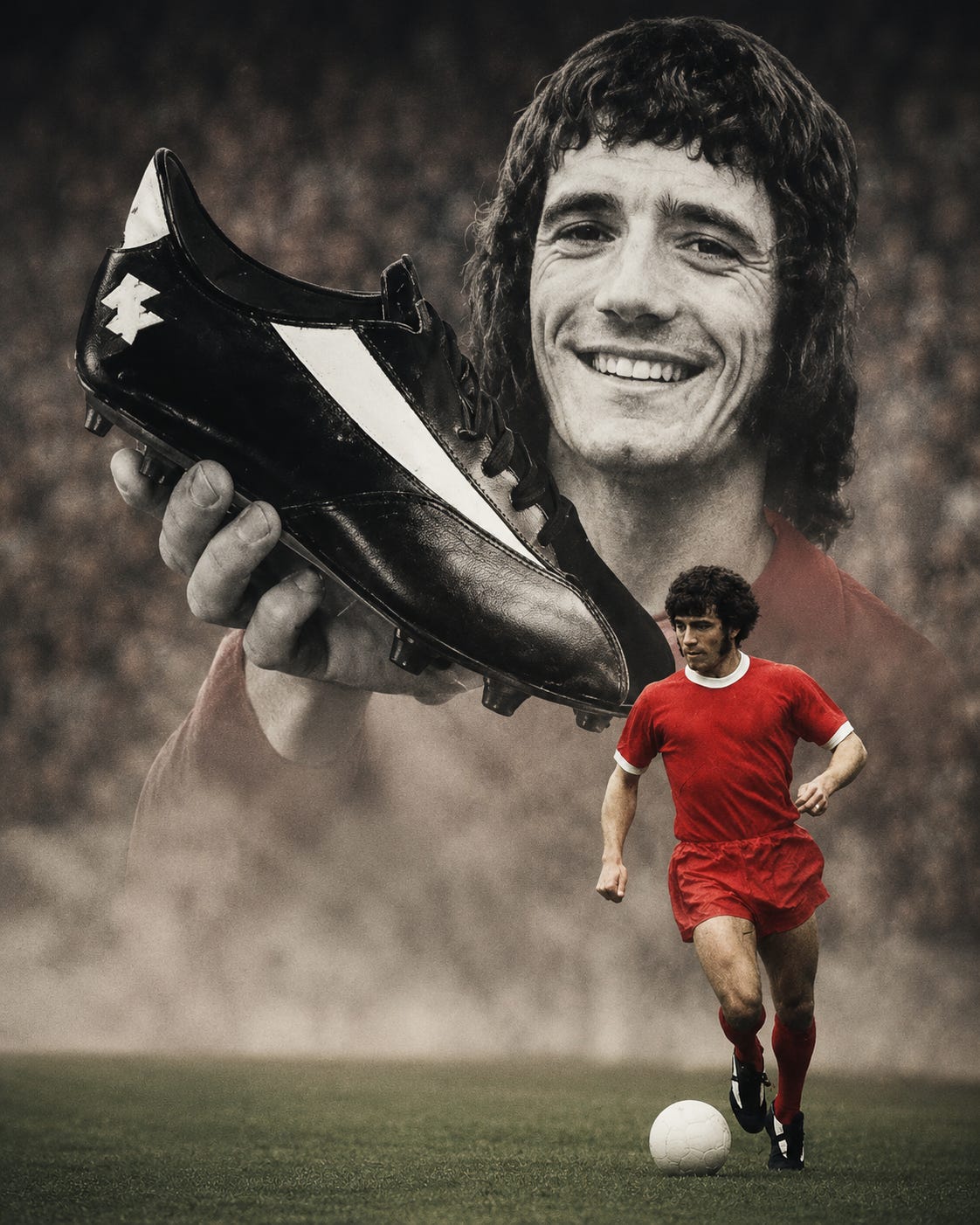
Kevin Keegan did not look like football’s next superstar.
He was too small.
Too ordinary.
Too enthusiastic.
Football experts have always enjoyed explaining why somebody will not make it.
Kevin Keegan spent his career making them look foolish.
He rose from Scunthorpe United to Liverpool.
From Liverpool to Hamburg.
From a £33,000 signing to European champion.
From promising young player to the best footballer in Europe.
Twice.
But this is not only a story about trophies.
It is a story about belief.
About George Best.
About Stylo Matchmakers.
And about the moment one great British football personality passed the torch to another.
George Best opened the door
Before Kevin Keegan became the face of English football, there was George Best.
Best changed what a British footballer could be.
He was not merely a player.
He was style.
Rebellion.
Talent.
Celebrity.
He became football’s first modern superstar before the industry knew what to do with one.
Keegan understood the debt.
Years later, he spoke warmly about Best and said there had been nobody better.
He did not try to place himself above him.
He gave him the credit.
Keegan said:
“I benefited from Bestie more than anybody.”
That included Best’s newspaper column.
It also included his boot contract.
Stylo Matchmakers.
Best had worn Stylo while becoming the most recognisable footballer in Britain.
When his career began to fade, Keegan stepped into that space.
Not by copying Best.
Nobody could copy George Best without looking like a man wearing somebody else’s coat.
Keegan became a different kind of superstar.
Best was the rebel.
Keegan was the believer.
Best made football glamorous.
Keegan made hard work glamorous.
Both wore Stylo Matchmakers.
The boot contract that connected two eras
Keegan was unusually honest about what happened.
He said he inherited Best’s Stylo Matchmakers contract.
That sentence matters.
It connects two of the greatest personalities in British football history through one British football boot company.
Stylo did not merely sponsor famous players.
It stood between generations.
George Best helped turn footballers into cultural icons.
Kevin Keegan took that opportunity and carried it forward.
He worked with Stylo and received his own KK Matchmakers boot.
This was not a modern endorsement where a player opens a box, holds the product for eight seconds and forgets its name before lunch.
Keegan became part of the product.
His initials went onto the boot.
His personality went with them.
Football boots were equipment.
The right player turned them into identity.
Keegan did exactly that.
Before the Ballon d’Ors
Liverpool signed Keegan from Scunthorpe United in 1971.
He was 20 years old.
Bill Shankly initially saw him as a midfielder.
That idea did not last long.
Keegan attacked everything.
Space.
Defenders.
Loose balls.
The limits other people placed upon him.
Shankly moved him forward alongside John Toshack, and English football changed.
Keegan scored on his Liverpool debut against Nottingham Forest.
He would eventually make 323 appearances for the club and score 100 goals.
Three league championships followed.
Two UEFA Cups.
An FA Cup.
Liverpool’s first European Cup.
The medals tell you what he won.
They do not explain how he played.
Keegan ran as though standing still might get him sent off.
He chased defenders who thought they had time.
He challenged men six inches taller.
He treated every loose ball as unfinished business.
George Best made genius look effortless.
Kevin Keegan made effort look like genius.
The day Liverpool discovered a superstar
Keegan’s fame did not arrive slowly.
It exploded.
A Liverpool Echo story recalls the chaos outside a sports shop in Bromborough shortly after he joined Liverpool in 1971.
Keegan appeared at the shop and caused pandemonium.
Supporters packed the area to see him.
This was before social media.
Before security teams followed footballers into shops.
Before every appearance was filmed, sponsored and uploaded with dramatic music.
Keegan had barely begun his Liverpool career, yet people already sensed something.
He was accessible.
He was exciting.
He looked like one of them.
Then he stepped onto the pitch and played as though he had been sent to represent them personally.
That connection never left him.
Liverpool supporters loved Keegan because he did not merely play for the club.
He looked grateful to be there.
There is a difference.
Mighty Mouse
Keegan was small by the standards of elite football.
The nickname was obvious.
Mighty Mouse.
It suited him because it carried affection without making him seem weak.
He was compact.
Powerful.
Fast.
Brave.
He attacked headers against centre-halves who looked as though they had been assembled in shipyards.
He did not wait for permission to compete.
He simply jumped.
That became his career.
Scunthorpe to Liverpool.
Liverpool to Hamburg.
Hamburg to two Ballon d’Or awards.
At every stage, Kevin Keegan jumped higher than expected.
The courage to leave Liverpool
In 1977, Keegan left Liverpool after helping the club win its first European Cup.
He joined Hamburg.
It was a brave decision.
He was leaving the best team in Europe.
Leaving England.
Entering a new league, language and culture while carrying the expectations of a record transfer.
Today, the move would arrive through a documentary series called The Next Chapter.
Keegan simply went to Germany and got on with it.
The beginning was difficult.
He struggled.
He became frustrated.
Then he adapted.
He learned the language.
He won the Bundesliga.
He won the Ballon d’Or in 1978.
Then he won it again in 1979.
The little player from Scunthorpe had become the best footballer in Europe.
The experts went quiet for a bit.
A superstar before personal brands
Keegan became one of Britain’s most recognisable people.
He appeared on television.
He recorded music.
He competed on Superstars.
He advertised products.
He wore his famous perm with the confidence of a man who had won two Ballon d’Ors and therefore did not require public approval.
He became a brand before footballers were instructed to build brands.
The difference was that Keegan’s personality came first.
The commercial opportunities followed.
Modern football often reverses the process.
The strategy is created.
The content calendar is approved.
A personality is added later, where available.
Keegan required no marketing invention.
He smiled.
He spoke honestly.
He occasionally exploded.
People believed him because there was clearly a real person in there.
King Kev
Liverpool made Keegan a star.
Hamburg made him a world star.
Newcastle made him immortal.
He joined Newcastle United as a player in 1982 when the club was in the Second Division.
His arrival transformed the mood.
Supporters returned.
Hope returned.
Newcastle won promotion in his final season.
Keegan retired in 1984.
Then football pulled him back.
In 1992, Newcastle were in serious trouble.
Keegan returned as manager and kept them from falling into the third tier.
He did more than save the club.
He woke it up.
His Newcastle team attacked.
They took risks.
They entertained.
They made supporters feel proud, nervous and alive, often within the same five-minute period.
People remember that Newcastle failed to win the Premier League.
That is true.
It is also a dull way to remember them.
Keegan gave Newcastle its imagination back.
Some trophies sit inside cabinets.
Some teams live permanently inside people.
His Newcastle side did the second.
The emotion was the point
Kevin Keegan cared visibly.
That became a weakness only to people who believe football should be run by refrigerators.
His famous “I would love it” interview has been replayed endlessly.
It is often framed as the moment Sir Alex Ferguson defeated him psychologically.
Perhaps.
It was also one of the last great unscripted moments in English football.
Keegan was angry.
Protective of his players.
Certain Newcastle could still win the league.
He said what he felt.
No press officer had time to remove the human parts.
Good.
That honesty was not a flaw.
It was the reason people believed him.
Why Kevin Keegan mattered to Stylo Matchmakers
Kevin Keegan was one of the main reasons I brought Stylo Matchmakers back.
I saw the photographs.
George Best in Stylo.
Pelé in Stylo.
Kevin Keegan in Stylo.
These were not anonymous athletes arranged around a marketing plan.
They were football personalities.
They had style before stylists.
They had followers before social media.
They made the boots important because supporters wanted a piece of what those players represented.
Stylo Matchmakers was never merely a boot company.
It was stitched into an era when football felt closer to its supporters.
Players became famous, but they had not yet disappeared behind walls of corporate management.
Keegan represented that better than almost anyone.
He was a global superstar who still felt local.
That is rare.
It was rare then.
It is nearly extinct now.
A working-class football hero
Keegan never forgot where he came from.
He came from mining stock near Doncaster.
He understood work.
He understood supporters.
He understood that football clubs were not entertainment properties that happened to sell scarves.
They belonged to places.
To families.
To people who worked all week and handed over part of their wage to stand in the rain.
Keegan respected that contract.
When he played, he emptied himself.
When he managed, he tried to give supporters football worth watching.
He did not always succeed.
That made him more human, not less important.
Football has lost more than a winner
Kevin Keegan died on 20 July 2026, aged 75.
Football lost a European champion.
A three-time English league winner.
A Bundesliga winner.
A two-time Ballon d’Or winner.
An England captain.
A Newcastle icon.
Stylo Matchmakers lost part of its history.
But the greater loss is harder to measure.
Football lost another link to an age when personality was not treated as a reputational risk.
Keegan was emotional.
Ambitious.
Occasionally furious.
Frequently brilliant.
Always recognisable.
He was never beige.
Thank you, Kevin
Kevin Keegan followed George Best into Stylo Matchmakers.
Then he walked out of Best’s shadow and built a legacy of his own.
Best showed Britain that a footballer could become a superstar.
Keegan showed that the superstar could still belong to the supporters.
He made people believe that hard work could compete with genius.
That courage could compensate for size.
That ordinary beginnings did not require ordinary endings.
At Stylo Matchmakers, we will always be proud that Kevin Keegan wore our boots.
We are even prouder of what he carried inside them.
Energy.
Courage.
Humility.
Emotion.
Belief.
Football gave Kevin Keegan fame.
Kevin Keegan gave football his heart.
Mighty Mouse. King Kev. One of our own.
Kevin Keegan, 1951–2026.