

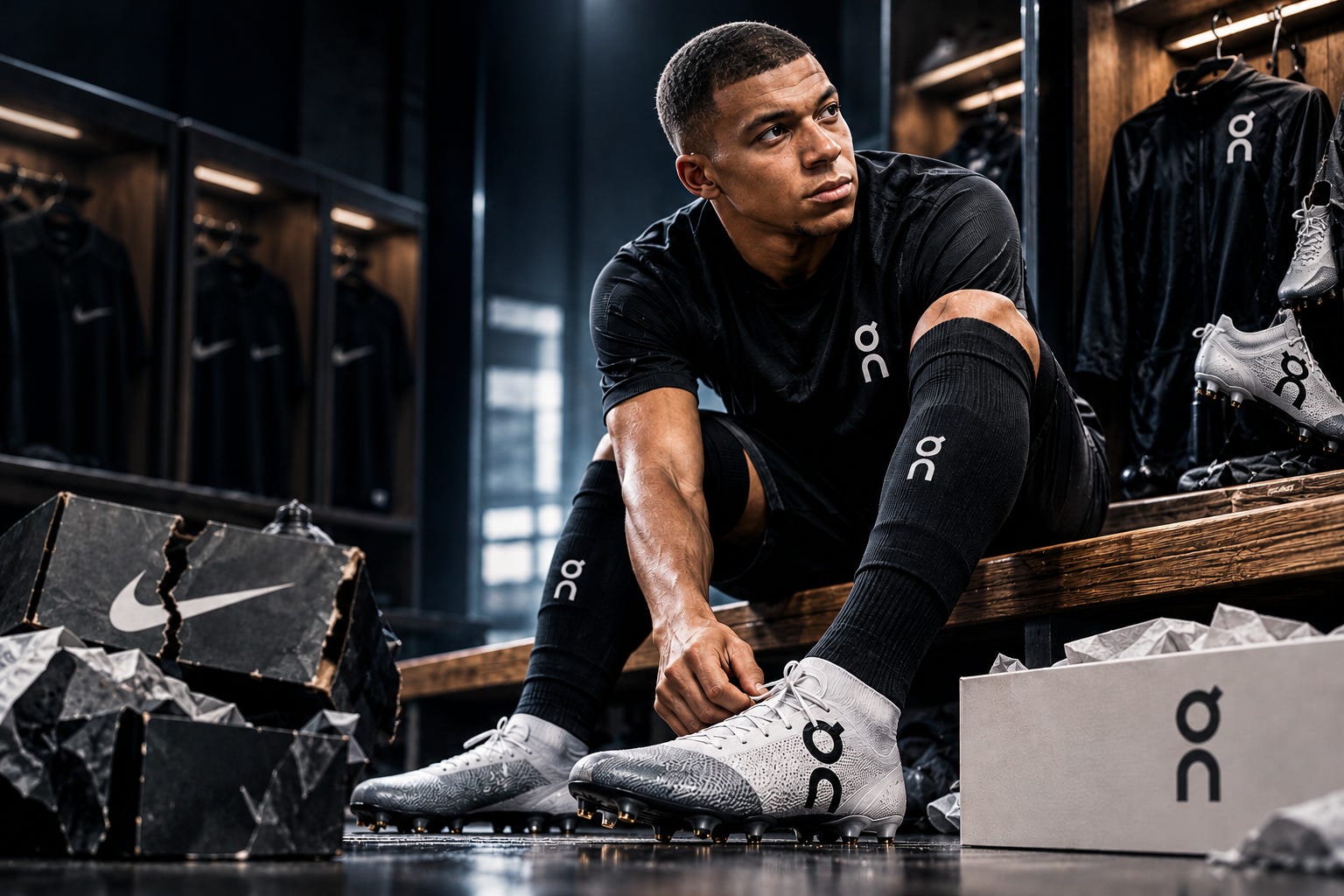
Kylian Mbappé has worn Nike since he was nine years old.
Think about that.
Before Monaco.
Before Paris.
Before Real Madrid.
Before the World Cup.
Before hundreds of millions of people knew his name.
Nike was there.
Now he has walked away.
Not to adidas.
Not to PUMA.
To On.
A Swiss company preparing to launch its first football boots.
And Mbappé isn’t simply becoming another highly paid face in another advertising campaign.
He is becoming a shareholder.
That is the bit that interests me.
Because this story is bigger than Kylian Mbappé changing his boots.
It might tell us where the football boot business is going next.
Football Had Started to Look Like a Three Brand Sport
A few weeks ago I wrote about what happened to all the football boot brands.
The numbers were ridiculous.
More than 1,200 boot choices were tracked at the 2026 World Cup.
Nike had 45.2%.
adidas had 38.9%.
PUMA had 9.8%.
Between them:
93.9%.
Everybody else shared 6.1%.
That isn’t a monopoly.
But it is an extraordinarily concentrated market.
And perhaps more importantly, it creates the impression that elite football footwear begins and ends with three companies.
Nike.
adidas.
PUMA.
Then one of the most valuable footballers on Earth does something interesting.
He leaves.
Mbappé Could Have Gone Anywhere
Mbappé isn’t a forgotten player looking for a boot contract.
He is the France captain and one of the biggest commercial properties in world sport.
Nike had been associated with him since childhood.
If the old order was completely secure, you might expect him to stay with one of the giants.
Instead, he chose a company preparing to make a serious move into football.
On has also brought Thierry Henry into its football operation.
That’s not dipping a toe into the game.
That’s arriving with intent.
But I’m not particularly interested in whether On can steal five points of market share from Nike.
Something bigger is happening.
Mbappé Didn’t Just Take the Cheque
Mbappé is taking equity.
That changes the relationship.
The traditional endorsement model is straightforward.
A company pays an athlete.
The athlete wears the product.
The athlete appears in the advertising.
The contract ends.
Suddenly another company’s product becomes brilliant.
We’ve all watched it happen.
Ownership creates a different conversation.
Why rent the athlete when you can make them part of the business?
Roger Federer already helped demonstrate that model with On.
Now Mbappé is entering as a shareholder as the company attacks football.
That matters to every challenger brand.
The Superstar Could Become the Partner
Imagine where this goes.
A young footballer becomes globally famous.
Instead of asking:
Who will pay me the biggest boot contract?
They ask:
What can we build together?
Salary gives you income.
Equity gives you participation.
If the business grows because of your influence, you share in what you helped create.
It also gives challenger brands a weapon.
Nike can probably outspend almost anybody if it really wants to.
A smaller company needs another reason for a superstar to choose it.
Ownership could be one.
That’s far more disruptive than simply launching another football boot.
Nike Is Still Nike
Let’s not get carried away.
Nike isn’t finished.
Not remotely.
It still has enormous distribution, extraordinary recognition, decades of football culture and some of the most recognisable boots ever made.
This isn’t David knocking Goliath over.
And it shouldn’t be.
I don’t want Nike to disappear.
Competition isn’t about replacing one dominant company with another.
It’s about making sure somebody else can still get through the door.
On now intends to try.
So do others.
Mizuno remains credible.
New Balance built a serious football operation.
Skechers entered.
Reebok is returning.
Patrick has put a boot back into the market.
And Stylo is back too.
Not all of them will succeed.
They don’t need to.
The door just needs to remain open.
Football Boots Used to Be Like This
Go back through football history and changing rooms had personality.
adidas.
PUMA.
Stylo.
Patrick.
Umbro.
Lotto.
Diadora.
Mizuno.
Gola.
Hi Tec.
Reebok.
Mitre.
Hummel.
And plenty more.
Different players wore different things.
Different countries developed different boot cultures.
Different companies had different ideas about what a football boot should be.
Some brands disappeared because their products weren’t good enough.
Fine.
That’s competition.
Others discovered that the economics had changed.
Professional endorsements.
Retail shelf space.
Global advertising.
Academy relationships.
Free product.
Digital marketing.
Eventually, building the boot wasn’t necessarily the hardest part.
Being seen was.
The Superstar Became the Shelf
That’s the modern football boot business.
Mbappé wears something.
Millions see it.
Kids want it.
Retailers stock it.
Social media amplifies it.
Academy players normalise it.
Sales create more marketing money.
That money signs another superstar.
And around it goes.
The biggest companies don’t merely occupy shelf space in shops.
They occupy shelf space inside people’s heads.
That’s an extraordinary advantage.
Which is precisely why Mbappé walking away matters.
For once, the superstar has taken some of that shelf with him.
This Is Where Stylo Comes In
I’m obviously not a neutral observer.
I brought Stylo Matchmakers back.
Stylo once had some of the greatest footballers on Earth wearing its boots.
Then it disappeared from modern football.
The game carried on.
Nike became enormous.
adidas remained enormous.
PUMA remained enormous.
Stylo became something people remembered.
When we brought the brand back, I never believed the objective should be to destroy Nike.
That’s ridiculous.
I don’t want Nike’s 45%.
I want footballers to have another choice.
There’s a big difference.
I want Nike making great boots.
I want adidas and PUMA making great boots.
I want Mizuno pushing them.
I want New Balance pushing them.
I want Reebok back.
I want Patrick back.
I want On trying something different.
And yes, I want Stylo in the room.
Because competition makes everybody better.
Independent Brands Don’t Deserve Your Money
This matters.
Small brands sometimes fall into the trap of believing people should support them simply because they’re small.
No.
Nobody owes us anything.
Heritage doesn’t automatically make a modern football boot good.
Independence doesn’t make a football boot good.
Having legendary footballers in your archive doesn’t mean a 17 year old should buy your product today.
Stylo has to earn that.
So does On.
If On’s boot is rubbish, footballers shouldn’t wear it.
If Stylo makes a bad boot, don’t buy it.
If Nike makes the best boot for your foot, wear Nike.
That’s the point.
Real choice isn’t choosing the underdog regardless of quality.
It’s giving the underdog the opportunity to compete.
Mbappé Has Given a Challenger Something Money Struggles to Buy
Credibility.
Before this deal, plenty of football supporters probably didn’t associate On with football.
Now its football project begins with Kylian Mbappé and Thierry Henry.
That’s one hell of an introduction.
But something else has happened too.
Another badge has entered the conversation.
In a market where three companies accounted for almost 94% of the tracked boots at the World Cup, that matters.
If On makes a brilliant boot, let it take market share.
If Mizuno makes a better one, let them take it.
If Reebok gets its return right, good.
If some company none of us has heard of yet invents something genuinely better, give them a chair too.
There should always be another chair.
The Next Great Football Boot Brand Might Not Exist Yet
Somewhere right now there could be somebody sketching a football boot.
A designer.
A former player.
A footwear engineer.
A kid obsessed with boots.
Maybe they’re in Leeds.
Tokyo.
Milan.
Los Angeles.
Lagos.
Who knows?
They shouldn’t look at professional football and conclude there is no point because three corporations already own the room.
That’s how industries stagnate.
Competition needs people stupid enough, brave enough or stubborn enough to believe they can build something better.
Stylo was once one of those challengers.
Now we are again.
On is another.
There will be more.
Don’t Let Any Brand Become Inevitable
This isn’t really about Nike.
I’d say exactly the same thing if Stylo somehow had 45% of the market.
Nobody should become inevitable.
Because when a brand feels inevitable, consumers stop asking questions.
Is this actually the best boot?
Is £250 reasonable?
Will it last?
Does it fit properly?
Am I buying it because I chose it?
Or because my favourite footballer was paid to wear it?
Those are healthy questions.
And after roughly two decades with Nike, Kylian Mbappé has just asked one of his own.
He chose something else.
Maybe On becomes enormous.
Maybe it doesn’t.
Maybe its first football boot is revolutionary.
Maybe it’s just another boot.
We’ll find out.
But one of the biggest footballers on Earth looked beyond the established order and decided he’d rather become part of building a challenger.
I like that.
Because football was never supposed to belong to three companies.
And neither was the boot room.
Maybe Mbappé hasn’t just changed his boots.
Maybe he’s made the room a little bigger.
Good.
We’ll see him in there.
*of course it's all about the money
*of course all the shoes are produced in a lot of the same factories
*of course he is free to choose his brand
*but only french players?
*of course they will get their "world-percentage" (maybe 1 or 2%)
*in my days I was happy with my Puma contract beside Johan Cruyff (just the 2 of us that year in the Netherlands)
*later Cruyff Sports started and although Johan was the best player in the world < it didn't succeed < the marketing etc. was probably not as it should have been < but he / they tried
*never stop trying ;-)