

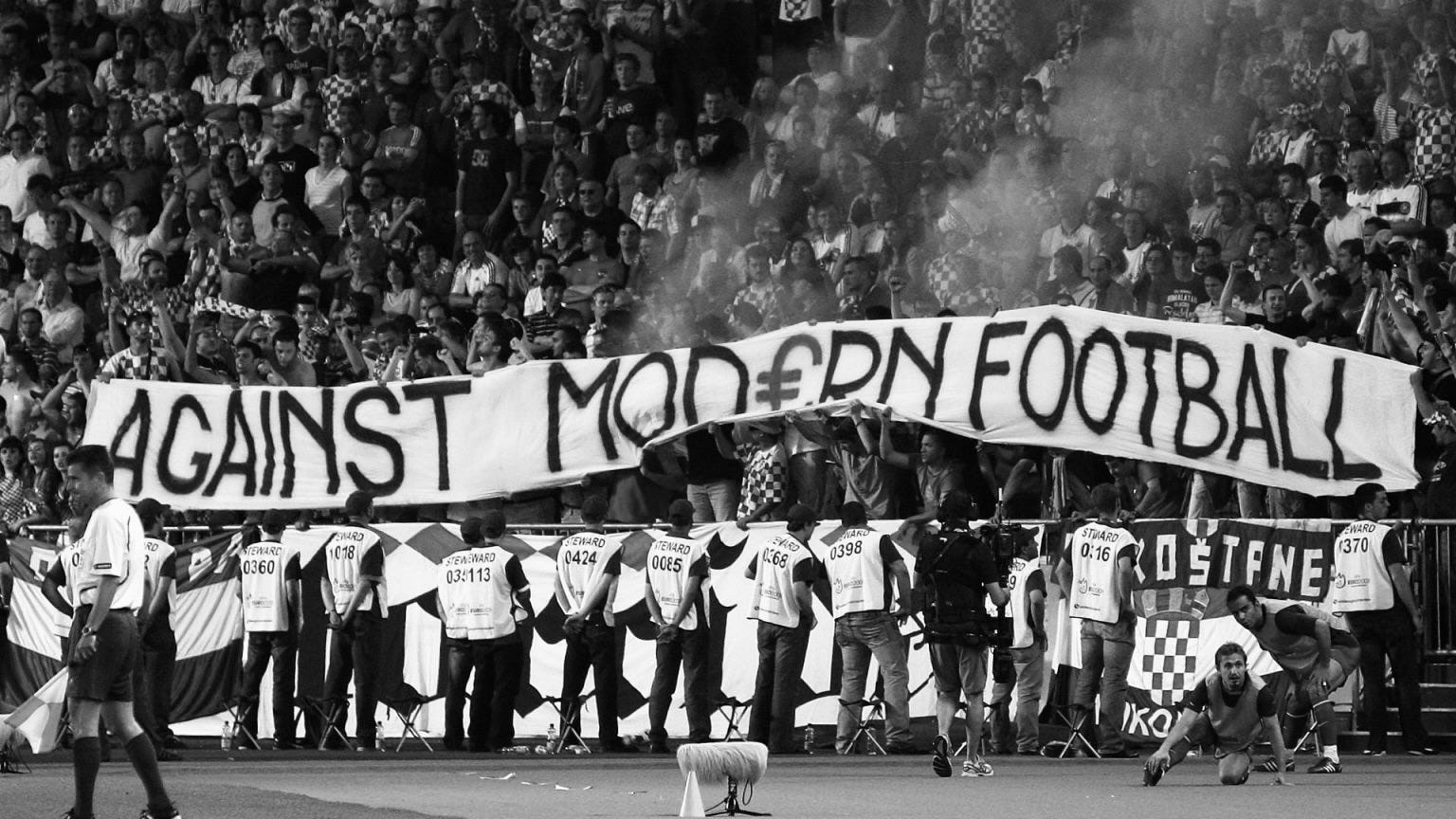
Modern football has never had more money.
It has never had more cameras.
More sponsors.
More analysts.
More investors.
More people in suits telling us the game has never been healthier.
Maybe they should come down from the hospitality box.
Because the richest game in history is becoming poorer in everything that matters.
It has perfect pitches.
Global broadcasts.
Luxury seats.
Transfer announcements shot like films.
Players walking through smoke.
A sponsor on every clean piece of fabric.
A statistic for every touch of the ball.
It has everything.
Except enough soul.
At Stylo Matchmakers, we support football.
The real game.
The players.
The supporters.
The clubs.
The streets, parks and grounds where football earns its meaning.
We do not support the corporate machine that has wrapped itself around the game and started calling itself football.
It is business wearing football’s shirt.
Football has become a product
The language gives it away.
A match is content.
A supporter is a consumer.
A player is an asset.
A club is a global brand.
A stadium is a platform.
History is intellectual property.
Loyalty is revenue.
Everything must be packaged.
Sponsored.
Measured.
Streamed.
Clipped.
Sold.
Then sold again.
The people running football can count almost everything.
Viewers.
Followers.
Subscribers.
Commercial partners.
Shirt sales.
Hospitality packages.
They cannot count what disappears when a father can no longer afford to take his children.
They cannot measure what is lost when a historic ground starts feeling like an airport lounge.
They cannot value the supporter who went for forty years and finally stopped because the club no longer seemed to want him.
He will not appear on their graph.
He will simply disappear.
The World Cup became an investment opportunity
In July 2026, FIFA considered creating a commercial subsidiary reportedly valued at around $20 billion.
External investors could have bought up to 20 per cent of the operation controlling commercial interests connected to the World Cup and other FIFA competitions.
One reported prospective investment group was linked to Joshua Kushner.
He is Jared Kushner’s brother.
Jared Kushner is Donald Trump’s son-in-law.
The distinction matters.
There is no evidence that Jared Kushner personally gave money to Gianni Infantino.
We do not need a lazy conspiracy.
The truth is serious enough.
Somebody looked at the World Cup and saw a financial product.
A company waiting to be floated.
A future income stream waiting to be carved up.
A piece of football history waiting to be sold in shares.
UEFA and its member associations rejected the proposal.
Other confederations objected.
UEFA was reportedly prepared to consider drastic action if the plan continued.
The proposal was dropped.
Good.
But it should never have reached that point.
FIFA is meant to protect the World Cup.
Not prepare it for investors.
The World Cup is not for sale
Private equity did not create the World Cup.
Supporters did.
Players did.
Countries did.
Families did.
Children staying awake long after bedtime did.
It belongs to Brazil in 1970.
Italy in 1982.
Argentina in 1986.
England in 1966.
France in 1998.
It belongs to the people who remember where they stood when the ball hit the net.
FIFA may control the commercial rights.
It does not own the meaning.
No president owns it.
No bank owns it.
No investor owns it.
FIFA is its custodian.
Not its estate agent.
A World Cup for the wealthy
The 2026 World Cup expanded to 48 teams and 104 matches.
More countries can take part.
That is good.
It also means more broadcasts.
More sponsorship.
More hospitality.
More tickets.
More inventory.
Both things can be true.
Expansion can open the game to more nations while giving the commercial machine more football to sell.
The warning came through ticket prices.
Supporter organisations raised formal complaints about excessive costs and unclear purchasing conditions.
Some tickets for the final were offered at prices running into thousands of dollars.
FIFA introduced a limited $60 supporter tier.
That was welcome.
It did not solve the wider problem.
The defence is predictable.
Demand is high.
Of course it is.
It is the World Cup.
But FIFA is not an ordinary seller operating in a normal market.
It controls the competition.
It controls the scarcity.
It controls the tickets.
It controls the official marketplace.
That gives FIFA more responsibility.
Not more freedom to charge whatever loyalty will bear.
Football should never ask how much it can extract from a supporter before he walks away.
Public cost. Private reward.
A World Cup needs more than football grounds.
It needs policing.
Security.
Transport.
Emergency services.
Public infrastructure.
Government support.
City cooperation.
The public helps carry the cost.
The commercial machine takes the reward.
So ask the questions.
What tax breaks are offered?
What special arrangements are granted?
How much public money is spent preparing host cities?
Who receives the revenue?
Who carries the risk when the promised benefits do not arrive?
Why should an organisation generating billions receive favourable treatment from governments and then charge the public thousands to enter?
That is not anti-business.
It is common sense.
Private profit should not rely on public generosity followed by private exclusion.
Football cannot act like a public institution when it wants help and a private monopoly when it wants money.
FIFA prefers power
The leaders of modern football look increasingly comfortable beside presidents, financiers and billionaires.
They talk about capital.
Investment.
Transformation.
Global opportunity.
They seem less comfortable answering supporters.
That matters.
The closer football’s rulers move towards political and financial elites, the further they move from the people who built the game.
Football should be wary when its future is being discussed by men whose greatest skill is turning shared assets into private returns.
It should be even more wary when the conversation takes place behind closed doors.
The investment proposal did not disappear because the corporate machine found a conscience.
It disappeared because football pushed back.
That proves the machine can still be stopped.
The people inside football simply have to choose to stop it.
The Premier League machine
The Premier League is a brilliant competition.
It contains great clubs.
Real clubs.
Clubs tied to towns, cities, families and generations.
That is why they should never be treated like ordinary portfolio assets.
The problem is not football becoming successful.
The problem is success becoming an excuse for extraction.
Matches are moved for television.
Players travel the world on commercial tours.
The calendar expands.
The content never stops.
Clubs chase global audiences while raising prices for local supporters.
Then they say the increases are needed to compete.
Compete with whom?
The billionaire down the road?
The sovereign-backed project?
The private investment fund?
The club borrowing against tomorrow?
Supporters did not create this arms race.
They are still expected to fund it.
Tickets rise.
Season tickets rise.
Shirts rise.
Memberships rise.
Concessions disappear.
For a club, another increase is a line of revenue.
For a family, it may be the end of going together.
Football does not lose one sale.
It may lose the next generation.
Owners want it both ways
Private investment is not automatically bad.
Money has saved clubs.
Built stadiums.
Improved training grounds.
Raised professional standards.
The problem is not capital.
The problem is what capital believes it owns.
A football club is not just a company.
It is not merely land, revenue and future growth.
It is memory.
Place.
Family.
Community.
Owners want the financial upside of a private asset and the civic privileges of a public institution.
When they need planning support, infrastructure or government help, the club belongs to the community.
When supporters ask for lower prices or greater control, the club becomes a private business.
They cannot have it both ways.
When an owner buys a club, he may gain a company.
He does not buy the history.
He does not buy the supporters.
He does not buy the town.
The badge may sit on his balance sheet.
It still belongs in the hearts of the people.
The transfer market is an arms race
The transfer market has rules.
It has windows.
Registration systems.
Agent regulations.
Lawyers.
Compliance teams.
Clearing systems.
It is still fragmented, inflationary and almost impossible for ordinary supporters to follow.
In 2025, clubs spent more than $13 billion on international transfer fees alone.
That does not include domestic transfers.
Image rights.
Signing bonuses.
Loyalty payments.
Or many of the other costs built around a deal.
Clubs also paid record agent fees.
The system crosses borders, tax regimes, legal jurisdictions and ownership structures.
The biggest clubs have armies of accountants and lawyers.
Smaller clubs are told to compete in the same market.
That is not a level playing field.
It is an arms race in football boots.
Every summer, supporters are told to celebrate spending.
Spend £50 million.
Spend £100 million.
Break the record.
Win the transfer window.
Then tickets rise.
Subscriptions rise.
Shirts rise.
More games are created.
The bill travels down the system.
It lands with the supporter.
Pay to play
Football should be simple.
A ball.
A wall.
Two coats.
A patch of ground.
But youth football is becoming expensive.
Registration.
Private coaching.
Elite camps.
Travel teams.
Tournament fees.
Hotels.
Transport.
Academy programmes.
Parents are sold fear.
Pay more or your child will fall behind.
Attend more or someone else will be selected.
Book another course.
Attend another trial.
Buy another piece of the dream.
The language is development.
The business model is anxiety.
How many good players never reach the gate because their families cannot afford the entrance fee?
How many future George Bests are playing somewhere nobody important is watching?
Talent is not distributed by household income.
Opportunity increasingly is.
Stylo Matchmakers believes football should find talent.
Not wealth.
Academies have improved the game
Modern academies have done good things.
They have produced better athletes.
Raised technical standards.
Improved education.
Improved safeguarding.
Reduced injuries.
Helped players train and recover properly.
That is progress.
The problem comes when the system becomes afraid of anything it cannot control.
Children enter younger.
Every movement is coached.
Every action is filmed.
Every physical output is recorded.
Every mistake can be replayed.
Keep your shape.
Protect the ball.
Make the safe pass.
Do not take the risk.
Do not lose possession.
The academy says it is producing intelligent players.
Sometimes it looks like it is producing obedient ones.
Football cannot measure imagination
Modern coaches know how far a player ran.
How many times he pressed.
How many passes he completed.
Where he received the ball.
How much expected threat he created.
The information can help.
It can also become a hiding place.
A high pass-completion rate may show control.
It may also reward the safe pass and punish the one that changes the game.
A cautious player can look efficient.
A creative player can look careless.
Numbers are not the enemy.
Worshipping them is.
A spreadsheet can count the pass.
It cannot measure the courage to try it.
It can map movement.
It cannot measure deception.
It can record possession.
It cannot explain how one player saw a gap before anybody else knew it was there.
Football can measure running.
It still cannot measure imagination.
Creativity causes trouble
Creative players have always been difficult.
They drift.
They improvise.
They ignore the obvious pass.
They lose the ball.
They try things sensible players would not attempt.
They may not top the running charts.
They annoy coaches.
They get called lazy.
Indisciplined.
A luxury.
Trouble.
Then they do something nobody else can do.
Football history belongs to those players.
Pelé.
George Best.
Johan Cruyff.
Diego Maradona.
Liam Brady.
Glenn Hoddle.
Paul Gascoigne.
Ronaldinho.
Stylo Matchmakers was worn by footballers from that world.
Players with character.
Players with nerve.
Players who took risks.
Players who could not be explained by a heat map.
You cannot understand George Best through distance covered.
You cannot explain Maradona through pass completion.
You cannot reduce Ronaldinho to pressing numbers.
Great players do not just solve the problem in front of them.
They see something nobody else has seen.
When obedience matters more than invention, the unusual child becomes a risk.
When the coach fears losing, the dribbler is told to pass.
When the system rewards predictable decisions, the unpredictable player becomes inconvenient.
Football says it wants difference.
Then it trains sameness.
What the street taught
Street football was not perfect.
It was rough.
Unstructured.
Sometimes unfair.
Good players were missed.
Nobody should romanticise neglect.
But the street taught things a coaching manual cannot manufacture.
You learned because an older child took the ball from you.
You adapted because the surface was bad.
You became tougher because nobody gave you the foul.
You learned to shield.
To deceive.
To survive.
To improvise.
The street did not produce perfect athletes.
It produced personalities.
You cannot recreate that by painting a concrete wall inside a £100 million academy.
You cannot manufacture rebellion through a syllabus.
You cannot schedule spontaneity for Thursday at four.
Creativity needs freedom.
Freedom brings risk.
Modern football does not like risk.
Boring football makes financial sense
The biggest clubs fear losing.
Managers fear the sack.
Players fear losing their place.
Owners fear losing value.
Everything pushes towards control.
Keep possession.
Reduce transitions.
Limit mistakes.
Protect the space.
Follow the structure.
The football may be clever.
It can also be sterile.
Two teams pass.
Both protect themselves.
Nobody takes a risk.
The analysts explain the tactical battle.
The supporter checks his phone.
Football has become better organised.
It has not always become better to watch.
The game was not invented to optimise possession.
It was invented to attack.
To score.
To take a chance.
To create the unexpected.
Without uncertainty, football becomes an exhibition.
Technically polished.
But distant from the reason people cared.
Nobody on the street asked for this
Nobody kicking a ball against a wall asked for private equity in the World Cup.
Nobody playing after school asked for variable ticket pricing.
Nobody standing on a terrace asked to become a customer profile.
Nobody in the park demanded another competition because football had not created enough inventory.
Nobody fell in love with expected threat.
The street cares whether the ball went through somebody’s legs.
It cares who scored the winner.
It cares whether the older child let the smaller one play.
It cares whether you came back when your team was losing.
It cares whether your boots lasted.
That is football.
The rest is administration.
Football needs administration.
It needs safety.
Investment.
Organisation.
Regulation.
But the administrators have confused managing the game with owning it.
They do not own it.
The investors do not own it.
The broadcasters do not own it.
The sponsors do not own it.
They are passing through.
The supporters were there before them.
The supporters will remain after them.
Corporate rebellion
Modern football wants rebellion without rebels.
It sells retro shirts.
Borrows terrace graphics.
Uses old badges.
Old songs.
Dead players.
Then it sells that history back to the people who created it.
Everything authentic is eventually discovered by a marketing department.
Then cleaned.
Licensed.
Packaged.
Sold.
They want the street without the people from the street.
They want working-class history without working-class prices.
They want noise without dissent.
They want supporters provided they behave, spend and keep quiet.
They want fans.
They do not want fan control.
Stylo knows this language because football brands use it too.
They borrow the past.
Buy the player.
Control the image.
Sell rebellion in a limited-edition box.
That is not our game.
This is not hatred of progress
Safer grounds are progress.
Better medical care is progress.
Women’s football growing is progress.
Better safeguarding is progress.
Player rights are progress.
Improved education and facilities are progress.
Stylo Matchmakers supports all of that.
None of it required turning the World Cup into an investment vehicle.
None of it required pricing supporters out of their own history.
None of it required treating football clubs as disposable assets.
None of it required coaching imagination out of children.
Progress and exploitation are not the same thing.
You can modernise football without sterilising it.
You can grow football without selling every inch of it.
You can make money without making money the point of everything.
What Stylo Matchmakers stands for
This is the Stylo Matchmakers view of football.
We support the game.
Not the corporations feeding from it.
We support clubs as communities.
Not entries in an investment portfolio.
We support players with personality.
Not footballers programmed to protect a statistic.
We support children with talent.
Not only children whose parents can afford the pathway.
We support competition.
Not guaranteed revenue.
We support investment when it serves football.
Not football when it is forced to serve investment.
Stylo Matchmakers comes from another game.
Not a perfect game.
A real one.
Played on mud.
Concrete.
Grass.
Anywhere two coats could make a goal.
Our history includes Pelé, George Best, Kevin Keegan, Trevor Francis, Billy Bremner, Johnny Giles and Liam Brady.
Different players.
Different characters.
They were not built by algorithms.
They were not optimised for content.
They were footballers.
Stylo returned in 2017 outside the corporate machine.
We remain there.
Independent.
Imperfect.
Unbought.
We do not have the biggest marketing budget.
Good.
Football culture should not be for sale.
We would rather make proper boots and speak plainly than become another obedient logo hanging from the corporate game.
We believe history should be respected.
Creativity should be protected.
Supporters should have power.
Children should be judged by talent.
Clubs should belong to their communities.
Investment should serve football rather than football serving investment.
Above all, we believe football is for the fans.
Not as a slogan.
As a line in the sand.
Modern football may control the broadcasts.
The tournaments.
The naming rights.
The ticket systems.
The data.
It still cannot manufacture loyalty.
It cannot manufacture belonging.
It cannot manufacture imagination.
Those things are learned in grounds, parks and ordinary moments.
In the first match with your father.
In the shirt handed down through a family.
In the child trying the impossible pass because nobody has taught him not to.
In scoring under a streetlight while your mates argue whether the ball crossed the line.
That final image is not nostalgia for a lost world.
It is the reason the whole machine has value in the first place.
That is football.
That belongs to the people.
And they are not having it.
We support football. Not the corporations feeding from it.
Against Modern Football.
Football Is for the Fans.
Current football is at a low 💔💔💔
Look what they done to my song, ma.