

He played football as though nobody had told him there were rules.
For a few extraordinary years, Robin Friday was brilliant, impossible and entirely his own man.
He also wore Stylo Matchmakers.
Robin Friday never played for England. He never played in the First Division. He never won the European Cup. He never became rich.
His entire Football League career amounted to 160 competitive appearances for Reading and Cardiff City.
More than half a century later, people are still talking about him.
That takes some doing.
Football usually remembers winners. Medals. Internationals. Men photographed holding silverware.
Friday left something stranger behind.
Stories.
Some are true. Some have probably improved with every pint poured since 1977. That is what happens when a footballer becomes folklore.
Strip all that away, though, and something important remains.
Robin Friday could seriously play.
Before the Legend
Friday was born in Acton, west London, in 1952.
There was no smooth academy conveyor belt towards professional football. He travelled through the non-league game with Walthamstow Avenue, Hayes and Enfield before Reading manager Charlie Hurley took a chance on him.
Friday was already 21.
Reading registered him to play in the Football League in January 1974. His league debut came against Northampton Town. Days later he scored at Barnsley and was offered professional terms.
The new career apparently meant taking a pay cut from his job as an asphalter.
Modern footballers occasionally speak about sacrifice.
Robin actually took one.
Then he started frightening defenders.
Reading supporters remember a six-foot forward who could control a football, dribble, shoot from distance, create chances, compete in the air and look after himself physically.
He would eventually make 135 appearances for Reading and score 53 goals.
He was not merely an eccentric who happened to own some football boots.
He was an exceptional footballer.
That distinction matters.
Elm Park Found Its Hero
Friday arrived at exactly the sort of football club where a character could become immortal.
There was no global content operation.
No personal social-media manager.
No carefully prepared post-match graphic containing a motivational quote.
There was Elm Park.
There was mud.
There were supporters standing close enough to tell you precisely what they thought of you.
And there was Robin.
During 1974–75 he scored 20 goals in all competitions.
The following season he scored another 22 as Reading won promotion from the Fourth Division. He was named Reading’s Player of the Season in both campaigns.
That promotion mattered.
Reading had waited half a century for it.
Friday was not a sideshow to the achievement.
He was central to it.
Then came the goal.
The Goal Nobody Filmed
On 31 March 1976, Reading played Tranmere Rovers at Elm Park.
Friday scored a goal that became part of English football folklore despite the inconvenient fact that television cameras were not there to preserve it.
The ball came towards him from goalkeeper Steve Death.
Friday controlled it with his back to goal, around 25 yards out, and produced a piece of technique so outrageous that referee Clive Thomas would later compare it with goals he had seen at the highest level.
Thomas had officiated at World Cups. He had seen Pelé and Johan Cruyff.
His verdict was remarkable:
“Even up against the likes of Pele and Cruyff, that rates as the best goal I have ever seen.”
No YouTube clip.
No fifteen camera angles.
No xG.
Just witnesses.
There is something wonderfully appropriate about Robin Friday’s greatest goal surviving mainly as memory.
You simply had to be there.
The Black Boots
There is another part of the story that matters to us.
Robin Friday wore Stylo Matchmakers.
The Stylo archive associates him with the Heirship Seventy Four, the classic black boot of the period.
Look at some of the players connected with Stylo during that era.
Pelé.
George Best.
Bobby Moore.
Kevin Keegan.
Billy Bremner.
Robin Friday.
On paper, Friday looks like the odd one out.
He isn’t.
In some ways, he might be the most Stylo footballer of them all.
Not because of what happened away from football.
Because when the ball arrived, individuality mattered.
Friday improvised.
He tried things.
He entertained people.
He did not appear to be playing from a coaching manual. He treated football as something to be manipulated rather than merely executed.
That is the part of old football worth protecting.
Not the terrible pitches.
Not the injuries.
Not the drinking culture.
The freedom.
Friday had it in abundance.
What Modern Football Would Do With Robin Friday
People often say modern academies would never produce another Robin Friday.
I am not sure that is true.
Modern coaching might have made him better.
Better pitches, sports science, nutrition, recovery and technical support would all have helped a player with that much natural talent.
The bigger question is whether the modern system could have contained him long enough to see the results.
Imagine Friday at 16 today.
GPS vest.
Nutrition plan.
Media training.
Sports psychologist.
Player liaison officer.
Agent.
Instagram account.
Club disciplinary policy.
Someone monitoring his sleep.
Robin might have lasted until Tuesday.
But there is another side to it.
Perhaps proper modern support might also have saved him.
Because beneath the funny stories sits something much darker.
Don’t Romanticise the Destruction
Football has a habit of turning damaged men into entertaining anecdotes.
Friday drank heavily. Drug use became part of his life. His behaviour became increasingly erratic. His relationships suffered. His reliability disappeared.
That is not rock and roll.
It is waste.
The Robin Friday legend can become so entertaining that we accidentally celebrate the things that helped destroy Robin Friday the footballer.
We shouldn’t.
There was nothing romantic about a man with that much ability leaving professional football at 25.
There was nothing rebellious about addiction winning.
The interesting rebellion happened with a football at his feet. The rest was tragedy.
Cardiff
By late 1976, Reading could no longer manage the situation.
Cardiff City bought Friday for £28,000.
Naturally, his arrival was not straightforward.
He travelled towards Cardiff without a proper rail ticket and required intervention before completing the journey.
Then came his debut.
Cardiff played Fulham on New Year’s Day 1977.
Fulham had Bobby Moore.
Friday scored twice.
Cardiff won 3–0.
For a moment, it looked as though Cardiff had bought one of English football’s great bargains.
There were still flashes of the old magic.
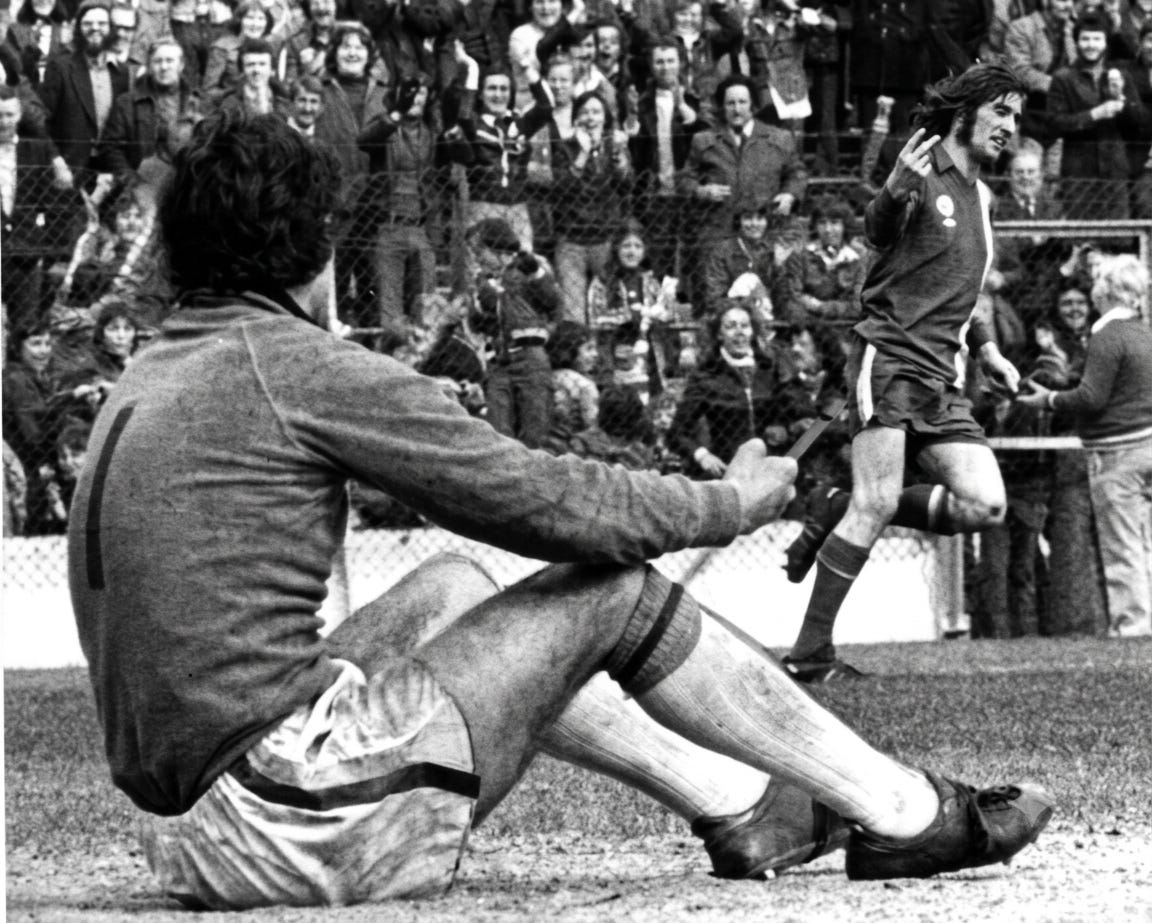
Against Luton Town that April, Friday rounded goalkeeper Milija Aleksic, scored and turned back towards him with two fingers raised.
The photograph became almost as famous as Friday himself.
Nearly twenty years later, Super Furry Animals used it for the artwork of The Man Don’t Give a Fuck.
Robin Friday had somehow become punk iconography without ever releasing a record.
It suited him.
Then It Ended
The decline was quick.
Friday disappeared for periods and his relationship with professional football deteriorated.
In October 1977, playing against Brighton, he clashed with a young Mark Lawrenson and was sent off.
The famous story says Friday later defecated in Lawrenson’s kit bag.
It is a magnificent pub story.
It also appears not to be true.
The version supported in the later accounts is that Friday went into Cardiff’s own dressing room, threw his teammates’ clothes into the bath and stormed out.
Robin Friday does not need invented mythology.
The truth is strange enough.
He played one further first-team game.
On 20 December 1977, Friday told Cardiff manager Jimmy Andrews he was finished.
He was 25.
Professional football never saw him again.
The Greatest Footballer You Never Saw
Friday died in 1990.
He was just 38.
By normal football measurements, his career should have gradually disappeared into the record books.
Instead, his reputation grew.
Reading supporters voted him their Player of the Millennium. He was later inducted into the club’s Hall of Fame. He became a cult hero at both Reading and Cardiff despite spending remarkably little time at either club.
There is a reason.
Supporters do not only remember achievement.
They remember feeling.
Robin Friday made people feel something.
You bought a ticket because you did not know what he might do.
Sometimes, neither did Robin.
Football has become extraordinarily good at producing professional players.
Quicker.
Stronger.
Better prepared.
More tactically educated.
But efficiency carries its own danger.
If everybody makes the percentage decision, football becomes predictable.
The great players have always contained a little disobedience.
Best had it.
Cruyff had it.
Maradona had it.
Friday had enough for several people.
He simply could not control where it stopped.
Robin Friday’s professional career lasted less than four years.
There are players who lasted twenty and left less behind.
He never became the footballer he might have been.
Perhaps that is part of why people still talk about him.
For a few short years, he played without permission, without caution and sometimes without much sense.
The boots were black.
The football was anything but.
Robin Friday wore Stylo Matchmakers.
Discover the Heirship Seventy Four.
I wish I’d seen him play Scott, he was just before I started watching football in ‘79 aged 6, but I’ve read the books about him and he had it all, a proper one-off maverick of the game, maybe he could have been helped, maybe he couldn’t, we’ll never know, but Robin lived and played on his terms, whether we like that or not, we have to respect it.