

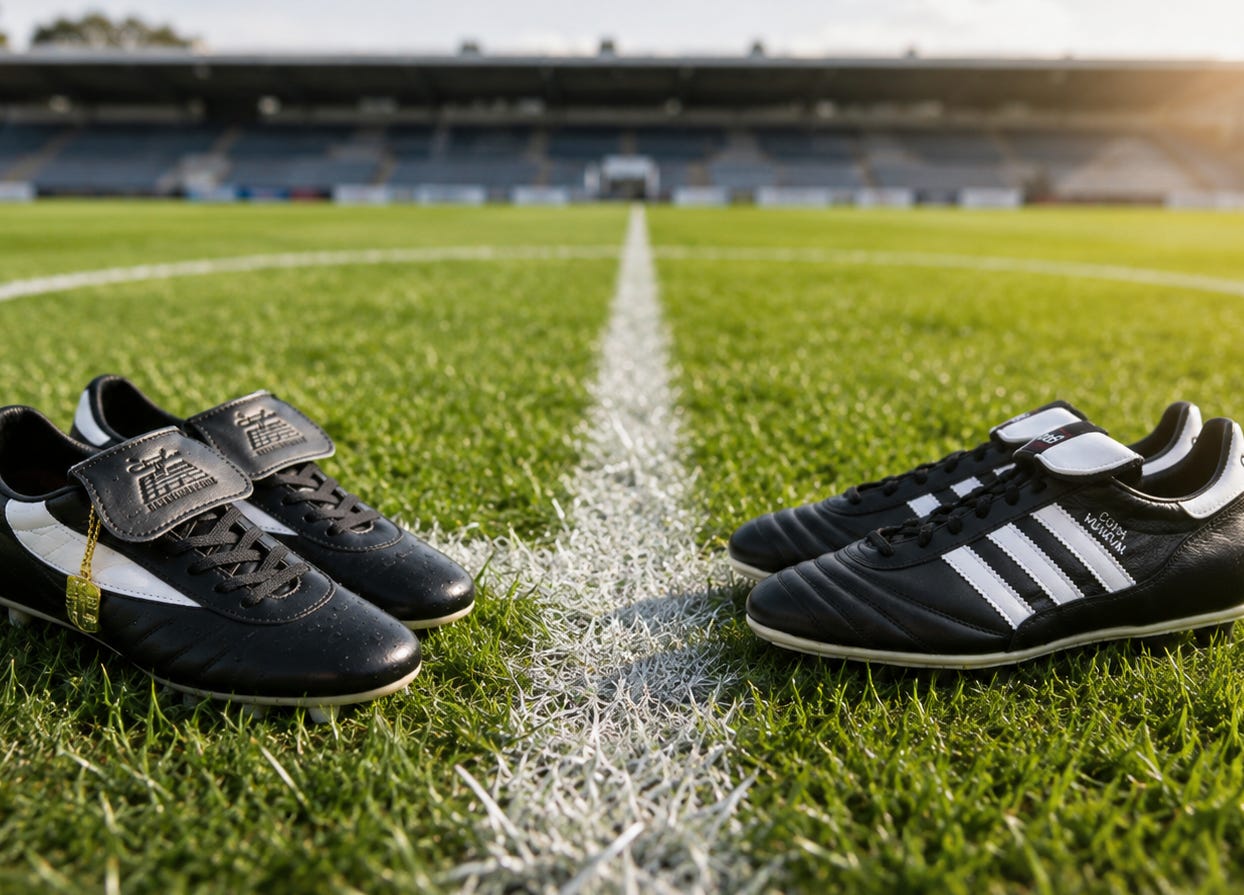
There are easier football boots to compare yourself against than the adidas Copa Mundial.
The Copa is an icon.
Black leather. White stripes. Fold-over tongue. Simple studs.
For generations of players, it has represented what a traditional football boot is supposed to be.
That reputation deserves respect.
But there is a difference between respecting a classic and assuming it can never be improved.
Football has changed enormously since the Copa first arrived.
Pitches are quicker.
Players accelerate harder.
Boot construction has evolved.
Heel support has improved.
Soleplates have become more sophisticated.
Attitudes towards materials have changed.
So perhaps the real question is not:
Is the Copa Mundial still a good football boot?
It clearly is.
The better question is:
If you rebuilt the classic leather football boot today, what would you keep — and what would you change?
That is where the Stylo Matchmakers Heirship Seventy Four becomes interesting.
Because the H74 was not designed to kill the classic football boot.
It was designed to evolve it.
Copa Mundial vs Heirship Seventy Four: Preservation vs Evolution
The difference between the two boots can be summed up very simply.
The Copa Mundial preserves the classic.
The Heirship Seventy Four modernises it.
The Copa remains famous because adidas has resisted the temptation to reinvent it every few seasons.
That consistency is part of the appeal.
Soft leather.
Familiar fit.
Traditional outsole.
Recognisable shape.
The H74 comes from another philosophy.
Stylo looked back to the company’s great 1970s period — the era of Kevin Keegan, Billy Bremner and some of British football’s most famous names — and asked a different question.
What parts of that football boot were genuinely brilliant?
And what parts could now be improved?
The answer became the H74.
A classic leather upper.
A traditional silhouette.
But underneath it, a more modern football boot.
It is essentially the football-boot equivalent of a restomod.
Keep the soul.
Upgrade the engineering.
The Boot Room 1000-Point Classic Leather Boot Test
Most football-boot reviews have a problem.
They either become advertisements disguised as reviews or obsess over things that do not actually matter very much.
Weight.
Colourways.
Celebrity endorsements.
A technology name somebody invented in a meeting.
We wanted something more useful.
So we built the Boot Room 1000-Point Classic Leather Boot Matrix.
A proper classic leather football boot should be judged across six areas.
CategoryMaximum ScoreWhat We JudgeUpper & Ball Touch200Leather quality, thinness, touch and responsivenessSoleplate & Traction200Stud design, stability, plate construction and gripHeel & Rearfoot Support150Lockdown, security and stability during changes of directionDurability & Build Quality150Leather resilience, stitching and overall constructionComfort & Break-In150Fit, cushioning, flexibility and first-wear comfortHeritage, Identity & Exclusivity150Authentic history, individuality, rarity and brand identityTOTAL1000
This is an editorial benchmark, not a laboratory certification.
Feet are different.
Playing styles are different.
Personal preference matters.
But applying the same criteria consistently makes a far better comparison than simply saying one boot “feels nice”.
The Result
Stylo Matchmakers Heirship Seventy Four: 910 / 1000
adidas Copa Mundial: 885 / 1000
That is close.
It should be.
The Copa Mundial is still one of the great football boots.
But the H74 edges ahead because Stylo has attempted to improve areas where traditional leather boots historically compromised.
Here is where the points went.
1. Upper & Ball Touch
adidas Copa Mundial: 190 / 200
Stylo Heirship Seventy Four: 180 / 200
The Copa wins this round.
There is no point pretending otherwise.
Its famous leather construction provides the plush, padded touch generations of Copa wearers love.
The leather moulds.
It softens.
The boot eventually begins to feel almost like an extension of the foot.
That remains one of the Copa Mundial’s great strengths.
The H74 takes a different route.
Its USP is super-thin premium cow leather.
Less material.
Less padding.
A more direct relationship between the foot and football.
The sensation is not intended to mimic the Copa.
It is deliberately cleaner.
More immediate.
More responsive.
Think of it this way:
Copa Mundial: plush leather touch.
H74: direct leather touch.
Some players will prefer the Copa.
Others will prefer the H74.
That is a genuine footballing choice rather than marketing.
2. Soleplate & Traction
Stylo H74: 185 / 200
adidas Copa Mundial: 155 / 200
This is where the H74 opens the gap.
A traditional leather upper does not require an old-fashioned underbody.
Stylo modernised the soleplate.
The H74 uses a contemporary moulded construction with longer, more substantial studs designed to provide strong grip on natural grass while retaining the simplicity of a fixed-stud football boot.
That matters because traction is not nostalgic.
You accelerate.
Brake.
Turn.
Press.
Change direction.
The soleplate is the part connecting every one of those movements to the pitch.
The Copa’s traditional construction remains dependable.
But this is also the area where its age shows most clearly.
The H74 takes the heritage look and puts a more modern platform underneath it.
Classic above the grass.
Modern where it meets the grass.
That is exactly how a heritage football boot should evolve.
3. Heel & Rearfoot Support
Stylo H74: 135 / 150
adidas Copa Mundial: 110 / 150
This is another area where the H74 philosophy makes sense.
Football is not played in straight lines.
Players cut.
Pivot.
Turn.
Accelerate.
Stop.
Accelerate again.
The rear of the boot has to control movement around the heel throughout all of it.
The H74 was built with greater heel structure and support than the old Stylo boots that inspired it.
That gives the rearfoot a more secure base.
Heel support will never look as exciting in an advert as another fluorescent colourway.
It is considerably more useful.
This is one of those improvements that demonstrates what Stylo was trying to achieve.
Keep the leather.
Keep the shape.
Improve the bits worth improving.
4. Durability & Build Quality
adidas Copa Mundial: 145 / 150
Stylo H74: 135 / 150
The Copa takes this round.
And it earns it.
A football boot that has survived generations deserves enormous credit for its reputation for longevity.
Traditional stitching.
Substantial construction.
Natural leather.
A design proven over decades.
The H74 is also built with substance rather than chasing minimum weight at any cost.
But the Copa has decades of real-world evidence behind it.
That matters.
And this is important for the credibility of our test.
We are not giving Stylo every category simply because this is the Stylo Boot Room.
If the Copa wins, it wins.
Otherwise the scoring becomes meaningless.
5. Comfort & Break-In
adidas Copa Mundial: 145 / 150
Stylo H74: 130 / 150
Another Copa victory.
The Copa’s reputation for comfort is legendary.
Its leather softens and moulds.
The cushioning creates that famous almost slipper-like sensation.
For some footballers, that alone ends the argument.
The H74 is intentionally different.
Its thinner leather reduces bulk and puts the player closer to the football.
That inevitably means sacrificing some of the deeply cushioned feel that makes the Copa famous.
So if your priority is maximum traditional softness:
Copa Mundial.
If your priority is a thinner, more immediate leather feel:
H74.
Neither philosophy is wrong.
They simply serve slightly different players.
6. Heritage, Identity & Exclusivity
Stylo H74: 145 / 150
adidas Copa Mundial: 140 / 150
This is perhaps the most interesting category.
The Copa has extraordinary history.
Its place in football culture is secure.
But heritage is not only about recognition.
It is also about authenticity.
Identity.
Rarity.
Stylo Matchmakers has its own history.
Pelé.
George Best.
Kevin Keegan.
Billy Bremner.
Trevor Francis.
And one of the most distinctive chapters in British football-boot culture.
The Heirship Seventy Four takes its identity from that genuine Stylo story.
But unlike the Copa Mundial, it is not everywhere.
That matters.
Wear a Copa and everybody knows what you have chosen.
Wear an H74 and somebody might ask:
“What are those?”
For some players, that is precisely the point.
The Copa is iconic.
The H74 is individual.
The Final 1000-Point Scorecard
CategoryStylo H74Copa MundialUpper & Ball Touch180/200190/200Soleplate & Traction185/200155/200Heel & Rearfoot Support135/150110/150Durability & Build Quality135/150145/150Comfort & Break-In130/150145/150Heritage, Identity & Exclusivity145/150140/150TOTAL910/1000885/1000
The scorecard reveals something useful.
The Copa wins where you would expect it to.
Comfort.
Traditional softness.
Proven durability.
The H74 wins where Stylo deliberately modernised the traditional boot.
Traction.
Heel support.
Direct feel.
Individuality.
That is why the H74 edges ahead.
Not because the Copa suddenly became bad.
Because the H74 attempts to solve some of the compromises the classic football boot left behind.
10 Reasons to Wear the Stylo Heirship Seventy Four
If you are searching for an adidas Copa Mundial alternative, these are the strongest reasons to consider the H74.
1. Super-Thin Cow Leather
This might be the biggest H74 USP.
The upper uses very thin premium cow leather.
You still get the natural sensation people want from a leather football boot.
But without unnecessary thickness between your foot and the ball.
Soft.
Natural.
Direct.
Simple.
The H74 does not need six invented technology names to explain what it is.
It is a thin leather football boot.
Sometimes the best specifications are the easiest to understand.
2. Genuine Leather Without Kangaroo Leather
This is a major distinction.
Kangaroo leather has historically been valued in football boots for softness and strength.
It has also become increasingly controversial.
Some consumers are perfectly comfortable wearing it.
Others would rather not.
The H74 gives those players another option.
Premium natural leather without kangaroo hide.
You do not have to move into a synthetic boot simply because you want to avoid K-leather.
That makes the H74 particularly interesting for traditionalists who still want genuine leather.
3. A More Direct Connection With the Ball
The thinner the unnecessary material between your foot and the football, the more immediate the sensation can become.
That is part of the H74 philosophy.
Less bulk.
Less cushioning.
More contact.
For midfielders, full-backs, number tens and ball-playing defenders, that proposition is obvious.
A football boot cannot give you technique.
It can only avoid interfering with the technique you already have.
The H74 tries to do exactly that.
4. A Modernised Soleplate
Traditional appearance should not require traditional engineering.
The H74 retains the character of an old-school leather football boot while sitting on a more modern moulded plate.
That is perhaps the clearest expression of what the boot is trying to be.
Not retro cosplay.
Evolution.
5. Better Heel Support
Players often obsess over uppers.
The heel matters too.
Strong rearfoot support can help the boot feel more secure during changes of direction.
The H74 was deliberately strengthened in this area.
You feel that most when football stops being linear.
Turning.
Pivoting.
Pressing.
Recovering.
Exactly the moments where stability matters.
6. Textured Side Venting
The H74 also includes textured vent areas on the side.
A small feature.
But a sensible one.
The construction introduces airflow and visual texture without destroying the classic shape of the boot.
This is how heritage products should be improved.
Quietly.
Functionally.
Without turning every change into a marketing circus.
7. Proper Protection
Football manufacturers spent years competing to make boots lighter.
At some point, nobody seemed to ask whether less material was always better.
Football still involves tackles.
Studs.
Blocks.
Late challenges.
The H74 uses thin leather where thinness improves touch while keeping enough structure for the boot to still feel protective.
That balance matters more than shaving another few grams from a specification sheet.
8. Authentic British Football Heritage
Stylo does not need to manufacture a retro story.
The story already happened.
Pelé wore Stylo.
George Best wore Stylo.
Kevin Keegan wore Stylo.
Billy Bremner wore Stylo.
The brand existed in the dressing rooms and stadiums of the football era modern manufacturers now spend fortunes recreating through nostalgia campaigns.
The H74 draws directly from that history.
It is heritage because it has heritage.
9. You Are Not Wearing the Mass-Market Uniform
adidas is one of the biggest sportswear companies in the world.
That scale brings enormous advantages.
Distribution.
Research.
Advertising.
Endorsements.
Retail presence.
But it also means ubiquity.
Go into almost any football dressing room and you know which three or four manufacturers will dominate.
Stylo offers something different.
A historic British football brand.
Independent.
Rarer.
Less predictable.
That will not matter to everybody.
But to players who still believe football should contain a bit of personality, it matters a lot.
10. It Modernises the Classic Instead of Replacing It
This is the whole H74 argument.
Stylo did not decide the traditional leather football boot was obsolete.
We decided parts of it were brilliant.
Leather.
Laces.
Touch.
Protection.
Simplicity.
Then we looked at what could improve.
Soleplate.
Heel support.
Leather thickness.
Ventilation.
Fit.
The result is not a rejection of football history.
It is an attempt to continue it.
Who Should Wear the Copa Mundial?
There are still plenty of players who should buy the Copa.
Choose it if:
you want its famous padded leather feel,
you already know Copas fit your feet,
you prioritise comfort above everything,
you specifically want the traditional Copa experience,
or you simply love one of football’s most recognisable boots.
There is nothing wrong with choosing the established answer when the established answer remains excellent.
Who Should Wear the Stylo H74?
The H74 makes more sense if you want:
a classic black leather football boot
super-thin cow leather
a more direct touch
no kangaroo leather
a modernised soleplate
greater heel support
textured side ventilation
proper protection
British football heritage
and something you will not see on every other player
That is a distinctive proposition.
And importantly, it is a product proposition rather than simply a heritage story.
Is the H74 Better Than the Copa Mundial?
According to the Boot Room 1000-Point Matrix:
Yes.
But only narrowly.
H74: 910
Copa Mundial: 885
And that narrow margin actually makes the result more believable.
The Copa remains superior in some areas.
The H74 is superior in others.
The difference is philosophy.
The Copa asks:
Why change something that already works?
The H74 asks:
Why stop improving something simply because it works?
That is the argument.
But What Would a Perfect 1000/1000 Leather Football Boot Look Like?
This is where things get even more interesting.
A 910-point football boot is excellent.
But our scoring system leaves 90 points on the table.
What would it take to collect them?
A genuine 1000/1000 classic leather boot would have to eliminate almost every traditional compromise while keeping the qualities players love about leather.
It would need to be classic in feel.
Modern in engineering.
And ruthless about unnecessary bulk.
The Blueprint for the Perfect Leather Football Boot
CategoryPerfect ScoreWhat a 1000-Point Boot Would NeedUpper & Ball Touch200/200Ultra-thin premium calf or cow leather, ideally around 0.9–1.1mm, treated for improved water resistance while retaining natural softnessSoleplate & Traction200/200Lightweight anatomical composite plate with carefully balanced conical/bladed traction and strong torsional supportHeel & Rearfoot Support150/150Structured heel counter, secure internal lining and targeted cushioning to minimise unwanted movementDurability & Build150/150Reinforced stitching, anti-stretch internal support and construction designed to resist over-expansion in wet conditionsComfort & Break-In150/150Ergonomic footbed, immediate flexibility and minimal pressure points from first wearHeritage & Exclusivity150/150Genuine historical credibility combined with controlled production and distinctive identity
That would be the target.
Not the lightest football boot ever made.
Not the most complicated.
Not the one with the biggest endorsement budget.
The best classic leather football boot possible.
How Could the H74 Move From 910 to 1000?
The interesting thing is that the H74 already has the philosophy.
The remaining gap is largely engineering.
1. Take the Leather Even Further
The current H74 already uses very thin cow leather.
A future generation could push that concept further.
An ultra-thin premium calf or cow leather in the region of roughly 0.9–1.1mm, carefully treated for greater resistance to moisture, could chase the final points in touch without abandoning natural material.
The objective would not be thinness for the sake of thinness.
It would be:
maximum natural sensation with enough structure to remain durable.
That is the difficult bit.
2. Build a More Sophisticated Soleplate
The H74’s modernised moulded sole already gives it a significant advantage in our comparison.
The next step could be a lighter, more anatomically shaped chassis.
Potentially a composite or carbon-infused construction.
The purpose would not simply be to advertise carbon.
That would be lazy.
The goal would be to improve:
torsional stability,
weight distribution,
flex through the forefoot,
and traction during changes of direction.
Any performance claim would then need proper testing.
Because technology should prove itself on the pitch before the marketing department gets near it.
3. Improve Internal Heel Lockdown
The H74 already scores strongly for heel support.
The next generation could go further.
A more structured external heel counter combined with a micro-suede or similarly high-friction internal lining and carefully positioned dual-density foam could improve the feeling of rearfoot security.
Not “zero slip”.
No honest manufacturer can guarantee that for every foot shape.
But reducing unwanted heel movement would be a worthwhile target.
4. Introduce Better Anti-Stretch Control
Natural leather moves.
That is part of what makes it lovely to wear.
It is also one of its compromises.
Over time, poorly controlled leather can stretch too much.
A 1000-point version would therefore need a strategically placed internal anti-stretch layer.
Not across the entire boot.
That could kill the natural feel.
Only where structure is required.
The objective would be to let leather behave like leather without allowing the boot to lose its shape.
5. Chase Genuine First-Wear Comfort
Traditional leather boots often improve after several wears.
That is charming until your heel is bleeding.
The perfect classic boot should not demand suffering as part of the break-in ritual.
A more ergonomic footbed.
Better pressure distribution.
Carefully positioned padding.
And enough flexibility from the first wear to reduce hotspots.
That would close much of the comfort gap with the Copa.
6. Keep Production Controlled
The final 150 points are not purely engineering.
A Stylo boot should never become another anonymous mass-market product.
Part of the attraction is that you do not see it everywhere.
So the theoretical perfect Stylo boot should remain controlled.
Smaller runs.
Better quality oversight.
Distinctive design.
A direct connection to the history of the brand.
The target should never be:
How do we make millions of these?
It should be:
How do we make the best version possible?
That is a very different business philosophy.
The H74 Mk II?
Perhaps that is ultimately where this test becomes more than an article.
Because once you define what a perfect classic leather football boot looks like, you have created a product brief.
Take what worked with the H74.
Keep:
the super-thin natural leather
the classic Stylo identity
the direct touch
the moulded traction philosophy
the stronger heel
the protection
Then improve:
water resistance
soleplate construction
torsional support
heel lockdown
anti-stretch control
first-wear comfort
That would not simply be another retro boot.
It would be an attempt to answer a much more ambitious question.
Can you build the best classic leather football boot in the world?
That should be the target.
Final Verdict
The adidas Copa Mundial remains one of football’s great products.
It deserves its reputation.
It is comfortable.
Simple.
Distinctive.
And generations of players have trusted it.
But the Copa’s greatest strength is also the reason this comparison exists.
It preserved the formula.
The Stylo Matchmakers Heirship Seventy Four starts from the same fundamental belief in leather, simplicity and touch — then asks where forty years of development could make the classic better.
Super-thin cow leather.
A more direct feel.
A modernised soleplate.
Greater heel support.
Textured ventilation.
Natural leather without kangaroo hide.
British football heritage.
A rarer identity.
That is why the H74 scores 910/1000 on our benchmark and edges the Copa Mundial at 885/1000.
Not because the Copa has suddenly become a bad football boot.
Because progress does not require abandoning tradition.
Sometimes it means understanding what made something great in the first place and refusing to stop there.
The Copa Mundial preserved the classic leather football boot.
The Heirship Seventy Four evolved it.
And the next challenge is bigger.
Build the first one worthy of 1000/1000.