

It began with a pair of pink Nike football boots.
I was organising a Hairbond photoshoot with Championship players and asked them to bring something retro.
One arrived carrying the pink Nikes.
“They are not retro,” I told him.
But to his generation, they were.
Football had become so dominated by the same handful of global brands that an old colourway now counted as heritage.
The game had forgotten its own boots.
That sent me looking for a British football name worth bringing back.
I found Stylo Matchmakers.
Before the comeback
Stylo was not a brand invented around a boardroom table.
It had been worn by Pelé, George Best, Kevin Keegan, Bobby Moore, Denis Law, Billy Bremner, Steve Heighway and Trevor Francis.
Real footballers.
Real photographs.
Real history.
George Best wore Stylo’s unmistakable side-laced boots. Pelé helped take the name around the world. Kevin Keegan wore the badge during one of the defining periods of his career.
Stylo once competed at the highest level of the game.
Then it disappeared.
British manufacturing declined. Retail became more concentrated. The largest sports companies gained control of sponsorship, shelf space and player contracts.
Smaller brands were pushed out.
Stylo became something supporters remembered rather than something players could wear.
In 2017, we decided to change that.
Bringing back more than a logo
Stylo Matchmakers Global Ltd was formed in February 2017.
The idea was not to print an old badge on a T-shirt and call it a revival.
We wanted to make football boots again.
That meant finding manufacturers, developing samples, creating packaging, registering trademarks, ordering stock and rebuilding a supply chain from nothing.
There was no enormous investment fund behind us.
No global retailer waiting.
No celebrity ownership group.
We had our own money, the history and a stubborn belief that football still had room for independent brands.
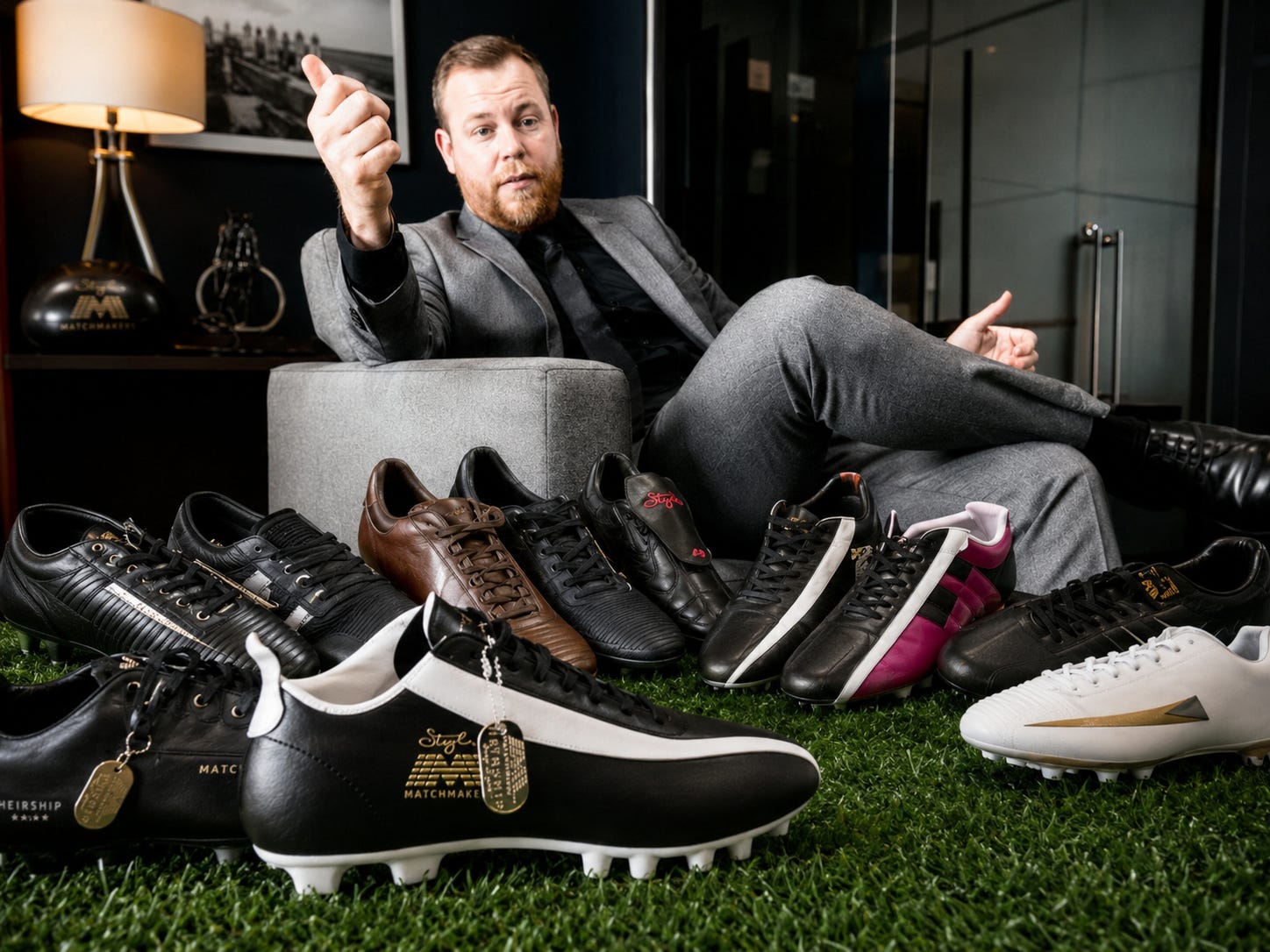
The first modern model was the Heirship Seventeen.
The name was deliberate.
We were not pretending to invent a new football culture.
We were accepting responsibility for an old one.
The hard part
Making the boots was difficult.
Making people care was harder.
Older supporters recognised Stylo immediately. Many younger players had never heard of it.
Retailers wanted proven sales.
Factories wanted large orders.
Players wanted free pairs.
Social media wanted constant noise.
The market did not care how famous Stylo had once been. It wanted to know whether anybody would buy it now.
We also made mistakes.
We created too many variations.
We ordered too much stock in certain sizes.
We underestimated the cost of warehousing.
We believed the story would travel further by itself.
It did not.
History opens the door.
Distribution keeps it open.
Nostalgia is free.
Manufacturing is not.
The badge returned to football
Slowly, the relaunch began to move.
Parents recognised the name.
Collectors found the new boots.
Coaches introduced Stylo to their players.
Customers who were tired of football boots looking like emergency lighting bought black and white boots again.
Professional players also began wearing them.
Christian Fuchs appeared in the Heirship Seventeen. Kyle Lafferty and Paul Gallagher wore Stylo. Kolo Touré was photographed in a pair during an exhibition event.
Former England goalkeeper David James wore the Heirship Seventy Four in Hong Kong.
Those moments meant more than publicity.
They proved the badge had returned to the pitch.
Not in an archive photograph.
Now.
We secured a partnership with the British Football Coaches Network and appeared on beIN Sports with Richard Keys and Andy Gray to discuss the revival.
By 2018, we had developed around a dozen boot variations and selling like hotcakes.
For a brand returning after decades away, that mattered.
It proved Stylo was more than a memory.
Returning to the classics
Once the modern collection was established, we returned to the designs that carried the history.
The Heirship Sixty Eight.
The Heirship Seventy Four.
Leather uppers. Traditional lines. Modern construction.
They were not made to sit behind glass.
They were made to be worn.
That was the point of the relaunch.
Football heritage should not become taxidermy.
It should be passed on.
A young player did not need to have watched George Best to understand why those boots looked different.
He only needed to put them on.
What success really meant
Success was never about becoming the largest boot company in the world.
It was about proving a forgotten British football brand could live again.
We made products.
We sold them internationally.
We reached professional players.
We rebuilt protection around the name.
We restored historic designs.
We introduced Stylo to customers born long after the original company disappeared.
Most heritage relaunches end with a logo, a press release and a range of expensive sweatshirts.
We made football boots.
That is the difference.
Why we continue
Football needs independent brands.
It needs businesses with real stories rather than purpose statements written by advertising agencies.
It needs alternatives to a market where a few corporations control the players, the advertising and most of the shop floor.
Stylo represents a period when a British company could create something distinctive, put it on the feet of the greatest players in the world and compete through ideas.
But the brand cannot survive by staring backwards.
The badge matters when somebody wears it.
The story matters when somebody new hears it.
The legacy matters when it reaches another generation.
That is why we continue.
Not because the relaunch was perfect.
Not because every product sold.
Not because history guarantees success.
We continue because we proved Stylo still had a pulse.
Still here
In 2017, bringing Stylo Matchmakers back looked slightly mad.
Most worthwhile ideas do at the beginning.
We faced manufacturing problems, excess stock, limited resources and an industry built to favour giants.
We also sold boots, reached professional players, restored classic designs and made people talk about Stylo again.
The largest brands will always have more money, more contracts and more shelf space.
They cannot buy what Stylo already earned.
A real place in football history.
Stylo Matchmakers was there.
It mattered.
And because we refused to leave it buried, it matters again.
We did not bring Stylo Matchmakers back to imitate modern football.
We brought it back to remind modern football what it had forgotten.