

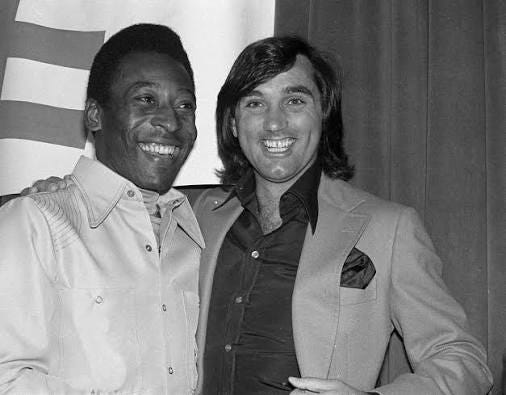
Before football boots became content, they were equipment.
There were no teaser campaigns.
No limited-edition colourway inspired by the inside of a nightclub toilet.
No professional footballer standing in a dark studio pretending to be shocked by a new soleplate.
A player found a pair of boots that fitted.
He wore them.
If he played well, other players noticed.
That was the market.
And for a remarkable period in British football history, many of the players being noticed were wearing Stylo Matchmakers.
Pelé wore them.
George Best wore them.
Kevin Keegan wore them.
Billy Bremner wore them.
Bobby Moore wore them.
Liverpool wore them.
Leeds United wore them.
Not in a heritage advert produced fifty years later.
On the pitch.
In the mud.
When trophies were being won and reputations were being made.
Stylo Matchmakers was not created as a retro brand.
It became retro because football forgot it.
This is the story of how it began, how it reached the top and why it deserves another chapter.
Before Matchmakers
The story begins before football.
The original Stylo footwear business was established by the Ziff family in 1935. It manufactured British-made shoes and developed into a significant footwear company with retail and manufacturing operations.
But Paul Ziff saw a different opportunity.
In 1962, he persuaded his elder brother Arnold Ziff, then chairman of Stylo, to let him establish a separate sports division with its own headquarters and factory.
Paul named it Stylo Matchmakers.
The full sports brand emerged in the 1960s, with 1966 generally recognised as its formal launch year.
The name was unusual.
That helped.
“Matchmakers” suggested connection.
The athlete and the product.
The player and the game.
Performance and personality.
It did not sound like a factory number or a piece of military equipment.
It sounded social.
Confident.
A little glamorous.
Paul Ziff was not merely interested in manufacturing another black football boot.
He understood that sport was becoming culture.
He saw that the people wearing a product could become as important as the product itself.
That sounds obvious now.
It was not obvious then.
Paul Ziff understood influence before football did
Paul worked with Mark McCormack, the pioneering sports agent who founded IMG and helped turn leading athletes into international commercial figures.
Their thinking extended beyond football.
Stylo Matchmakers became involved in football, tennis and golf. Its sporting connections included Pelé and George Best, but also figures such as Arnold Palmer and Rod Laver.
This was not a small football label putting one photograph in a catalogue.
Stylo Matchmakers was being built as a modern sports brand before the modern sports-marketing industry had fully formed.
The company recognised something powerful.
Supporters did not merely want what footballers advertised.
They wanted what footballers genuinely wore.
That distinction matters.
A famous face can hold any product for a photograph.
But when a player trusts the product during a match, the endorsement carries weight.
Paul Ziff made the player part of the brand story.
Not as decoration.
As proof.
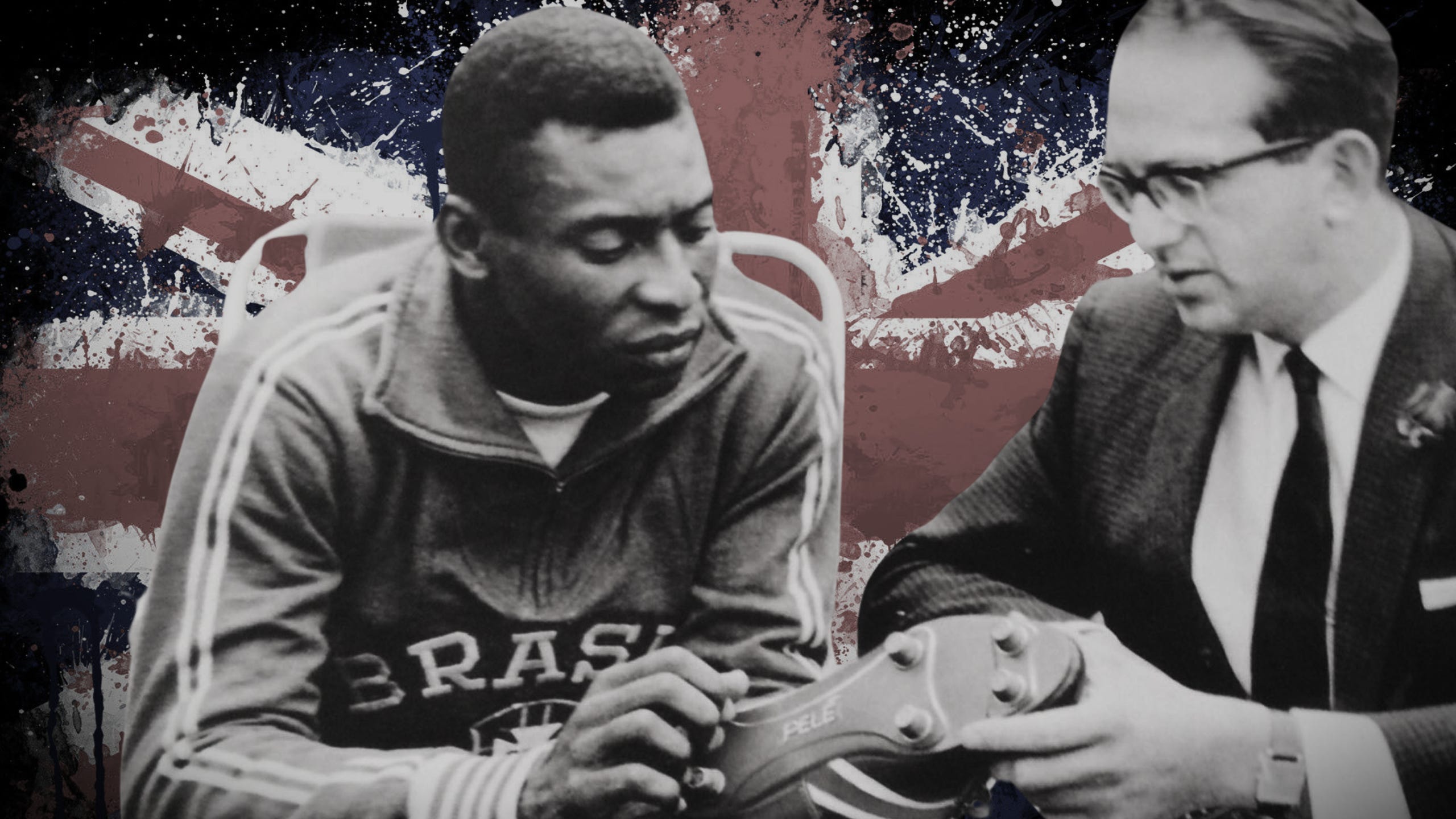
Then came Pelé
Pelé gave Stylo Matchmakers international credibility.
The Ziff family’s records describe personalised boots being produced for him, including his name on the boot. The family also recalls Paul’s pride in having signed one of the most famous athletes in the world.
This was not simply about selling boots in Britain.
Pelé represented football without borders.
He was Brazil.
He was the World Cup.
He was the player recognised by people who did not even follow the game.
Putting Stylo Matchmakers on Pelé’s feet told the market that this British sports brand belonged on the world stage.
But Pelé was only one half of the partnership that defined Stylo.
The other half smoked, drank, stayed out late and occasionally destroyed an entire defence before lunch.
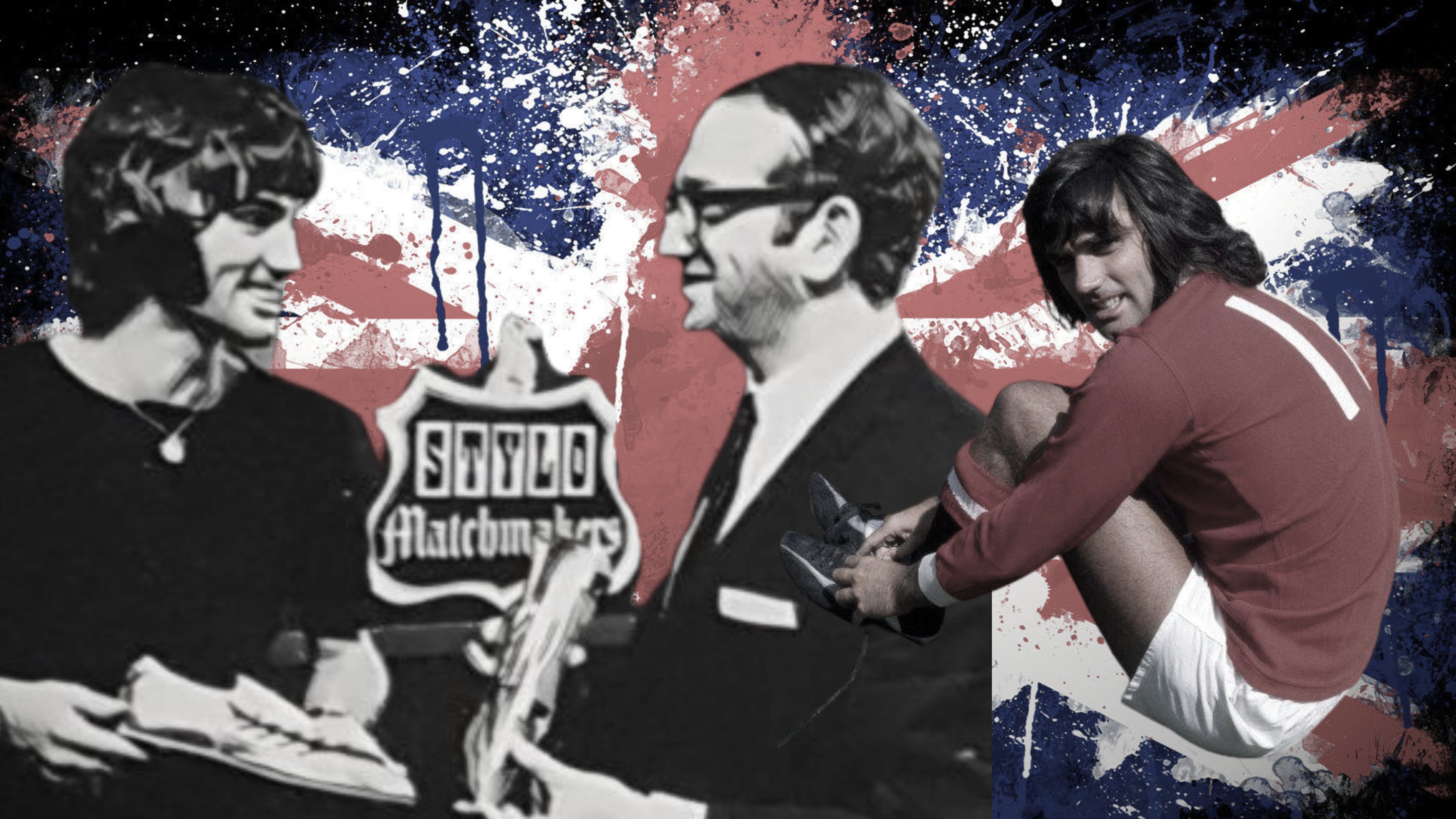
George Best was the perfect Matchmaker
George Best did not look like a conventional British footballer.
He looked like football had accidentally joined a rock band.
He had the balance of a dancer, the confidence of a film star and the ability to make a defender reconsider his choice of employment.
Best was not merely one of football’s greatest players.
He was one of its first genuine pop-culture figures.
That made him perfect for Stylo Matchmakers.
The partnership appeared in advertising during the late 1960s and early 1970s. UEFA’s history of the football boot records the Stylo campaign line associated with Best:
“Put yourself in my shoes.”
Simple.
No scientific diagram.
No claim that a strip of rubber would improve acceleration by 1.7%.
Just George Best telling young players to put themselves in his boots.
Good luck to the defender.
Best had his own Stylo signature range, while original advertising and surviving boots turned the connection into a lasting part of football culture.
Stylo did not make George Best interesting.
George Best made everything interesting.
But the brand had the sense to recognise that footballers could represent more than performance.
They could represent attitude.
Individuality.
Style.
Rebellion.
That became the emotional territory of Stylo Matchmakers.
From individual stars to entire dressing rooms
Signing one famous footballer creates attention.
Winning over a dressing room creates a business.
Stylo Matchmakers moved beyond individual endorsements and established relationships across leading British clubs.
Players associated with the brand included Billy Bremner, Norman Hunter, Kevin Keegan, Steve Heighway, Trevor Francis, Bobby Moore and others from the strongest sides of the era.
The Ziff family describes Stylo Matchmakers as a market leader in football and golf shoes from the 1960s into the 1980s. Contemporary accounts and surviving photographs show the boots appearing throughout elite British football.
This was the great strength of Stylo.
The boots crossed tribal lines.
Manchester.
Liverpool.
Leeds.
Nottingham.
Birmingham.
London.
Scotland.
Stylo was not attached to one club, one city or one type of player.
Creative players wore them.
Hard men wore them.
Managers wore them.
That last part sounds strange today.
Modern managers spend matches in luxury trainers and padded coats that make them look ready to manage an expedition to the North Pole.
In the 1970s, men such as Bill Shankly, Brian Clough, Don Revie and Jock Stein were regularly seen around training grounds in football boots.
Stylo understood the influence of those men.
Win over the manager and you could win over the room.
Kevin Keegan and the road to Liverpool
Kevin Keegan became one of the central figures in Stylo’s growth.
He was not George Best.
That was the point.
Best was glamour and instinct.
Keegan was movement, determination and relentless improvement.
He looked like the supporter who had somehow fought his way onto the pitch and refused to leave.
Keegan wore Stylo Matchmakers at Liverpool and developed a close connection with the company, including a boot carrying his initials.
Through Keegan and players such as Steve Heighway, Stylo became increasingly visible inside Liverpool Football Club.
Then came 1974.
Stylo Matchmakers entered an agreement with Liverpool that the brand describes as the club’s first boot-sponsorship arrangement.
Bill Shankly endorsed the relationship and was photographed wearing the boots in training and around matches. The connection continued into the Bob Paisley era.
The timing could hardly have been better.
Liverpool won the 1974 FA Cup.
Keegan scored twice in the final against Newcastle United.
Photographs from the period show Liverpool players wearing Stylo Matchmakers as the club moved from domestic force to European institution.
Stylo was no longer simply borrowing fame from individual players.
It was becoming part of winning teams.
The boot became part of the uniform
Today, boot contracts are highly individual.
One player wears Nike.
Another wears Adidas.
Another wears Puma.
The goalkeeper may be promoting something that looks as though it was designed by a packet of highlighter pens.
In Stylo’s strongest period, large parts of a team could wear the same brand.
That gave the boots a collective identity.
Liverpool players wore them.
Members of Don Revie’s Leeds United side wore them.
Players connected to Brian Clough’s Nottingham Forest wore them.
Celtic entered a Stylo relationship during Jock Stein’s time as manager.
These were not irrelevant teams filling catalogue space.
They were among the defining clubs and personalities of British football.
The boots appeared during an era of:
League titles.
European Cups.
FA Cup finals.
Packed terraces.
Heavy pitches.
Heavier tackles.
Very little concern for ankle preservation.
Stylo’s credibility was earned under match conditions.
Not under studio lighting.
It was bigger than football
The name Stylo Matchmakers became closely associated with football, but Paul Ziff’s ambition was broader.
The company produced footwear across several sports.
Arnold Palmer was linked with its golf shoes.
Rod Laver was associated with Stylo tennis footwear.
Nick Faldo later wore Stylo golf shoes during his career.
The business was considered a leading name in both football and golf footwear for a significant period.
This matters because it reveals the original scale of the idea.
Stylo Matchmakers was not created as a novelty boot brand.
It was a British sports company with international athletes, serious manufacturing and ambitions across different sports.
Paul Ziff was building athlete culture before the phrase “personal brand” had been dragged into every LinkedIn post on earth.
Why Stylo mattered
Stylo arrived during an important change in football.
Boots were becoming lighter.
The traditional ankle-high work-boot shape was disappearing.
Players wanted greater movement, better feel and footwear suited to a faster game.
At the same time, television was turning footballers into recognisable national personalities.
Stylo sat where those two changes met.
It sold performance.
But it also sold identity.
Other manufacturers made excellent boots.
Stylo made the boot feel like part of the player.
That is why Best mattered.
That is why Keegan mattered.
That is why full teams mattered.
The product and personality strengthened each other.
That was the real matchmaking.
Then the giants took control
Great brands do not always disappear because the products become bad.
Sometimes the market changes around them.
During the 1980s and 1990s, the global sportswear business became bigger, richer and more aggressive.
International companies gained greater control over player endorsements, club relationships, retail distribution and advertising.
Boot technology became a permanent marketing race.
New models.
New materials.
New colours.
New promises.
Then another launch three weeks later because apparently the previous revolution had already become unfashionable.
Stylo Matchmakers gradually lost its position at the centre of football.
The brand that had helped pioneer athlete-led sports marketing was overtaken by companies capable of spending on a completely different scale.
By the time football entered the Premier League age, Stylo was largely absent from the elite game.
The players remained famous.
The photographs remained.
The brand itself faded.
Accounts of the company’s history place its strongest period from the 1960s through the 1980s, while later reporting described it as a famous name being brought back after decades away from top-level football.
Football did what football often does.
It remembered the superstar.
It forgot the British company that helped put boots on his feet.
The story should have ended there
Most forgotten sports brands remain forgotten.
The trademarks expire.
The remaining products reach collectors.
The old advertisements appear online.
Someone posts a photograph and writes:
“They don’t make them like this anymore.”
Everybody agrees.
Then everybody returns to buying exactly what the biggest companies tell them to buy.
I could not accept that as the ending.
I had spent years around football, products, licensing and brand building.
I understood that Stylo could not return by pretending it was still 1974.
The world had changed.
The pitches had changed.
The players had changed.
The soleplates certainly needed changing.
But the emotional value remained.
Stylo represented something modern football was losing.
Independence.
Character.
History.
A direct connection between the player and the product.
I did not see a dead brand.
I saw unfinished business.
The return in 2017
I brought Stylo Matchmakers back in 2017.
The first new boot was called the Heirship Seventeen.
The word “Heirship” was deliberate.
We were not claiming to have invented football again.
We were accepting responsibility for a lineage.
The first job was to prove Stylo could still produce a serious football boot.
Not a souvenir.
Not a fashion trainer with studs glued underneath.
A football boot.
The Heirship Seventeen was followed by modern interpretations of historic Stylo designs.
The Heirship Sixty Eight honoured the era of George Best.
The Heirship Seventy Four drew from the period of Kevin Keegan, Liverpool and Stylo’s great team relationships.
The uppers retained the classic leather identity.
The soles were modernised for contemporary pitches and players.
The purpose was not to trap Stylo in the past.
It was to take the strongest part of its past and make it playable again.
Back on the pitch
The revival began to find its own moments.
The Stylo story was discussed on beIN Sports with Richard Keys and Andy Gray, putting the forgotten brand back in front of a large international football audience.
At the Hong Kong Soccer Sevens, former England goalkeeper David James debuted the revived Heirship Seventy Four, while Viv Anderson represented a living connection to the original era.
Professional players wore Stylo again.
The boots were no longer archive pieces.
They were back where they belonged.
On feet.
On grass.
Being kicked.
That is the traditional product-testing method in football.
What Stylo means now
Stylo cannot return by trying to imitate Nike or Adidas.
They are enormous international corporations.
Stylo is not.
Pretending otherwise would be brave for approximately eleven minutes.
The opportunity is different.
Stylo has something the largest brands cannot create through another campaign.
A genuine place in football history.
Not heritage manufactured by an agency.
Not a retro logo found in a filing cabinet last Tuesday.
Real history.
Pelé.
Best.
Keegan.
Bremner.
Moore.
Shankly.
Liverpool.
Leeds.
Footballers and managers who shaped the game.
But history is only valuable when it creates a future.
Stylo must stand for the independent player.
The Sunday league footballer.
The academy player.
The parent buying boots for a child who will outgrow them before the direct debit has cleared.
The supporter tired of being sold a revolution every month.
The player who wants leather, protection, identity and value.
Stylo does not need to become the biggest football brand.
It needs to become the most meaningful alternative.
The next chapter
This Substack will tell the full Stylo Matchmakers story.
The founders.
The footballers.
The managers.
The famous boots.
The lost designs.
The victories.
The decline.
The mistakes made during the revival.
The battles an independent football brand faces when a few global corporations control the market.
We will not airbrush the story.
Stylo has experienced glory.
It has also experienced disappearance.
The comeback has had good moments, hard lessons and periods when progress was slower than it should have been.
That is what makes the story worth telling.
Anybody can write about victory after the trophy has been lifted.
The interesting part is what happens when you are still trying to get back into the stadium.
Stylo Matchmakers helped shape how football boots were marketed.
It helped connect great players with great products.
It appeared on the feet of world champions, European champions, league champions and some of the most influential personalities the game has produced.
Then football forgot.
We did not.
The past cannot play the next match for us.
But it can remind us of the standard.
History in our studs. Unfinished business at our feet.