

There are moments when rebuilding an old football brand suddenly stops feeling like an idea.
It isn’t when you register the trademark.
It isn’t when the first boxes arrive.
It isn’t even when somebody buys a pair.
It becomes real when football accepts you back.
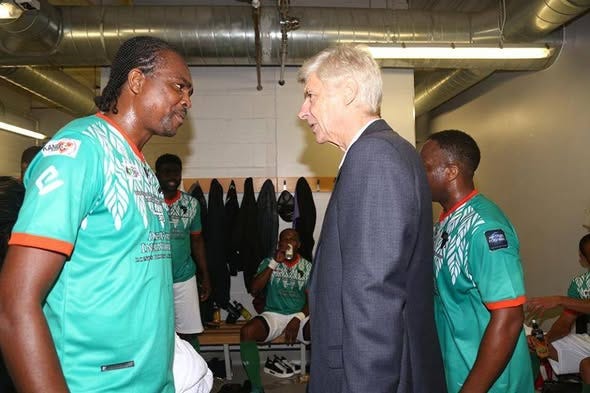
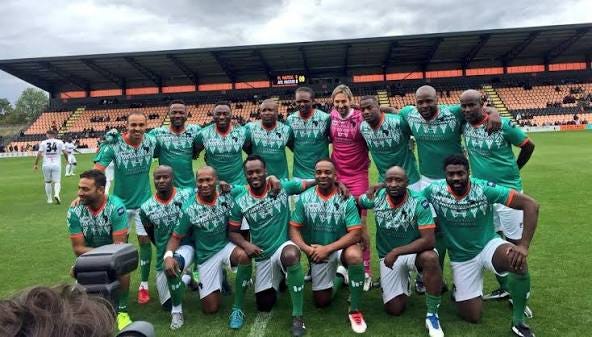
For Stylo Matchmakers, one of those moments came at The Hive, Barnet, in September 2018.
Nwankwo Kanu had brought together a remarkable collection of former Premier League and African footballers for the Kanu Cup.
Arsène Wenger was there.
Robert Pirès.
Michael Essien.
Sol Campbell.
William Gallas.
Steve McManaman.
Louis Saha.
Jens Lehmann.
Yakubu.
Players who had won Premier League titles, FA Cups, European Cups and international honours.
And sitting amongst their kit were pairs of Stylo Matchmakers.
A football boot brand once worn by Pelé, George Best, Kevin Keegan and Billy Bremner was back in a dressing room full of elite footballers.
Then something better happened.
They put them on.
This Was Kanu’s Day
The most important part of the story is why everybody was there.
Kanu’s football career could easily have been taken away from him.
After joining Inter Milan in 1996, doctors discovered a serious heart condition. He underwent surgery and faced the possibility that the career he had worked his entire life for could be over.
He came back.
And then he built some career.
Ajax.
Inter Milan.
Arsenal.
Portsmouth.
Nigeria.
Olympic gold.
Premier League titles.
FA Cups.
European football.
But what he did with that experience mattered more.
Kanu established the Kanu Heart Foundation to help children and young people in Africa suffering from serious heart conditions receive life-saving treatment.
That was what the match at Barnet was about.
This wasn’t another legends game cooked up because somebody realised nostalgia sells tickets.
There was a purpose.
Footballers gave their time.
Supporters bought tickets.
Sponsors contributed.
And Kanu used the profile football had given him to help children facing the same fear he once had.
That gave the afternoon weight.
It also made Stylo’s involvement feel right.
The Heritage Trap
When you bring back an old football brand, everybody naturally wants to talk about the past.
With Stylo, that’s understandable.
The archive is ridiculous.
Pelé.
George Best.
Kevin Keegan.
Billy Bremner.
Trevor Francis.
European Cup winners.
England internationals.
Some of the best footballers of their generation.
That’s an extraordinary inheritance.
But heritage can become a trap.
Because if everything important about your company happened before half your customers were born, you haven’t really revived a brand.
You’ve opened a museum.
When I brought Stylo Matchmakers back in 2017, I wasn’t going to beat Nike and Adidas by spending more money than them.
That would have been an impressively short business plan.
The challenge was relevance.
Could we put Stylo back on footballers?
Could we make the product credible again?
Could we stop saying:
Look who used to wear Stylo.
And start saying:
Look who is wearing Stylo now.
Barnet gave us an answer.
The Six Who Wore Stylo
Stylo wasn’t simply a sponsor’s logo attached to the event.
The boots were actually being used.
Nwankwo Kanu
This was his match.
His charity.
His cause.
And Kanu himself wore Stylo.
That mattered enormously to me.
He wasn’t holding a boot up for a photograph.
He wasn’t standing beside some sponsorship board because somebody had written it into an agreement.
He laced them up and played football in them.
Ajax.
Inter Milan.
Arsenal.
Portsmouth.
Nigeria.
Olympic champion.
Premier League champion.
FA Cup winner.
One of the great African footballers of his generation.
A year after I had brought Stylo back, Nwankwo Kanu was playing in the boots.
Kolo Touré
An Arsenal Invincible.
Premier League champion with Manchester City.
Africa Cup of Nations winner.
More than 100 appearances for Ivory Coast.
And exactly the sort of footballer you hope somebody will be when you finally meet them.
No performance.
No nonsense.
No entourage conducting a feasibility study into whether Kolo Touré could possibly put on a football boot.
He picked the Stylos up.
Pulled them on.
And played.
Daniel Amokachi
Everton.
Beşiktaş.
Nigeria.
World Cups.
Olympic gold.
Africa Cup of Nations winner.
One of the great African forwards of the 1990s.
Amokachi had played on some of football’s biggest stages.
At Barnet, he wore Stylo.
Jonathan Greening
Manchester United.
Middlesbrough.
West Brom.
Fulham.
Part of Manchester United’s 1999 European Cup-winning squad and a player who went on to build a long career in English football.
He wore them too.
Sébastien Bassong
Newcastle United.
Tottenham Hotspur.
Norwich City.
Cameroon.
Premier League football.
Champions League football.
A proper centre-half who had spent years putting football boots through considerably more punishment than a marketing department ever could.
Eric Djemba-Djemba
Manchester United.
Aston Villa.
Cameroon.
His name became part of Premier League folklore, but beneath the jokes was an international footballer who had reached a level almost nobody ever reaches.
He wore Stylo too.
Six former internationals.
Six men who had spent their careers in dressing rooms where the boots matter.
And there they were wearing ours.
The Dressing Room Was the Marketing
This is probably the bit modern sports marketing has forgotten.
Everything now needs a campaign.
A hashtag.
A launch film.
An influencer strategy.
A presentation explaining the “brand ecosystem”.
Then somebody produces a report saying the campaign delivered nine million impressions because nine million people couldn’t scroll past the advert quickly enough.
Football boots are much simpler.
Make a good boot.
Put it in front of a good footballer.
If he trusts it, he wears it.
That’s how football brands were built long before anybody had heard the phrase engagement metrics.
And that’s what I loved about Barnet.
The product was exactly where it belonged.
In a football dressing room.
Boot bags open.
Players getting changed.
Laces being pulled tight.
Studs clicking against the concrete.
Then the walk towards the tunnel.
Then grass.
No explanation necessary.
The dressing room was the advertisement.
From History to Active Duty
The Kanu Cup didn’t suddenly turn Stylo Matchmakers into Nike.
Let’s not rewrite history.
There wasn’t a £100 million order waiting for me on Monday morning.
Premier League agents weren’t queuing outside the office.
But Barnet gave Stylo something much harder to manufacture.
Credibility.
For the first time since the revival, we weren’t relying entirely on photographs from the 1960s and 1970s to explain why Stylo mattered.
We had something happening now.
Pelé wearing Stylo was history.
George Best wearing Stylo was history.
Kevin Keegan wearing Stylo was history.
And that history mattered.
But on that afternoon at Barnet, the brand stopped merely looking backwards.
Nwankwo Kanu picked the boots up.
Kolo Touré picked them up.
Daniel Amokachi.
Jonathan Greening.
Sébastien Bassong.
Eric Djemba-Djemba.
They put them on.
They walked down the tunnel.
They played football.
And suddenly Stylo Matchmakers wasn’t simply a famous name from football’s past.
It was back in active duty.
That’s why I still remember the Kanu Cup.
Not because Stylo sponsored a charity match.
That’s the corporate version.
The real story happened on the dressing-room floor.
A football brand that had disappeared from the game had found its way back into the hands of footballers.
Pelé and Best had written the first chapters.
On a concrete floor at Barnet, six internationals started writing the next one.