

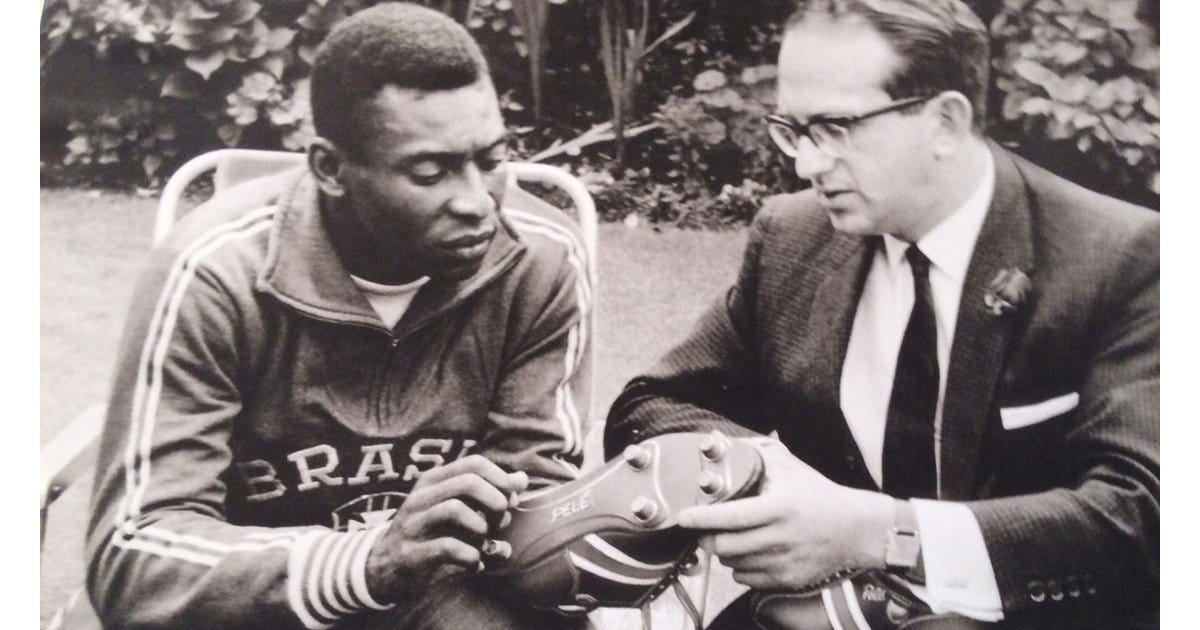
Paul Ziff did not wait for Pelé to telephone.
This was sensible. Pelé was busy being Pelé.
Brazil arrived in England for the 1966 World Cup as defending champions. They had won in 1958 and 1962. Pelé was already the most famous footballer on earth.
Most businessmen would have watched from the directors’ box, applauded politely and later told everyone they had been in the same stadium.
Ziff went after his signature.
He signed Pelé to wear Stylo Matchmakers.
That was Paul.
The Best Player in the World
The 1966 World Cup was brutal for Pelé.
He scored against Bulgaria, was kicked badly and missed Brazil’s next match. He returned against Portugal and was kicked again. Referees were less protective then. Defenders were more agricultural.
Brazil went home in the group stage.
Pelé remained Pelé.
Paul Ziff understood the difference between a bad tournament and a bad footballer. It sounds obvious. Football has employed many people who never managed it.
He had come to the World Cup to build Stylo Matchmakers, not to chase whoever had scored twice on Tuesday.
He wanted the best.
So he signed the best.
Paul Ziff, Matchmaker
Paul had persuaded his brother Arnold Ziff to let him establish a sports division within the family footwear business.
He called it Stylo Matchmakers.
The name suited him.
Paul matched great footballers with proper boots.
There were no launch films. No helicopters. No solemn voice explaining that a new synthetic upper had changed human movement forever.
There was leather, a contract and a player.
Paul did the rest.
He understood that the fastest way to establish Stylo was to put its boots on the feet of men who knew the difference between a good product and an expensive one.
Pelé knew.
So did George Best.
So did Billy Bremner and Kevin Keegan.
Paul worked to bring the finest players in football to Matchmakers. He wanted stars, but only if they could play.
A useful policy.
A British Brand with Nerve
Signing Pelé was not the act of a timid company.
Stylo was a British footwear brand entering an international market already occupied by larger businesses with more money and wider distribution.
Paul Ziff had nerve.
Nerve is cheaper than a global marketing department. It is also harder to find.
He saw that footballers were becoming personalities in their own right. Supporters cared about what they wore, how they played and how they carried themselves.
Paul understood endorsement before the modern football industry turned every player into a moving advertising board.
He did not wait until Stylo was globally important before approaching the world’s greatest players.
He approached the world’s greatest players and made Stylo important.
That is the difference between ambition and a business plan.
One moves.
The other often has charts.
Boots Made for Pelé
The boots produced for Pelé were personalised. His name appeared on them.
They were working equipment.
Football boots then had to survive hard pitches, bad weather, heavy tackles and footballs that seemed to gain weight whenever it rained.
The boot had a job.
It was not there to provide a lifestyle.
Pelé did not need footwear to give him imagination. He had enough already.
The boots needed to fit, protect him and stay out of his way.
That was the honest relationship between a player and his equipment.
Modern companies sometimes speak as though their latest boot has granted a footballer speed, balance and courage.
Paul Ziff knew better.
He signed the talent. He did not claim to have invented it.
What Pelé Meant to Stylo
Pelé gave Stylo something no slogan could manufacture.
Authority.
His endorsement told footballers that this British brand belonged at the highest level of the game.
Pelé had already won two World Cups. Four years after England, he would win a third in Mexico and produce one of the great final chapters of any international career.
He was not simply a famous player.
For much of the world, he was football.
His arrival changed how Stylo could see itself. It was no longer merely a British company making football boots.
It was a brand worn by Pelé.
There are worse lines to have in a company history.
Paul Built the Team
Pelé was the greatest signing, but he was not the only one.
Paul kept working.
George Best wore Stylo. Best played as though defenders were an inconvenience placed on the pitch to delay him.
Billy Bremner wore Stylo. He took a more direct approach to inconvenience.
Kevin Keegan wore Stylo and became European Footballer of the Year twice.
Different players. Different personalities. The same standard.
Paul understood that a brand needed more than one famous photograph. It needed a team of players carrying its boots into dressing rooms, stadiums and cup finals.
That required persistence.
Contracts had to be agreed. Relationships maintained. Boots delivered. Footballers could be demanding. This may be the least surprising fact in the story.
Paul handled it.
Stylo became part of football because he kept placing its products in front of people whose opinions mattered when the whistle blew.
Before Football Became a Billboard
Football marketing later became much larger.
It did not always become cleverer.
Today, boot contracts are negotiated by agencies and announced through campaigns involving studio lighting, dramatic music and products with names that sound like failed space missions.
The money is enormous.
The language is heroic.
The boots are often fluorescent.
Paul operated in a simpler world, though not an easier one.
He found great players. He made his case. He signed them.
There was no algorithm measuring Pelé’s engagement rate.
Pelé had won two World Cups.
That was considered sufficient data.
Pelé Did Not Need Stylo
Stylo Matchmakers did not make Pelé great.
No boot could.
A brand should never claim ownership of a player’s talent. The honour runs the other way.
Pelé gave Stylo a permanent place in football history.
Paul Ziff made the relationship possible.
That was his achievement.
He brought together the finest footballer of his generation and a British brand with enough confidence to stand beside him.
Then he went looking for the next great player.
The Tribute Paul Deserves
Football remembers the goalscorers.
It is less reliable with the people who built the stages around them.
Paul Ziff deserves to be remembered as a man who understood the commercial future of football without losing sight of the game itself.
He believed the best players should wear Matchmakers.
Then he did the work.
He did not inherit Pelé.
He signed him.
He did not talk about ambition while waiting for somebody else to act.
He crossed the room and asked.
That was how Stylo Matchmakers grew.
Not through mythology.
Through judgement, courage and hard work.
The King Wore Stylo
Pelé’s 1966 World Cup ended in pain and disappointment.
Four years later, he returned and won it again.
The best players survive bad tournaments. They do not become lesser players because one summer went wrong.
Paul Ziff understood that.
While others watched Brazil leave England, he saw what Pelé still represented.
He signed him.
Then he spent years bringing more of football’s finest players to Stylo Matchmakers.
Pelé did not need Stylo to become immortal.
But because Paul Ziff had the nerve to ask, the King wore Matchmakers.
That is not marketing mythology.
It is football history.
Pelé wore them. Paul Ziff made it happen.