

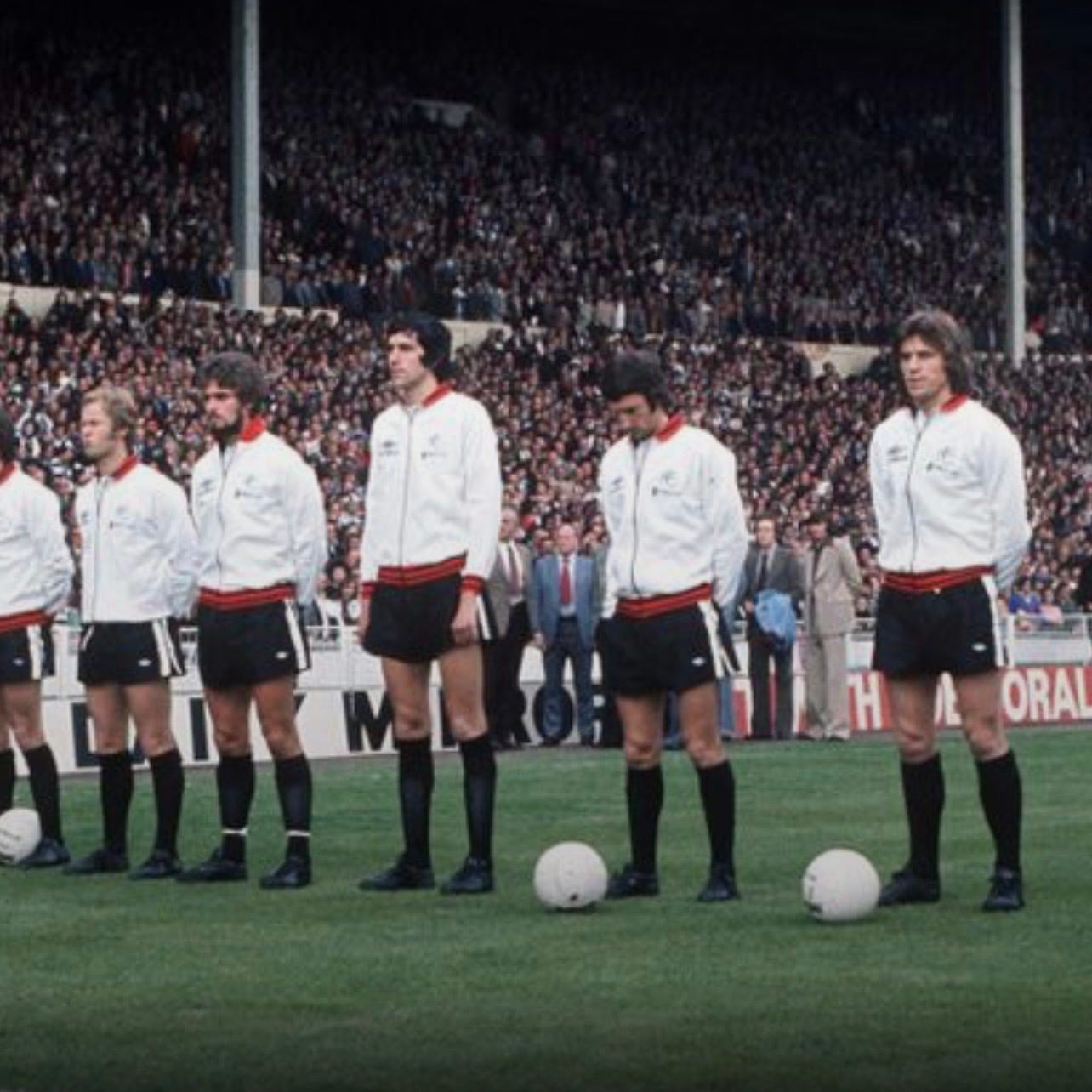
There was a can of black paint moving around the Fulham dressing room at Wembley.
Outside, 100,000 people filled the stadium.
The television cameras were ready.
The FA Cup waited.
Inside, some of Fulham’s players were covering the markings on their boots.
Bobby Moore was there. Alan Mullery was there. Fulham were preparing for the biggest match in the club’s history.
Yet before they could face West Ham United, the players had become trapped in a dispute between two boot companies.
One was Adidas.
The other was Stylo Matchmakers.
Adidas had money, international reach and growing influence across world football.
Stylo had a prior agreement.
Before Wembley changed the value
Fulham had reportedly entered into a team boot arrangement with Stylo Matchmakers during the 1974–75 season.
Stylo was not an outsider searching for borrowed history. It was an established British manufacturer whose boots had been worn by leading professionals, including Pelé, George Best, Denis Law, Kevin Keegan and Bobby Moore.
The Fulham arrangement had been made before anyone knew the club would reach Wembley.
Then came an exhausting FA Cup run. Fulham needed twelve matches to reach the final, including repeated replays against Hull City and Nottingham Forest before overcoming Everton, Carlisle United and Birmingham City. It remains the club’s only FA Cup Final appearance.
Suddenly, the value of every player’s feet changed.
This was not another Second Division match.
This was Wembley.
Millions would see the final on television. Newspapers would carry photographs across Britain. A recognisable boot beneath Bobby Moore’s white shirt represented national exposure.
Adidas wanted that exposure.
The agreement behind the agreement
Later accounts from Fulham players and supporters describe a separate Adidas arrangement being made for the final.
The surviving public record is incomplete. There is no dependable figure showing exactly what Adidas offered, who negotiated every part of the arrangement or whether money had already changed hands.
That uncertainty should not be disguised.
The central sequence, however, is consistent across the available accounts.
Fulham already had a Stylo arrangement.
A dispute arose over players appearing in Adidas boots at Wembley.
Legal action followed.
The manufacturers’ markings were covered before the players entered the field. A later account of the final described Fulham’s boots as having all their identifying marks blacked out, making them look like slippers against the team’s black socks.
The commercial logic was straightforward.
Adidas did not need the whole season.
It needed the final.
Stylo had secured its position before Wembley made that position unusually valuable. Adidas appears to have moved when the television audience arrived.
The match had not begun, but the players’ feet were already commercial territory.
Stylo refused to move
A smaller company might have accepted the outcome.
Adidas was expanding rapidly during the 1970s. Horst Dassler understood that sporting success could be converted into commercial dominance through athlete relationships, governing bodies, sponsorship and television exposure.
Stylo could have watched a richer rival collect the value attached to an agreement it believed it already held.
It did not.
Stylo challenged the situation through legal channels.
The precise procedure remains uncertain. Without the court papers, it would be reckless to claim that Stylo obtained a formal injunction against Adidas or Fulham.
What can safely be said is that the dispute became serious enough to demand a solution immediately before one of the largest sporting events in Britain.
Fulham’s players would not be forced into unfamiliar boots.
But the rival branding could not be shown.
The stripes had to go.
The black paint
The compromise was brutally practical.
Cover the markings.
No press release.
No sponsorship summit.
No careful corporate language.
Just paint.
Under the Wembley lights, Fulham’s boots looked strangely anonymous. The clean stripes and manufacturers’ marks that normally identified them had disappeared into the leather.
The image captures football at the point of change.
The old game was still present: black boots, heavy leather, a domestic cup final and players preparing in a cramped dressing room.
The new game was already pushing through the door: endorsement money, exclusive visibility and multinational companies competing for control of the television image.
Between them sat a can of black paint.
The players in the middle
The Fulham players were not simply greedy men chasing another payment.
Some reportedly had reservations about the Stylo boots supplied to them or did not want to wear unfamiliar footwear in the most important match of their careers.
That concern was reasonable.
A leather boot in 1975 could be stiff, heavy and unforgiving. A player should not have been expected to risk blisters, discomfort or uncertain footing at Wembley merely to settle a dispute between manufacturers.
The compromise allowed the players to wear footwear they trusted while denying the rival company visible advertising.
But the players reportedly lost the endorsement money attached to the deal.
Nobody got everything.
Stylo protected its contractual position but lost the clear exposure of its own branding.
Adidas got boots onto the pitch but not the recognisable stripes.
The players wore their preferred footwear but lost the expected commercial reward.
Then the football began.
Alan Taylor scored twice in four second-half minutes as West Ham United won 2–0. Fulham’s first FA Cup Final ended in defeat.
West Ham took the trophy.
The boots told another story.
What Wembley revealed
The dispute was more than a curious footnote.
It showed how football’s commercial balance was shifting.
Stylo represented an older model. A boot company earned its place through manufacturing, club relationships and players who trusted the product.
Adidas was helping build something larger: a system in which visibility itself became the decisive asset.
Appear on the best players.
Appear in the biggest matches.
Repeat the image across television screens.
Use that familiarity to win more athletes, retailers, tournaments and customers.
It was intelligent business. It was also difficult for smaller manufacturers to challenge, regardless of their history or the quality of their boots.
What emerged was not a level playing field so much as a private league table whose entrance fee kept rising.
Craftsmanship still mattered.
Relationships still mattered.
But neither carried the same force as the ability to buy the moment when the whole country was watching.
The company that stood its ground
Stylo did not defeat Adidas as a global business.
Adidas went on to become one of the largest and most influential companies in sport.
Pretending otherwise would turn history into advertising.
But Wembley showed that Stylo was not a decorative heritage brand or a passive casualty of corporate football.
It was commercially serious.
It had an agreement.
It defended it.
That distinction matters today because heritage is cheap when it is manufactured after the event. Brands release retro collections, recreate old advertising and purchase associations with football’s past.
Stylo does not need to manufacture this story.
It happened.
Bobby Moore was there.
The final was real.
So was the dispute.
And when Fulham emerged from the tunnel, the marks of Adidas had disappeared beneath black paint.
Wembley, 1975
There is no verified public figure showing exactly what Adidas offered.
No discovered court order yet proves that Stylo secured a formal injunction.
There is no evidence that the argument delayed kick-off.
The facts do not need inflating.
Fulham had a Stylo arrangement.
A competing Adidas deal emerged around the FA Cup Final.
Stylo objected.
A last-minute compromise allowed the players to wear their preferred boots, but not to display the rival branding.
Outside, Wembley waited.
Inside, the paint dried.
Adidas brought the money.
Stylo brought the contract.
Horst Dassler’s commercial machine went on to reshape world sport.
But at Wembley in 1975, Stylo Matchmakers made it hide its stripes.