

Football has a terrible memory.
We remember the winners.
The wealthy clubs.
The television stars.
The goals repeated a thousand times on social media.
Ask a young supporter who won the Premier League last season and they’ll probably know.
Ask who won the first FA Cup and you might get a blank expression.
Yet without those early clubs, there wouldn’t be a Premier League.
There wouldn’t be an FA Cup as we know it.
There might not even be the same football culture we take for granted today.
Wanderers.
Blackburn Olympic.
Old Etonians.
Corinthian.
Names that once meant something extraordinary.
Across the Atlantic, Chicago Sting, Washington Diplomats and Los Angeles Aztecs helped give American soccer an identity long before today’s clubs became global businesses.
Some of these institutions disappeared.
Others survived through mergers, revivals or entirely different circumstances.
But their stories slipped out of the conversation.
Football didn’t forget these clubs because they were unimportant. It forgot them because the spotlight moved somewhere else.
At Stylo Matchmakers, we want to change that.
Not by opening a museum.
By bringing their names, identities and stories back into everyday football culture.
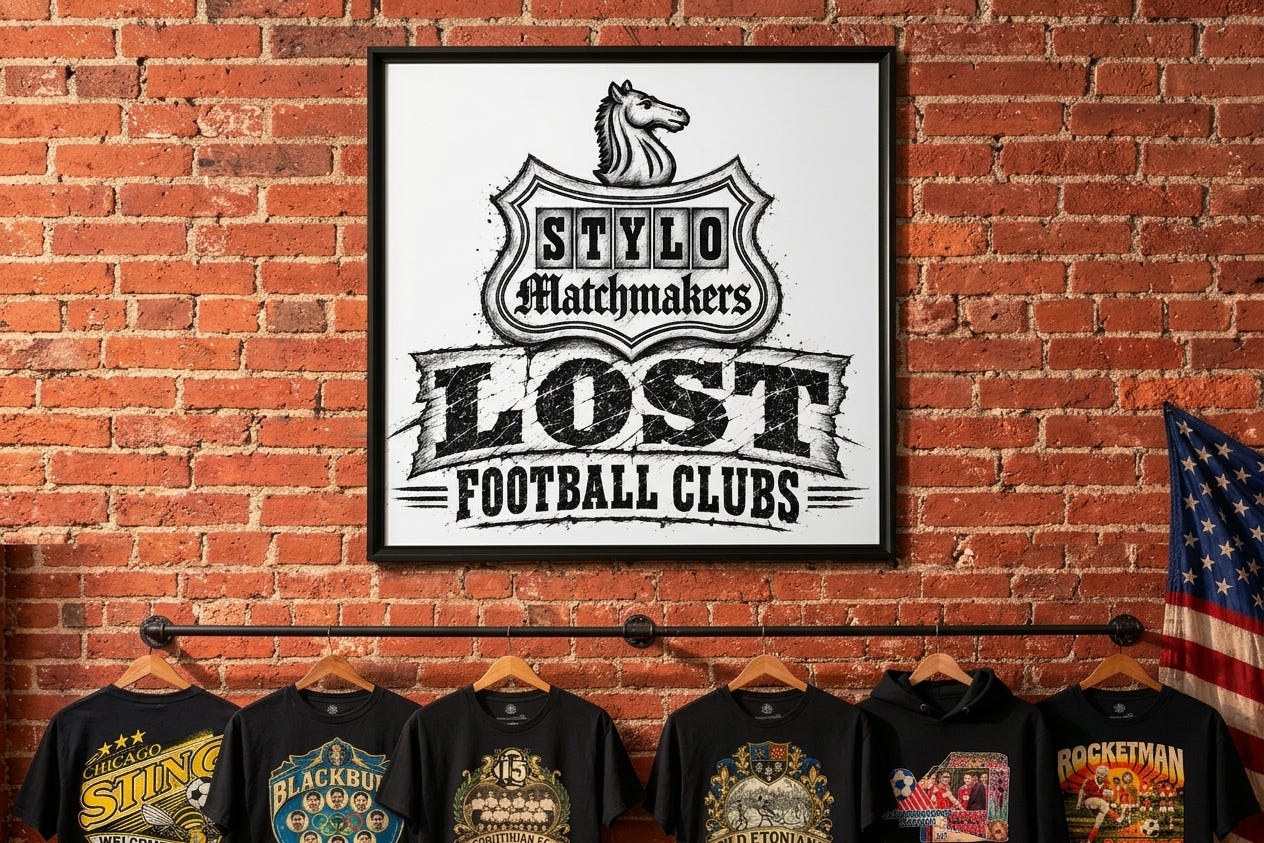
That’s why we’ve created our Lost Football Clubs Collection.
And every design starts with a story worth telling.
Wanderers: The First Kings of English Football
On 16 March 1872, Wanderers faced Royal Engineers at the Kennington Oval.
It was the first FA Cup final.
There were no sponsors on the shirts.
No global television audience.
No multimillion-pound player contracts.
Football was still establishing what it would become.
Wanderers won 1–0.
The winning goal came from Morton Betts, playing under the name A. H. Chequer.
The first FA Cup had its first champions.
But Wanderers weren’t finished.
They would win the trophy five times between 1872 and 1878.
Five FA Cups.
Before Manchester United won their first.
Before Liverpool won theirs.
Before Arsenal had even been founded.
For a period, Wanderers were among the greatest teams in the country.
Then football changed.
The game expanded beyond its early amateur circles.
New clubs emerged.
The original Wanderers gradually disappeared from competitive football.
Their name has since been revived, but the original institution never became one of the professional giants.
Yet they helped give English football its oldest great competition.
That deserves recognition.
Our Wanderers F.C. Heritage Tee takes inspiration from those early pioneers, using vintage football imagery and an archive-style crest.
Not a modern replica.
A tribute to the club that won the first FA Cup.
Before football had superclubs, it had Wanderers.
Blackburn Olympic: The Working Men Who Broke the Establishment
Now we come to one of my favourite stories in football.
The FA Cup final.
Old Etonians against Blackburn Olympic.
On one side stood a club from England’s public-school football establishment.
On the other stood a team from an industrial Lancashire town.
And the balance of English football was about to change.
Blackburn Olympic won 2–1 after extra time.
They became the first northern working-class club to win the FA Cup.
It was a result that represented something bigger than football.
For years, much of the national game’s early power had belonged to amateur clubs associated with privileged institutions.
But in the industrial north, football was becoming part of working life.
Factory workers.
Tradesmen.
Communities.
People who didn’t need an expensive education to understand the game.
Blackburn Olympic challenged the established order and won.
Professionalism was formally legalised two years later.
The Football League followed in 1888.
The centre of football’s power had shifted.
But Olympic never enjoyed the commercial future that other northern clubs would eventually build.
The club folded in 1889.
Blackburn Rovers became a name recognised around the world.
Olympic became a footnote.
Yet in one afternoon, they helped announce football’s transformation into the people’s game.
That’s why we created the Blackburn Olympic F.C. Tee.
Inspired by Victorian football illustrations, early cup imagery and the club’s extraordinary achievement.
It carries a name that should mean far more than it does today.
Blackburn Olympic weren’t just FA Cup winners. They were proof that football didn’t belong to the establishment.
Old Etonians: The Champions of a Disappearing Era
Every revolution has two sides.
Blackburn Olympic represented the future.
Old Etonians represented the era being overtaken.
And their history is fascinating.
Old Etonians won the FA Cup in 1879.
Then again in 1882.
Their second victory came against Blackburn Rovers.
They were one of the great names of early English football.
But a year later, Blackburn Olympic defeated them.
That 1883 final became a symbol of football’s changing social landscape.
The old amateur establishment was losing its dominance.
The industrial towns were becoming stronger.
Professionalism was coming.
Old Etonians still exist as an amateur football club.
They aren’t a vanished institution.
But their era as national cup champions belongs to another world.
Imagine a club associated with former Eton College pupils winning the modern FA Cup.
The thought seems extraordinary.
Yet for a period, that was English football.
The Old Etonians F.C. Tee is inspired by Victorian football illustration and the earliest days of the national game.
Because understanding football means remembering more than the clubs that eventually won the commercial race.
It means understanding who played before the rules, money and social structures changed.
Corinthian: The English Club That Helped Inspire Brazil
Not every influential football club needed a cabinet full of FA Cups.
Some changed the game through their ideas.
Corinthian Football Club was founded in 1882.
It became one of the most celebrated amateur sides in football.
The club was associated with sporting conduct, technical quality and the belief that football should be played in the right spirit.
The Corinthians toured internationally at a time when the game was still spreading around the world.
And one particular connection survives to this day.
In 1910, Sport Club Corinthians Paulista was founded in São Paulo, taking inspiration from the visiting English Corinthians.
Today, Corinthians is one of Brazil’s great football institutions.
Millions follow the club.
Its name is recognised across the football world.
Yet the original English Corinthian FC receives only a fraction of that recognition.
In 1939, Corinthian merged with Casuals to form Corinthian-Casuals, preserving the legacy through a new institution.
That history deserves to be celebrated.
Our Corinthian F.C. Tee reflects the club’s sporting identity.
Football with principles.
A design inspired by a name that influenced the game far beyond England.
Some clubs win trophies. Others leave their names on the other side of the world.
Corinthian did something remarkable.
It helped export an idea of football culture.
Chicago Sting: When American Soccer Had Its Own Identity
Football history doesn’t stop at the English Channel.
And some of the most interesting forgotten clubs come from America.
Before today’s professional soccer landscape, cities across the United States embraced ambitious clubs with extraordinary personalities.
Chicago Sting was one of them.
Founded in 1974, the club became part of a remarkable period of American soccer.
Big crowds.
International players.
Colourful identities.
And an ambition to make football something genuinely American.
In 1981, Chicago Sting won the Soccer Bowl, defeating New York Cosmos.
The victory gave Chicago a championship and one of American soccer’s great sporting moments.
The club would also win another major outdoor championship in 1984.
But the league environment was unstable.
The original national competition collapsed in 1985, and Chicago Sting later competed indoors before ceasing operations in 1988.
The name disappeared from professional football.
The history didn’t.
Our Chicago Sting 1981 Championship Tee celebrates that title-winning moment.
The black and yellow identity.
The championship.
The era when American soccer had swagger.
It’s designed to feel like a vintage championship shirt, not an imitation of modern club merchandise.
Because Chicago once had a soccer champion that deserves to be remembered alongside the city’s other great sporting stories.
Washington Diplomats: Football in the American Capital
Then there was Washington.
The Diplomats were part of the same extraordinary era.
A club with a name built for the American capital.
Red shirts.
Bold graphics.
International ambition.
Washington Diplomats helped bring professional soccer into the sporting culture of the capital during the 1970s.
And like so many clubs of that era, their story was shaped by the financial instability of the wider league.
The original franchise folded after the 1980 season. A successor using the same name played in 1981.
That was the end of the Diplomats’ top-flight story.
But the identity remains unmistakable.
The name.
The colours.
The spirit of seventies American soccer.
Our Washington Diplomats Heritage Tee takes inspiration from that original identity and the graphics of the period.
Not simply to celebrate a former club.
But to show that football history is full of names that deserve another opportunity to be seen.
Los Angeles Aztecs: Champions Before the Modern Soccer Boom
Los Angeles has an extraordinary soccer history.
Long before today’s global investment and international spotlight, the Los Angeles Aztecs were bringing ambitious professional football to Southern California.
Founded in 1973, the Aztecs won the North American championship in 1974, their first competitive season.
They later attracted remarkable footballing names.
George Best played for the club.
Johan Cruyff followed.
Rinus Michels managed the team.
Think about that.
Best.
Cruyff.
Michels.
All connected to the same Los Angeles football institution.
The original club ceased operations after the 1981 season.
But the story remains part of the city’s football history.
At Stylo, our North American Champions 1974 LA Aztecs Tee celebrates that remarkable first-season title.
Not because football history should remain trapped in the seventies.
Because modern soccer didn’t arrive from nowhere.
It was built on generations of people taking risks, founding clubs and trying to establish the game.
Some succeeded.
Some disappeared.
But all helped create the opportunity that modern soccer enjoys.
The Biggest Clubs Aren’t Always the Most Important
This is what fascinates me about football history.
We tend to measure importance by money.
How much is the club worth?
How many shirts does it sell?
How many followers does it have?
How many trophies has it won recently?
But that is only one way of understanding football.
Wanderers helped establish the FA Cup.
Blackburn Olympic challenged the game’s social establishment.
Old Etonians represented an amateur era that shaped early football.
Corinthian influenced the sport internationally.
Chicago Sting brought championship football to Chicago.
Washington Diplomats helped build a professional soccer identity in the American capital.
Los Angeles Aztecs brought some of the greatest footballing minds and players to California.
Their stories cannot be reduced to whether their original companies survived.
Or whether somebody can attach a current valuation to them.
Football clubs are more than businesses.
They are institutions.
Sometimes their greatest contribution survives long after their final match.
A club can disappear from the league table without disappearing from football history.
Why Stylo Matchmakers Is Doing This
Stylo has its own football history.
The original brand emerged in the 1960s.
Pelé wore Stylo Matchmakers.
So did George Best, Kevin Keegan and Billy Bremner.
The boots belonged to an era when footballers had character, supporters had identities and the game wasn’t permanently being repackaged for commercial consumption.
When I began reviving Stylo in 2017, I knew the heritage was valuable.
But heritage alone doesn’t make a business.
You have to do something with it.
You have to create products people want.
Give people reasons to care.
And make the past relevant to the present.
That’s why our clothing collections aren’t simply about recreating old football shirts.
They’re about telling stories.
Our Football Lived Here collection remembers grounds that disappeared.
Player Legends celebrates footballers who shaped the game.
The Gaffers remembers managers who built extraordinary teams.
And Lost Football Clubs recognises institutions that deserve more than a footnote in a record book.
We make clothing.
But I want the clothing to begin a conversation.
Somebody sees a Blackburn Olympic shirt.
They ask what it means.
You tell them about 1883.
About the working men who challenged the football establishment.
Suddenly, a forgotten football club is being discussed again.
That’s worth something.
Football History Shouldn’t Belong Only to the Richest Clubs
Modern football is very good at celebrating the institutions that dominate today.
The Premier League.
The Champions League.
The superclubs.
The billionaire owners.
The global entertainment empires.
I understand the commercial attraction.
But history isn’t a competition won by whoever has the largest marketing department.
Thousands of clubs and generations of supporters built this game.
Some were champions.
Some were pioneers.
Some changed the rules.
Some brought football to new communities.
And some disappeared because the game moved in a direction they could no longer follow.
Their contribution should not disappear with them.
That’s what we’re trying to recognise.
The winners write the headlines. But the forgotten clubs helped write football’s history.
The Lost Football Clubs Collection
We’ve started with a group of designs inspired by clubs whose stories deserve a wider audience.
The historical archive includes:
Wanderers F.C. Tee — The first FA Cup winners in 1872.
Blackburn Olympic F.C. Tee — The working-class pioneers who won the FA Cup in 1883.
Old Etonians F.C. Tee — Twice FA Cup winners from English football’s amateur establishment.
Corinthian F.C. Tee — The famous English amateurs whose influence reached Brazil.
Chicago Sting 1981 Tee — A tribute to Chicago’s championship-winning soccer club.
Washington Diplomats Tee — A celebration of Washington’s seventies soccer identity.
LA Aztecs 1974 Champions Tee — Remembering the original Los Angeles Aztecs’ championship season.
Each of these shirts is currently listed at £39.
The wider collection also includes additional American soccer designs, sweatshirts and hoodies.
Explore the complete Stylo Matchmakers Lost Football Clubs Collection.
We’re Not Finished
I want this collection to keep growing.
But not simply by choosing names that sell.
I want to find clubs with stories that deserve another audience.
Clubs that won something remarkable.
Clubs that challenged the establishment.
Clubs that helped develop the game in their communities.
Clubs whose supporters still carry their memories.
And clubs whose names have almost disappeared.
Some might come from England.
Others from Scotland, Wales, Ireland, Europe or America.
The important thing is that the stories are worth telling.
Because football history doesn’t belong exclusively to the people who can afford to promote it.
It belongs to everybody who helped create it.
The Clubs Went. The Stories Stayed.
Football moves quickly.
Players retire.
Managers leave.
Grounds are demolished.
Clubs fold.
Leagues collapse.
And another generation grows up knowing only the teams on television.
But look at what these forgotten institutions achieved.
Wanderers gave the FA Cup its first champions.
Blackburn Olympic showed that the industrial north could beat the old amateur establishment.
Old Etonians helped define football’s early years.
Corinthian carried English football culture around the world.
Chicago Sting became champions.
Washington Diplomats helped give the American capital a football identity.
Los Angeles Aztecs brought some of the game’s greatest names to California.
These aren’t meaningless names from an old record book.
They are part of the reason football became the game we love.
And I don’t believe they should be forgotten simply because they no longer dominate the commercial conversation.
At Stylo Matchmakers, we’re bringing their stories back.
One design at a time.
Not as souvenirs of failure.
As reminders of what they achieved.
Football didn’t begin in 1992.
And football history doesn’t belong only to the clubs that survived.
Discover Lost Football Clubs by Stylo Matchmakers.
And tell me something.
Which forgotten football club deserves to have its name brought back next?
Stylo Matchmakers
Born 1966. Reborn 2017. Still independent.
The clubs went. The stories stayed.