

I have been thinking about something that has started to bother me.
We are losing football history.
Not the scores.
Not the league tables.
Not who won the FA Cup.
We can look those up in seconds.
I mean the things you cannot Google.
The dressing rooms.
The characters.
The terrible pitches.
The train journeys.
The managers.
The arguments.
The laughs.
The supporters.
The things that happened when there wasn’t a camera pointing at everyone.
The stories only the people who were actually there can tell.
That history has a clock on it.
And I think we need to do something about it.
We recorded over our own history
There is something almost unbelievable about old television.
For years, broadcasters routinely wiped recordings.
Videotape was expensive. It could be reused.
So it was.
Programmes were broadcast and then recorded over.
Film was discarded.
Sport disappeared with everything else.
Nobody doing it imagined that decades later we would carry devices in our pockets capable of storing and watching almost anything ever filmed.
Television was for today.
Football was for Saturday.
When Saturday was gone, everyone moved on to the next one.
The result is extraordinary.
There are footballers who made hundreds of professional appearances whose careers today are represented by a few photographs and a handful of surviving clips.
Compare that with a talented 17 year old today.
Before he has even established himself in the first team, there can be hundreds of clips.
Goals.
Training.
Interviews.
Podcasts.
Social media.
Every moment documented.
Every touch capable of surviving forever.
Yet men who spent fifteen years playing professional football can have entire seasons of their careers that today’s supporters will never see.
That doesn’t make their history less important.
It makes preserving what remains more important.
Football didn’t start in 1992
I understand why 1992 became such an important dividing line.
The Premier League transformed the commercial presentation of English football.
Television changed.
Money changed.
Stadiums changed.
Eventually the internet changed everything again.
But sometimes modern football feels as though somebody pressed START in 1992.
Premier League goals.
Premier League appearances.
Premier League records.
Premier League legends.
Fine.
But football was already old.
Generations had already built it.
People had filled terraces.
Players had won European Cups.
England had won a World Cup.
Clubs had become institutions at the centre of towns and cities.
Thousands of footballers had already given supporters moments they would remember for the rest of their lives.
They did it without social media.
Without personal photographers.
Without content departments.
Without YouTube.
Without somebody following them around making sure their legacy was being documented.
They just played football.
Stylo Matchmakers was there
That’s what makes this personal for me.
Stylo Matchmakers comes from that football world.
We aren’t a modern company trying to manufacture a retro story.
Stylo has one.
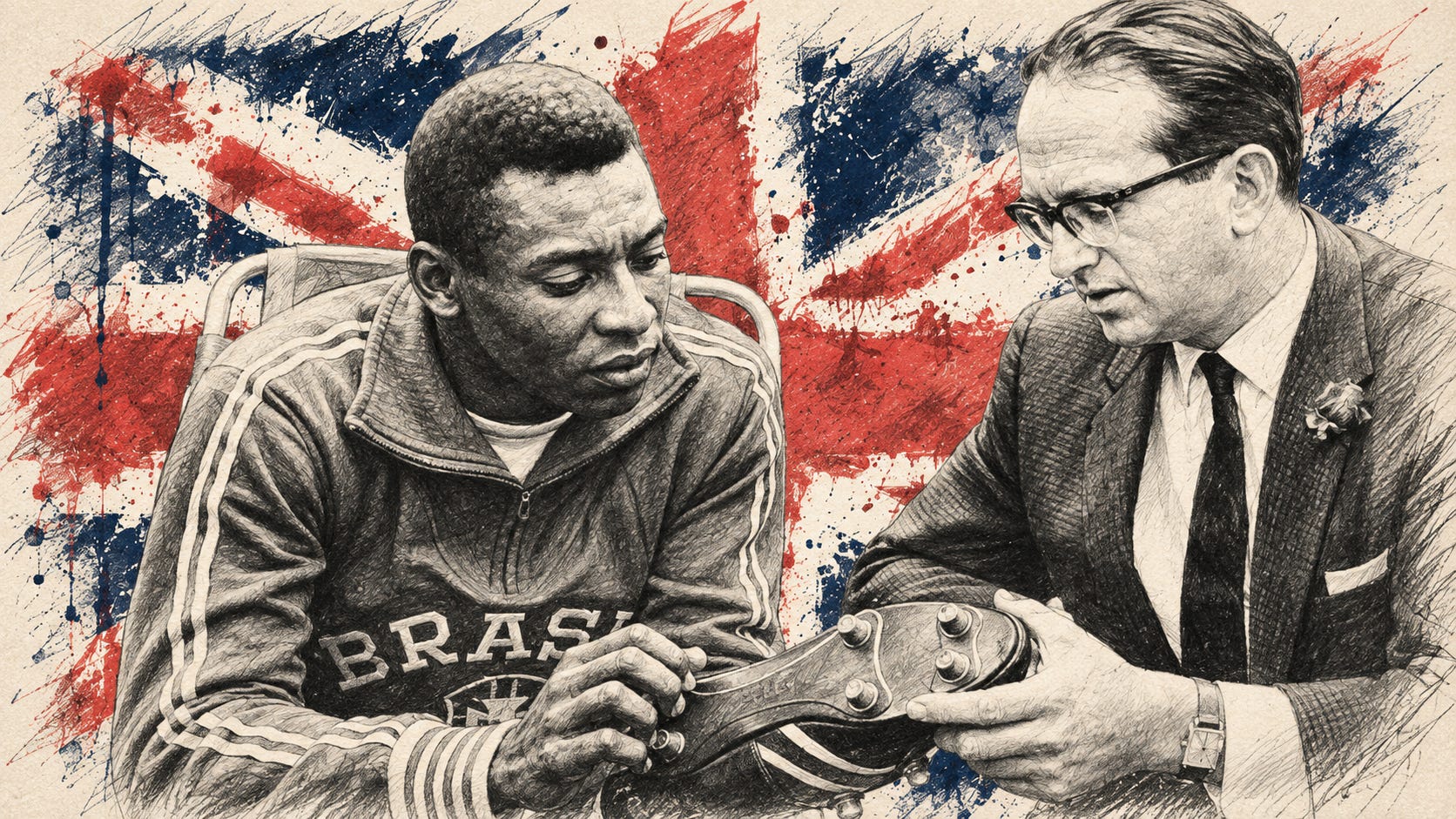
Our boots walked onto those pitches.
Our name existed in that football culture.
The smell of dubbin on black leather.
Studs clicking down concrete tunnels.
Mud being knocked from boots against dressing room walls.
Saturday afternoon terraces.
Players walking onto pitches carrying nothing more complicated than their boots and their ability.
Stylo Matchmakers was there.
Some extraordinary footballers helped write our history.
And I’ve realised something.
THE LEGENDS HELPED MAKE STYLO HISTORY.
NOW IT’S STYLO’S TURN TO PRESERVE THEIRS.
That is what I want to do next.
Not merchandise. Memory.
I don’t want to find an old footballer, put his face on a T shirt and call it heritage.
There is enough of that.
I want to start somewhere completely different.
With a chair.
Sit down.
Turn the camera on.
And listen.
Tell me about your first pair of boots.
Tell me who spotted you.
Tell me about leaving home.
Tell me about the manager who changed your life.
Tell me who the best player you ever faced really was.
Tell me who was better than people remember.
Tell me about the teammate who made everyone laugh.
Tell me about the ground you loved.
Tell me about the ground you hated.
Tell me about the supporters.
Tell me what happened on the coach.
Tell me what happened in the dressing room.
Tell me what football smelled like twenty minutes before kick off on a wet Saturday afternoon in November.
Tell me something nobody has ever bothered asking you.
Tell me what football was really like.
Then we preserve it.
Properly.
The player is the archive
This is the part I think football has missed.
We think an archive is a building.
A room full of film.
A database.
A cupboard full of programmes.
It isn’t always.
Sometimes the archive is a 78 year old man sitting in his living room.
Fifty years of football can be sitting inside his head.
Things that were never filmed.
Things that were never written down.
Things his teammates knew.
Things supporters saw from the terrace.
Things his children have heard a hundred times.
When that person disappears, part of football disappears with him.
You cannot restore that footage.
You cannot search another database.
You cannot recreate the conversation.
It’s gone.
That is what gives this urgency.
The Stylo Living Archive
I want Stylo Matchmakers to create something permanent.
The Stylo Living Archive.
A home for the memories of the footballers who built the game before everything was recorded.
Not a dusty museum.
A living archive.
Long conversations.
Portrait photography.
Old photographs digitised where possible.
Boots.
Shirts.
Programmes.
Letters.
Contracts.
Newspaper cuttings.
Stories.
Memories.
The things sitting in boxes underneath beds and at the back of cupboards.
The things families might not even realise are historically important.
Let’s put the footballer at the centre of his own history.
And let’s record it while he can still tell us what really happened.
Then we create
Once the story is preserved, we can create around it.
Films.
Articles.
Short documentaries.
Photography.
Design.
Clothing.
Limited collections.
Books.
Prints.
Perhaps exhibitions.
Perhaps things I haven’t even thought of yet.
But there is one rule I want at the centre of it.
The product follows the history.
The history never follows the product.
We’re not starting with something to sell and finding a footballer to attach to it.
We’re starting with the footballer.
His life.
His memories.
His personality.
His history.
Then, if it feels right, we create something from it.
This isn’t about money
There can be a commercial model around this.
There probably has to be if we want The Stylo Living Archive to grow, travel and preserve hundreds of stories.
And if Stylo creates something around somebody’s name, image and history, I believe that person should participate in the value created.
Of course they should.
But that isn’t why I want to do this.
Money isn’t the point.
Meaning is.
Imagine somebody buys a Stylo piece because he watched that player with his dad in 1976.
His son sees it.
“Who’s that?”
Dad tells him.
Maybe the son searches for him.
He discovers the interview we recorded.
He sees the photographs.
He hears the player tell the story in his own voice.
He discovers the team.
The ground.
The supporters.
The era.
Something has travelled from one generation to another.
That’s the point.
The clothing becomes a conversation starter.
The conversation becomes a memory.
And the memory keeps the history alive.
I don’t only want the famous names
This matters enormously to me.
Football history cannot become the same twenty superstars recycled forever.
Every club has its legends.
The goalkeeper who stayed for twelve years.
The centre half nobody wanted to play against.
The winger who could fill a ground.
The local lad who made it.
The captain.
The journeyman.
The one club man.
The lower division striker.
The player who made 400 appearances and never received an international cap.
The man whose goal on a Tuesday night fifty years ago is still remembered in one particular town.
Those people matter.
You don’t need to have won the Ballon d’Or to have left a mark on football.
If people still tell stories about you, you are part of football history.
In fact, those may be the stories we most urgently need to preserve.
The biggest names will always have documentaries.
Somebody will always write another book about them.
But who records the man who played 350 times for a Second Division club in the 1970s?
Who asks him?
Who scans his photographs?
Who records his memories?
Who tells his grandchildren what Grandad actually did?
Maybe we should.
Sometimes the archive is sitting in an armchair
The most valuable undiscovered football archive in Britain might not be sitting in a vault.
It might be sitting in someone’s living room.
It might be a box of photographs underneath a bed.
An old pair of boots in a loft.
A programme with something written on the back.
A letter from a manager.
A shirt nobody has touched for thirty years.
Or a story that has been told around the same kitchen table for half a lifetime.
Sometimes the archive isn’t an object at all.
Sometimes it’s a memory that has never been recorded.
That’s what I want to find.
Because technology can restore a photograph.
It can clean up old film.
It can repair sound.
It can search millions of documents.
There is one thing technology cannot do.
It cannot interview somebody after they’re gone.
So let’s not wait for the obituary.
Let’s ask them now.
This should have happened years ago
That’s the part I can’t get away from.
Football has generated extraordinary wealth.
We’ve spent billions on players.
Billions on broadcasting.
Billions rebuilding stadiums.
We measure passes.
Sprints.
Possession.
Expected goals.
Distance covered.
We can tell you what part of the pitch somebody touched the ball on last Saturday afternoon.
Yet there are men alive today who played hundreds of professional football matches in the 1960s, 70s and 80s whose stories have never been properly recorded.
How did we allow that to happen?
We preserved the trophies.
We preserved the statistics.
We preserved the grounds.
We preserved the shirts.
Sometimes we forgot to preserve the people.
And ultimately football isn’t any of those other things.
Football is people.
An open invitation to former professionals
So this isn’t just an article.
It’s an invitation.
If you played professional football in the 1960s, 70s or 80s, I want to hear from you.
Famous or forgotten.
International or lower division.
Hundreds of caps or none.
It doesn’t matter.
You were there.
That’s what matters.
If you have photographs sitting in boxes, I’d like to see them.
If you’ve still got your boots, show us.
If you have programmes, letters, contracts, shirts or newspaper cuttings, keep them.
If you’ve got stories you’ve told in the pub for forty years but nobody has ever recorded, tell them again.
If there’s something about your generation of football that today’s supporters simply don’t understand, tell us.
If you’re the son, daughter, wife, teammate or representative of a former footballer whose story deserves preserving, I’d like to hear from you too.
And don’t assume nobody will care.
We do.
Before somebody else has to tell your story
Football isn’t going to slow down.
There will always be another season.
Another signing.
Another wonderkid.
Another television deal.
Another billionaire.
Another piece of technology telling us what football will look like next.
That’s fine.
But somebody needs to look backwards while we still can.
Not because everything was better then.
It wasn’t.
Not because we should live in the past.
We shouldn’t.
But because the game we have today was built by people who came before us.
Stylo Matchmakers was part of that world.
Those footballers helped make our history.
Now I want us to help preserve theirs.
Not when they’re gone.
Now.
While we can still sit across from them.
While we can still ask the questions.
While they can still correct the stories we’ve been telling incorrectly for fifty years.
While they can still laugh about it.
While they can still look at us and say:
“No. That’s not how it happened. I’ll tell you how it really happened.”
That’s the history I want.
The human history.
This should have been done years ago.
We can’t change that.
But we can start now.
THE LEGENDS HELPED MAKE STYLO HISTORY.
NOW IT’S STYLO’S TURN TO PRESERVE THEIRS.
THE STYLO LIVING ARCHIVE
Football didn’t start in 1992.
Let’s make sure its stories don’t disappear with the people who lived them.
If you played the game, worked in it, or have photographs, objects or stories that deserve preserving, I want to hear from you.
Email: hq@brandsutd.com
And if you know an ex professional whose story should be part of The Stylo Living Archive, send them this article.