

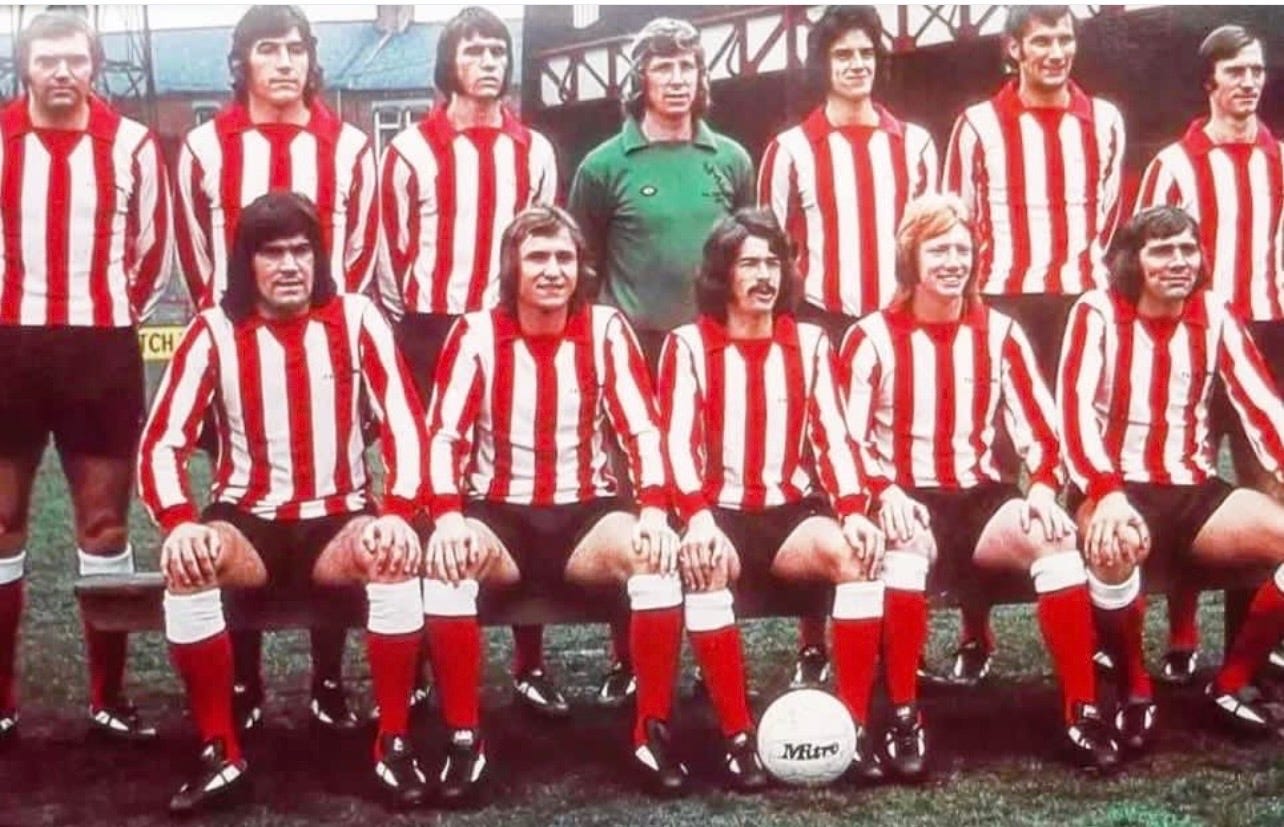
Look at the photograph.
Red and white stripes. Heavy shirts. Long hair. Hard faces.
And below them, black Stylo Matchmakers.
No launch campaign.
No smoke machine.
No one calling them a colourway.
They were boots.
Sunderland was not built for theatre
Sunderland came from work.
From shipyards. From cold streets. From men carrying the week through the turnstiles with them.
Roker Park had wind off the North Sea and terraces packed tight. The crowd knew when a player had hidden. They knew when he had taken responsibility.
You could fool a camera.
You could not fool Roker Park.
The crowd gave everything.
The players had to return it.
The boots had a job
Football boots were tools.
The leather darkened in the rain. Mud collected around the studs. If they were left in a kit bag overnight, they were still damp and heavy the next morning.
A player wanted them to soften around his feet, grip the ground and stay together when somebody arrived late through the back of him.
That was enough.
Nobody expected a boot to give him an identity.
The footballer already had one.
Stylo Matchmakers spread through dressing rooms because players trusted them. One man wore a pair. A teammate tried them. Another pair appeared the following week.
Boot to boot.
Player to player.
No script required.
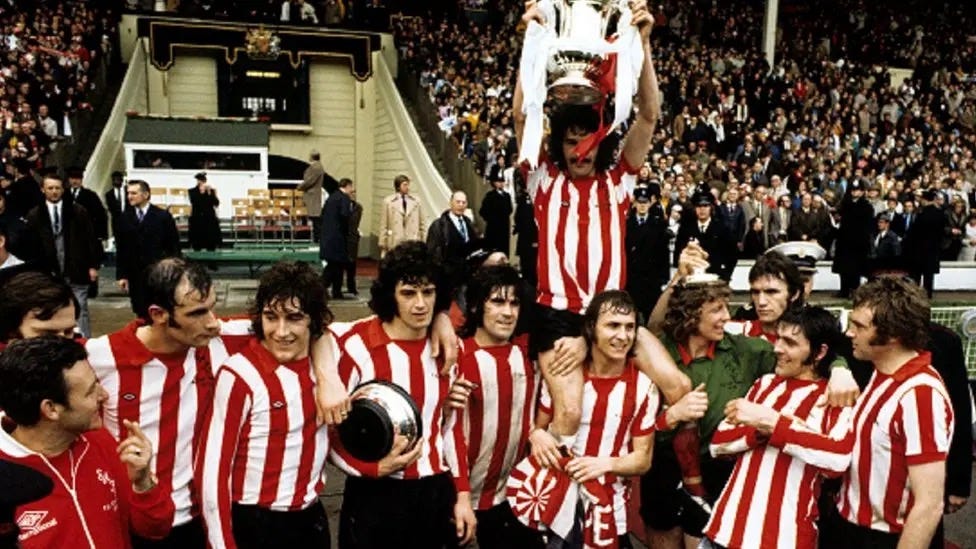
Then came 1973
Sunderland were in the Second Division.
Leeds United were one of the finest teams in Europe.
The result had already been written.
Sunderland had not read it.
Bob Stokoe sent out a side that knew exactly what it was. It could defend. It could suffer. It could wait.
Ian Porterfield scored.
Jim Montgomery made one save, then another.
Peter Lorimer struck the rebound hard. Montgomery got across and pushed it onto the bar.
For a second, Wembley stopped.
Then Sunderland understood.
This might really happen.
They won 1–0.
Not because they had more money.
Because eleven men kept their nerve longer than eleven others.
Football was always at its best when the script could still be torn up.
No passengers
The photograph comes from an era before every player was encouraged to become a separate business.
They stood together.
Same shirt.
Same badge.
Same mud waiting for them.
A great player could still be a star. George Best was. Kevin Keegan was. Liam Brady was.
But the star still had to fit inside the team.
He still had to track back.
He still had to face the dressing room after a bad game.
There were men in there who would tell him the truth.
Football needs those men.
Why Stylo belonged there
Stylo Matchmakers were worn by great players because they worked.
That is not romance.
It is the point.
George Best wore them.
Kevin Keegan wore them.
Billy Bremner wore them.
Liam Brady wore them.
Sunderland players wore them too.
Different feet.
Different styles.
Same test.
Could the boot do its job?
A boot cannot make a player brave.
It cannot give him vision.
It cannot rescue a poor first touch.
It should fit.
It should grip.
Then it should get out of the way.
The player must do the rest.
A club was a place
The old game was not perfect.
Players were badly treated. Grounds could be dangerous. Wages often bore little relation to the money clubs made from them.
But a club was still understood as a place.
Sunderland was not an entertainment property with a history department attached.
It was Sunderland.
The badge belonged emotionally to the people who carried it through relegations, false dawns and long journeys home.
Now that history is often broken into clips, merchandise and content inventory. The memories remain with the supporters. The commercial rights sit somewhere else.
That is the modern trick.
Take something built by generations of people and sell it back to them as a product.
Matchmakers
The name was right.
The right boot matched to the right player.
Nothing more complicated than that.
Black boots beneath red and white shirts.
The leather darkened.
The studs filled with mud.
The player still had to control the ball.
Sunderland in red and white.
Stylo Matchmakers in black.
No one pretending the boots could play for them.