

Look at a football changing room from 1992.
Look down.
adidas.
PUMA.
Umbro.
Diadora.
Lotto.
Reebok.
Hi-Tec.
Gola.
Patrick.
PONY.
Fila.
Valsport.
Mitre.
Kelme.
Hummel.
Kappa.
Quick.
CICA.
Mizuno.
And smaller names that appeared for a season, a country, a club or a generation.
Some were brilliant.
Some were average.
Some deserved to disappear.
That’s what competition looks like.
Now look at the biggest football tournament on Earth.
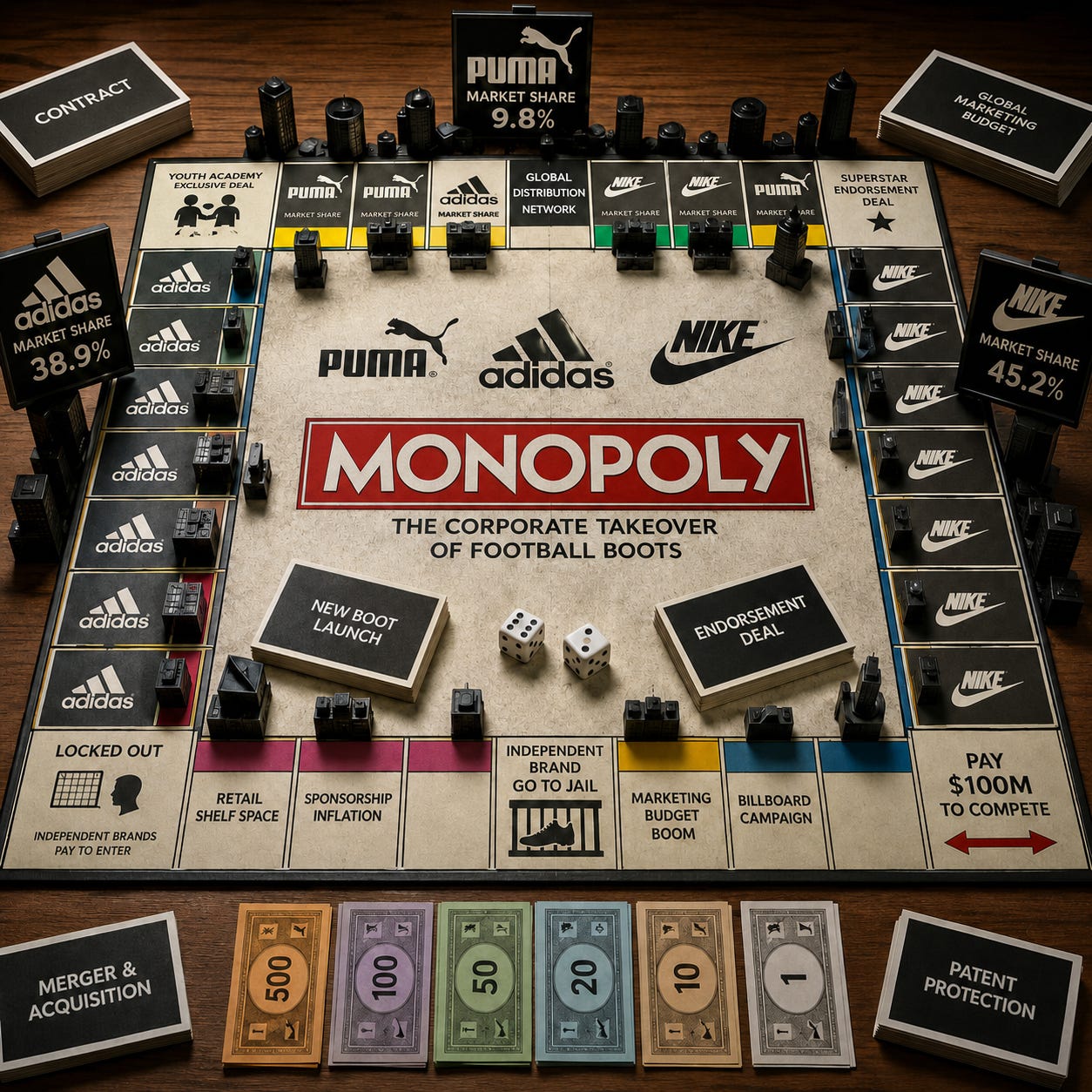
Pro:Direct tracked more than 1,200 boot choices at the 2026 World Cup.
Nike: 45.2%.
adidas: 38.9%.
PUMA: 9.8%.
Together:
93.9%.
Everybody else shared 6.1%.
Nike and adidas alone had 84.1%.
The Nike Mercurial Vapor 17 alone was worn by 236 players — 19% of the sample.
One model.
Nearly one footballer in five.
This is not evidence that Nike, adidas and PUMA illegally monopolise football boots.
They compete aggressively with each other.
Other manufacturers are allowed into the market.
The correct economic description is an oligopoly.
But forget economics textbooks for a moment.
If three giant corporations occupy almost 94% of the boots visible at football’s biggest tournament, what does the average 12-year-old actually see?
Three companies.
Again.
Again.
Again.
That matters.
Because football might technically offer hundreds of boots.
Visibility determines which choices feel real.
Where did everybody else go?
This is the question.
The football industry grew enormously after 1990.
Premier League television money arrived.
The Champions League grew.
Global audiences exploded.
Boot prices increased.
Retail grew.
Footballers became international celebrities.
You might reasonably expect that expanding market to support more manufacturers.
Instead the opposite happened.
The game became richer.
The boot room became poorer.
Not necessarily poorer in technology.
Poorer in competition, character and variety.
And the brands that disappeared generally followed one of three routes.
1. THE LIFESTYLE PIVOT
These companies didn’t necessarily die.
Something more subtle happened.
They stopped being meaningful football-boot companies.
Gola
Gola began in Britain in 1905 with deep roots in football footwear.
For generations it was a genuine sporting brand.
Then came tougher competition and financial problems.
The eventual revival of Gola was intelligent.
Heritage trainers.
Retro styling.
Lifestyle.
Fashion.
The badge survived.
The football boot largely didn’t.
Hi-Tec
When the Premier League started in 1992, Hi-Tec says 52 Premier League players wore its Kings Cup boot.
Fifty-two.
Imagine an independent brand outside the biggest three having fifty Premier League footballers today.
It would be considered a major industry disruption.
In 1992 it was simply another serious competitor.
Hi-Tec survived as a business.
Today we associate it much more with walking and outdoor footwear.
Another football choice quietly left the changing room.
Valsport
Valsport dates back to 1920.
Italian footwear.
Serie A history.
Italian craftsmanship.
Proper football pedigree.
Today Valsport still makes beautiful shoes.
But predominantly sneakers and lifestyle products.
The company survived.
The football category lost another competitor.
Quick
Quick was once a major Dutch football footwear manufacturer.
It had decades of football history.
Production eventually stopped in the early 1990s.
The badge later returned.
Again, largely through retro footwear and lifestyle.
Different company.
Same pattern.
This should tell us something.
Heritage sports brands discovered there was often an easier commercial route than trying to fight Nike and adidas for professional footballers.
Get off the pitch.
Go into fashion.
Sell the history instead of trying to compete in the present.
Financially, that can make complete sense.
But every time it happens, football loses another voice.
2. CORPORATE CONSOLIDATION
Then there are brands that didn’t lose a simple consumer vote.
Corporate decisions changed their future.
Reebok
Younger players may not realise how serious Reebok once was in football.
Proper boots.
Proper professional players.
Serious market presence.
Then adidas bought Reebok in 2006.
Over time, Reebok’s performance football operation disappeared and players moved towards adidas products.
One competitor effectively vanished from elite football.
Years later adidas sold Reebok.
And now Reebok is returning.
In 2026 it launched the Sidewinder 26 Elite, bringing the brand back into performance football.
How difficult is the road back?
Pro:Direct found one Reebok-wearing player in its 2026 World Cup sample.
One.
That is what twenty years away can do.
Warrior
Warrior didn’t fail because footballers suddenly hated Warrior boots.
New Balance entered football using Warrior.
There was serious investment.
Liverpool.
Boots.
Professional footballers.
Then New Balance decided its global football operation should carry the New Balance brand instead.
Warrior disappeared from football.
That may have been perfectly sensible corporate strategy.
But another badge vanished from the changing room.
That’s the point.
Markets don’t only become concentrated because consumers sit down one day and collectively choose three brands.
Companies merge.
Owners change strategy.
Brands are repositioned.
Product lines are closed.
Corporate portfolios are simplified.
And each decision can reduce competition without anybody ever announcing:
WE ARE REDUCING COMPETITION.
3. THE VISIBILITY SQUEEZE
This category is perhaps the most important.
Because having a good football boot became insufficient.
You needed enough money to make somebody notice it.
PONY
In 1998, PONY pulled away from Premier League sponsorship.
Contemporary reporting described intense competition producing rapid inflation in sponsorship costs.
That should be pinned on the wall of every independent football company.
The warning was there nearly thirty years ago.
Football visibility was becoming expensive.
And once visibility becomes expensive, capital begins deciding who gets seen.
CICA
Even Clarks once had a performance sports operation.
CICA boots appeared during the 1990s.
Advertising.
Football.
Real product.
Today they’re more likely to be discussed as footwear-history objects than as something a professional footballer might wear.
Another experiment disappeared.
Nomis
Nomis arrived much later.
So nobody can dismiss this purely as old companies failing to modernise.
Nomis tried to challenge the existing market with technology and an alternative proposition.
Harry Kewell wore the brand.
It attracted attention.
Then the business ran into severe financial problems.
The original operation collapsed.
Making a football boot is difficult.
Funding a football-boot company long enough to challenge corporations with global sponsorship budgets is considerably harder.
Pelé Sports
What name could possibly give a football brand more credibility than Pelé?
It still wasn’t enough.
Pelé Sports arrived with interesting products and perhaps the greatest football association imaginable.
Then it faded away.
Think about that.
If even the name Pelé cannot guarantee enough oxygen in the modern footwear business, how high is the barrier for somebody starting from nothing?
Patrick
Patrick also retreated from football-boot production.
A name once worn by Michel Platini and Kevin Keegan spent roughly two decades away from performance boots.
Then in 2026 Patrick made a limited Japanese-built football boot based on Platini’s old model.
We welcome that.
Because every boot company that comes back creates another choice.
The list gets longer
Then there are brands whose football presence diminished, disappeared or became marginal at various points from the 1990s onwards:
Gola.
Hi-Tec.
Patrick.
Quick.
Valsport.
PONY.
CICA.
Reebok.
Fila.
Warrior.
Nomis.
Pelé Sports.
Mitre footwear.
Kappa football boots.
Le Coq Sportif football boots.
Rucanor.
Quasar.
Lanzera.
Others remained but became dramatically less visible at elite level.
Umbro.
Lotto.
Diadora.
Joma.
Kelme.
ASICS.
And others survived strongly enough to remain serious alternatives.
Mizuno deserves particular credit.
So do newer challengers such as New Balance and Skechers.
The precise histories differ.
Some companies collapsed.
Some were acquired.
Some changed category.
Some still sell boots in particular markets.
It would therefore be wrong to say all these businesses were “killed.”
But something very clearly was killed.
The diversity of the elite football boot wall.
The barrier isn’t the boot anymore
This is the fundamental change.
Imagine you build an outstanding football boot tomorrow.
Perfect fit.
Beautiful upper.
Excellent soleplate.
£90.
Players love it when they try it.
Congratulations.
You have solved perhaps half the problem.
Now get a Premier League player to wear it.
Pay them.
Get distribution.
Get retailers to take your stock.
Get shelf space.
Pay for digital advertising.
Create content.
Sponsor teams.
Build relationships.
Give thousands of pairs away.
Compete against companies whose annual marketing budgets can dwarf the value of your entire business.
Suddenly you aren’t competing over football boots.
You’re competing over capital and attention.
That is the moat.
And the moat starts younger than people think
The commercial battle doesn’t begin when a footballer makes his Premier League debut.
It starts when he’s a kid.
To be accurate, not every professional academy forces every young player to wear one specific boot brand.
We shouldn’t pretend it does.
But look at the environment surrounding elite youth football.
Major brands partner with academies.
They activate at grassroots tournaments.
They provide kit.
They place superstar players into youth campaigns.
They produce junior versions of the same boots worn by famous professionals.
And some elite young players now receive personal commercial deals astonishingly early.
In 2025, The Times reported on a Nike commercial deal involving a 12-year-old Barcelona academy player.
Twelve.
Not twenty-two.
Twelve.
That’s where modern sports marketing has reached.
And think about what happens psychologically long before a contract exists.
A kid joins an academy.
He sees Nike.
adidas.
PUMA.
His heroes wear them.
His teammates wear them.
Social media feeds him them.
YouTube reviews them.
Boot launches feature the players he wants to become.
The junior model looks like the £250 professional version.
By fourteen or fifteen, another brand doesn’t merely feel different.
It can feel wrong.
Not contractually wrong.
Culturally wrong.
That’s arguably more powerful.
Brand loyalty before a first-team contract
This is the genius of the system.
A company doesn’t necessarily need to tell a 12-year-old:
You must wear us forever.
It simply needs to make itself part of what elite football looks like.
Then the child does much of the work.
He asks his parents for the boot.
He wears it.
His teammate sees it.
His teammate wants it.
The academy environment reinforces it.
The superstar reinforces it.
The video game reinforces it.
The retailer reinforces it.
By the time that child becomes a consumer with his own money, ten years of brand conditioning may already have taken place.
That is an extraordinary advantage for established corporations.
The loop
It works like this:
Sign the superstar.
The superstar wears the boot.
Millions of children see it.
Children buy the junior version.
Youth players normalise the brand.
Retailers see demand.
Retailers give it more space.
More sales create more sponsorship money.
More sponsorship money signs more stars.
More stars create more visibility.
And the loop begins again.
Now put a small company into that cycle.
It doesn’t need a bad product to lose.
It can simply be invisible.
This is why 93.9% matters
The World Cup number isn’t simply trivia.
It shows the outcome of the flywheel.
Nike: 45.2%.
adidas: 38.9%.
PUMA: 9.8%.
93.9% combined.
Everyone else: 6.1%.
That does not prove wrongdoing.
It does demonstrate enormous concentration.
And concentration changes markets.
Call it corporate football
Again, legally this isn’t a monopoly.
Three major competitors means oligopoly is the accurate term.
But consumers don’t spend their Saturday afternoons thinking about competition-law definitions.
They see three corporations dominating the elite game.
They see the same brands.
The same players.
The same retailers.
The same adverts.
The same £200-plus price category.
The same launch machinery.
So yes:
Football boots have become another corner of corporate football.
And we don’t think that’s particularly good for people.
Not because corporations are automatically evil.
Large companies can create brilliant things.
Nike has.
adidas has.
PUMA has.
The problem is concentration of power.
Competition works best when somebody can challenge the accepted answer.
Why ordinary footballers should care
Because fewer serious competitors eventually affects you.
PRICE
If £200-plus elite boots become normal across the dominant companies, the market begins accepting £200-plus as what premium football costs.
A challenger can say:
No.
MATERIALS
If the market moves aggressively towards ultra-thin synthetic construction, another company should be free to say:
We still believe leather has value.
FIT
Feet aren’t identical.
More manufacturers mean more lasts, shapes and philosophies.
DESIGN
Not everybody wants the same fluorescent speed boot.
DURABILITY
A challenger can prioritise longevity while somebody else prioritises grams.
CULTURE
Football becomes more interesting when everybody doesn’t look like they received the same corporate uniform.
Competition isn’t about feeling sorry for small businesses.
Competition makes big businesses behave better too.
The illusion of infinite choice
This is one of modern capitalism’s cleverest tricks.
Open a retailer website.
Hundreds of football boots.
It looks like incredible competition.
But look closer.
Mercurial in twelve colours.
Phantom in nine.
F50 in another ten.
Predator.
Future.
Ultra.
Junior versions.
Academy versions.
Pro versions.
Elite versions.
Different colours.
Different tiers.
Loads of SKUs.
But much of that apparent choice sits underneath a tiny number of corporate owners.
That’s not the same thing as having twenty serious manufacturers with twenty independent philosophies.
Forty flavours of three companies isn’t automatically forty independent choices.
The supermarket problem
Imagine walking into a supermarket.
There are fifty boxes of cereal.
Then you discover forty-six of them belong to three corporations.
You technically have choice.
But those corporations control most of the shelf.
Football footwear increasingly has the same problem.
And the shelf isn’t merely inside Sports Direct.
The shelf is:
television.
Instagram.
YouTube.
academy football.
professional endorsements.
retail stores.
football websites.
World Cups.
That’s an extraordinarily valuable shelf.
Stylo was one of the casualties
We don’t get to write this pretending we’re outside the story.
Stylo Matchmakers disappeared too.
We once had:
Pelé.
George Best.
Kevin Keegan.
Billy Bremner.
Trevor Francis.
Real football history.
Then Stylo vanished from modern football.
The sport didn’t wait for us.
Nike became enormous.
adidas remained enormous.
PUMA remained enormous.
Stylo became something people remembered.
We brought it back in 2017.
That history gives us a story.
It gives us no entitlement whatsoever.
Nobody owes Stylo a sale.
Nobody should buy an H74 because George Best once wore our badge.
Make a good boot.
Price it properly.
Put it in front of a footballer.
Then:
let them choose.
That is the market we want.
We don’t want Nike’s 45%
This is important.
Stylo doesn’t need to become another giant.
The world has plenty.
We don’t need half the Premier League.
We don’t need half the World Cup.
We need enough footballers who want an alternative.
People who like leather.
People who want black boots.
People who don’t want to pay £265.
People who would rather judge the boot than the endorsement contract.
People who enjoy wearing something their whole team hasn’t already bought.
That’s enough.
Small doesn’t have to mean unsuccessful.
Small can mean independent.
Break the 93.9%
So what can ordinary football actually do?
Not complain about corporations on the internet.
Do something simpler.
1. Vote with your feet
Stop assuming the most expensive boot is automatically the best boot.
Try alternatives.
Mizuno.
Umbro.
Diadora.
Lotto.
Joma.
Reebok.
Patrick.
Independent brands.
Stylo.
Whatever genuinely works for your foot.
If Nike makes the best boot for you?
Wear Nike.
That’s choice too.
But actually make the choice.
Don’t outsource it to somebody else’s sponsorship deal.
2. Keep grassroots football open
Local clubs and academies need money.
Sponsorship helps.
Nobody sensible wants to remove funding from youth football.
But where possible, don’t turn children into captive consumers.
A shirt partnership doesn’t need to become lifelong footwear loyalty.
Allow players and parents room to choose equipment based on:
fit.
safety.
price.
comfort.
and preference.
Grassroots football should develop players.
Not corporate customers.
3. Choose individuality over endorsement
Your favourite player is probably paid to wear his boots.
You aren’t.
That’s liberating.
Wear what suits:
your foot.
your game.
your wallet.
Footballers spent generations becoming famous because they were individuals.
It’s strange that we now spend so much money trying to look exactly like them.
And retailers have a part to play
Give an independent manufacturer a shelf.
Not as charity.
If the product is poor, remove it.
But test it.
Small brands cannot become viable alternatives if consumers never physically see them.
A healthy retailer shouldn’t only ask:
What already sells?
Sometimes it should ask:
What deserves an opportunity to sell?
Otherwise today’s market leader automatically becomes tomorrow’s market leader.
That’s not competition.
That’s momentum.
Coaches have a part to play too
A coach shouldn’t care whether the left-back has a Swoosh, three stripes or something nobody recognises.
Does it fit?
Is it safe for the surface?
Can the family afford it?
Can the kid play?
Good.
Training starts at six.
That should be enough.
Parents have more power than they think
Every parent eventually hears it.
“But everyone has these.”
That’s probably the most powerful marketing sentence in youth football.
You don’t need to turn buying boots into a political lecture at breakfast.
Kids want to fit in.
That’s normal.
But we can teach them another idea too:
Different isn’t automatically worse.
Sometimes different is how better starts.
Small brands must earn it
And independent companies should not expect sentimental support.
Being small doesn’t make you good.
Being heritage doesn’t make you good.
Being anti-corporate doesn’t make you good.
Stylo included.
The challenge is higher.
If we say the industry charges too much, our value needs to be better.
If we talk about durability, our boots need to survive football.
If we talk about heritage, the modern product still has to perform.
If we want people to choose independent brands, we have to give them a reason.
That’s fair.
Let competition work again
Maybe Patrick’s return grows.
Maybe Reebok succeeds.
Maybe Mizuno takes another few percentage points.
Maybe Umbro returns to more professional feet.
Maybe some completely unknown company builds the best boot of 2030.
Maybe Stylo takes a tiny piece.
That’s healthy.
Because the objective isn’t:
Destroy Nike.
The objective is:
Don’t let anybody become inevitable.
Once a corporation feels inevitable, consumers stop questioning the price.
Retailers stop questioning the shelf space.
Young players stop questioning the badge.
And challengers stop believing entry is possible.
That’s when choice becomes theoretical.
Football doesn’t belong to corporations
Nike doesn’t own football.
adidas doesn’t own football.
PUMA doesn’t own football.
Stylo doesn’t either.
The game belongs to the people playing it.
And those people deserve a proper market.
Cheap boots.
Premium boots.
Leather boots.
Synthetic boots.
Black boots.
Mad boots.
British boots.
Italian boots.
Japanese boots.
American boots.
African boots.
Boots made by billion-dollar corporations.
Boots designed by somebody working from a tiny industrial unit.
Let them compete.
Let bad products fail.
Let good products survive.
But keep the door open.
Because football with three corporations taking 93.9% of the visible market isn’t the end of competition.
But it should be a warning.
STYLO MATCHMAKERS
Born 1966. Reborn 2017. Still independent.
Against Modern Football. Built for Originals.
BREAK THE 93.9%
Try something different.
Keep grassroots choice open.
Wear the boot — not the endorsement.
The corporations already have the billboards.
The rest of us still have our feet.
Awesome content. Perhaps not a monopoly, but oligopoly seems to be the trend?