

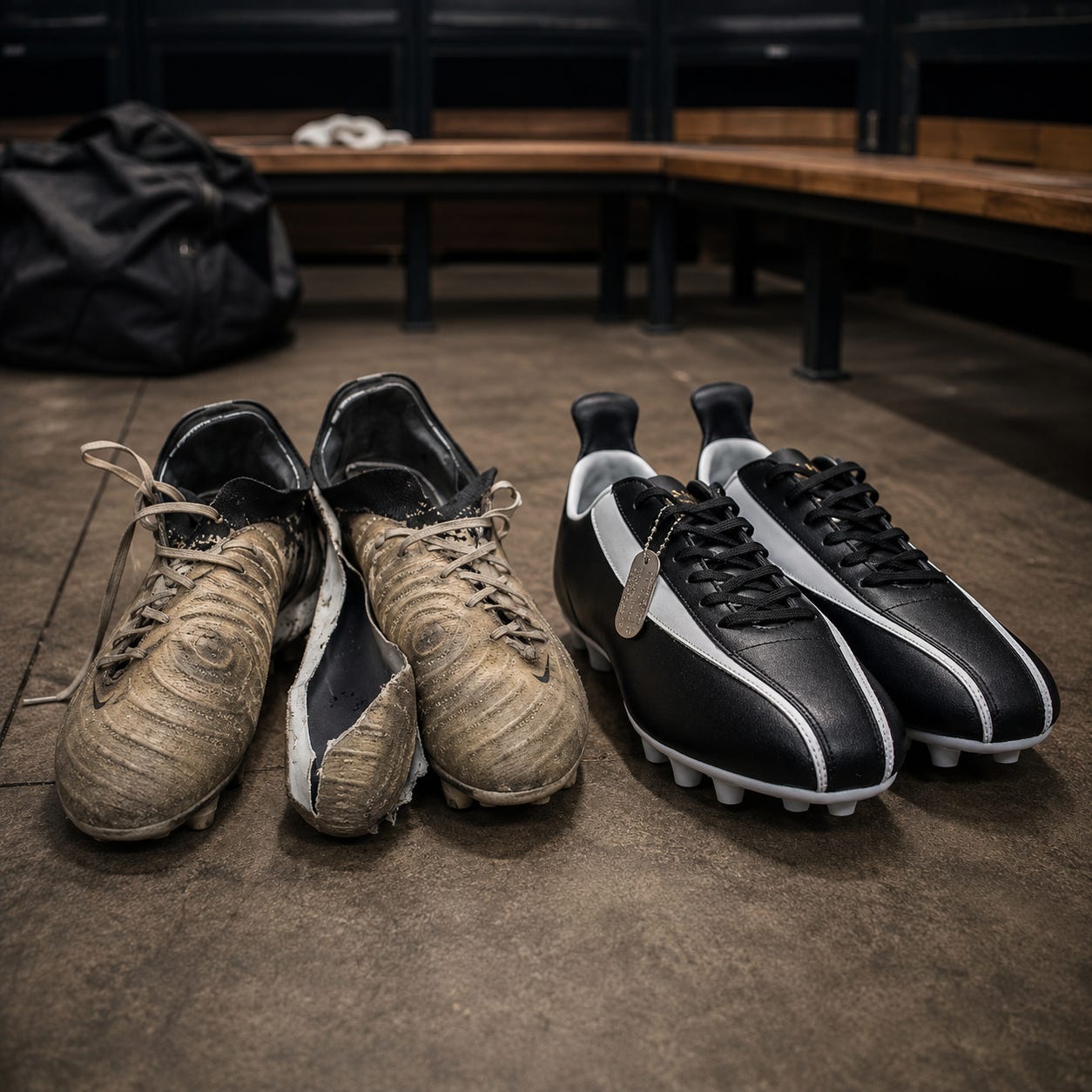
Football boots have never been better.
That’s worth saying first.
They’re lighter.
They’re more consistent.
They’re easier to wear straight from the box.
Modern soleplates can be excellent.
Synthetic uppers can produce incredible touch with almost no weight.
The best modern boots are genuine pieces of engineering.
But there’s another question football doesn’t ask often enough.
How long should a football boot actually last?
Because somewhere in the pursuit of lighter, faster and thinner, something changed.
A football boot used to become part of your kit.
Now it can sometimes feel like another consumable.
Wear it.
Replace it.
New generation.
New colour.
New launch.
Repeat.
And that’s strange when top-end football boots can cost more than £200.
If we’re paying premium prices, shouldn’t we expect premium longevity too?
The failure usually starts somewhere boring
Nobody launches a football boot campaign around the bit where the upper meets the sole.
Unfortunately, that’s exactly the sort of place that matters.
Football boots spend ninety minutes flexing, twisting and absorbing impact.
The toe bends.
The forefoot torques.
Studs bite while the upper wants to keep moving.
Then repeat that hundreds of times.
Add rain.
Mud.
Frozen winter pitches.
Dry artificial surfaces.
Rubber crumb.
Players standing on your feet.
That’s where construction gets tested.
A boot can have the lightest upper in football and still be useless if the structure underneath it gives up.
Durability is engineering too.
We became obsessed with weight
For years the football boot industry chased grams.
Every new boot seemingly had to be lighter than the one before it.
Twenty grams saved here.
Ten grams there.
Thinner upper.
Less padding.
Less structure.
Eventually football reached a strange point where being able to say a boot weighed almost nothing became part of the product itself.
And there are advantages.
Some players love that close-to-the-ball sensation.
Quick players may prefer less bulk.
A very light boot can feel fantastic.
But engineering always involves trade-offs.
Remove material and you remove material.
Reduce padding and there is less padding.
Make an upper thinner and you’re asking less material to deal with the same tackles, stretching, twisting and rain.
Light isn’t automatically better.
Heavy isn’t automatically better.
The sensible question is:
Better for what?
Football isn’t played in a laboratory
Boots aren’t worn on pristine carpet.
They’re dragged through mud.
Frozen.
Soaked.
Dried badly beside radiators.
Left in kit bags overnight.
Stood on.
Twisted.
Scraped across artificial pitches.
Used Tuesday.
Again Thursday.
Then for ninety minutes on Saturday.
That’s football.
A proper football boot shouldn’t require perfect conditions to survive.
It should expect abuse.
Because players certainly aren’t going to stop giving it any.
There was something useful about leather
Leather wasn’t perfect.
Let’s kill the nostalgia before it gets silly.
Old boots could become heavy when wet.
Some needed serious breaking in.
Leather could stretch too far.
Maintenance mattered.
The old leather football boot wasn’t a magical object created before capitalism ruined everything.
But good leather possessed an attribute modern football sometimes undervalues.
It changed with you.
Wear a good leather boot and the material begins to soften.
Creases appear.
The upper shapes itself around the foot.
Eventually your pair looks slightly different from everybody else’s.
That’s not automatically deterioration.
Sometimes that’s the product becoming yours.
A crease isn’t a defect
Modern consumers have almost been trained to see evidence of use as failure.
A crease:
Old.
A scuff:
Damaged.
Leather softening:
Worn out.
But football boots are tools.
They’re supposed to show evidence that somebody actually played football in them.
A proper boot should be allowed to age.
Football never stays factory-new.
Neither should something designed to survive it.
The twelve-month revolution
This may be the cleverest trick in modern football footwear.
Every year we’re introduced to something revolutionary.
Then approximately twelve months later that revolutionary product somehow needs replacing with another revolutionary product.
New upper.
New plate.
New name.
New campaign.
New footballer standing in smoke looking extremely serious.
And inevitably:
NEW GENERATION.
Sometimes the improvement is genuine.
Sometimes it’s significant.
But if last year’s boot was genuinely world-class, it hasn’t suddenly forgotten how to play football because another box arrived.
Football boots became fashion products as much as sporting equipment.
Fashion needs turnover.
Durability doesn’t always help turnover.
We shouldn’t romanticise bad old boots
Some old football boots were tanks.
Unfortunately, some felt like tanks too.
Heavy.
Rigid.
Long break-in periods.
Limited flexibility.
Modern manufacturers fixed genuine problems.
Synthetic materials improved consistency.
Construction became lighter.
Water absorption reduced.
Soleplates became more flexible.
Comfort improved.
That’s progress.
Stylo isn’t interested in reversing it.
We don’t want footballers wearing 1960s boots simply because George Best once did.
That’s costume.
We want something else.
Evolution without amnesia.
Take what modern footwear improved.
Keep it.
But don’t throw away durability, protection, fit and feel just to save another few grams.
Three Stylo approaches
That’s why the modern Stylo Heirship range doesn’t pretend one material answers every problem.
Different players want different things.
Heirship Seventeen
The Heirship Seventeen takes the modern route.
Japanese microfibre.
Structured.
Consistent.
Designed to retain its shape rather than behaving like traditional leather.
It’s for footballers who want modern materials without needing their boot to feel disposable.
Heirship Sixty Eight
The Heirship Sixty Eight takes the more traditional route.
Cow leather.
More substance.
More protection.
More of the traditional relationship between a leather upper and the player’s foot.
Wear it.
Let it soften.
Let it become yours.
Heirship Seventy Four
Then there’s the Heirship Seventy Four.
Our attempt to sit between the two worlds.
Softer.
Thinner.
Premium leather.
Classic fold-over tongue.
Moulded soleplate.
Longer moulded studs designed to give more bite on softer pitches.
It isn’t a reproduction of a 1974 football boot.
That would miss the point.
It takes the principles we still believe matter and applies them to football now.
The soleplate matters as much as the upper
This is the unglamorous part of football-boot design.
The upper gets photographed.
The soleplate gets punished.
Every sprint asks the boot to flex.
Every turn twists it.
Every planted stud sends force through the bottom of the shoe.
Artificial surfaces can be particularly unforgiving because traction and abrasion repeatedly work against the construction.
That’s why we don’t judge a football boot by how beautiful it looks when it comes out of a box.
The real question starts when the box is in the bin.
What happens after the matches begin?
So let’s stop saying “durable”
Every football brand can write that word.
It means almost nothing without a test.
So The Boot Room is going to use a much harder benchmark.
The 40-Match Test
Forty full matches or equivalent playing sessions.
Not twenty minutes taking photographs.
Not a clean training pitch.
Real football.
Natural grass.
Wet pitches.
Mud.
Dry ground.
Artificial surfaces where appropriate for the soleplate.
Repeated flexing.
Stud pressure.
Training.
Matches.
Weather.
Then we’ll inspect:
upper separation;
soleplate integrity;
excessive stretching;
heel structure;
stud wear;
stitching and seams;
material breakdown;
fit after prolonged use;
comfort;
and whether we’d still choose to play another ninety minutes in them.
That is a durability review.
Anything before that is mostly a first impression.
Forty matches isn’t forever
And it shouldn’t be.
Football boots are consumable sporting equipment.
Players move differently.
Surfaces differ.
Some people train once a week.
Others play four times.
No responsible manufacturer can promise that every boot will survive exactly the same amount of punishment.
But 40 matches gives us a serious benchmark.
If a £200-plus boot reaches forty matches in excellent structural condition, tell people.
If it doesn’t, tell people that too.
And Stylo gets no exemption because it’s our name on the website.
If a Heirship fails the test, we’ll say where it failed.
That’s how the benchmark becomes worth something.
Maybe durability isn’t fashionable enough
There isn’t much glamour in:
OUR SOLE IS STILL ATTACHED.
Nobody runs through flames because their boot survived February.
Nobody needs a dramatic orchestral soundtrack for:
We built this part stronger because people stand on your feet.
But perhaps football should care about these things more.
Because durability is performance.
Protection is performance.
Comfort in the 87th minute is performance.
Maintaining shape is performance.
A soleplate remaining attached to its upper is definitely performance.
The industry became obsessed with measuring grams.
Let’s start measuring matches.
£200 changes the expectation
Price matters.
We don’t expect a £30 boot to behave like a handmade object for ten years.
That would be unreasonable.
But once a football boot crosses £200, players have the right to become demanding.
At that price, surviving football shouldn’t feel like a bonus feature.
It should be part of what you’re paying for.
A premium price should mean more than:
lighter box.
famous footballer.
beautiful launch film.
limited colourway.
It should result in a product that earns the word premium after it has been used.
Not merely before.
Football boots should become yours
Your favourite boots probably weren’t your favourite on the day you bought them.
They became your favourite.
You scored in them.
Won in them.
Lost in them.
Played terribly in them.
Played the game of your life in them.
They moulded.
Creased.
Scuffed.
Picked up mud from grounds you’ve forgotten.
Eventually they became associated with football rather than shopping.
That’s what a proper football boot should be allowed to do.
Stylo doesn’t want disposable football boots
We don’t want somebody buying another pair because an algorithm tells them their current colourway is old.
We’d rather build boots people actually want to play football in.
And if eventually you destroy them?
Good.
They did their job.
Football boots shouldn’t live forever.
But they should live long enough to acquire a story.
That’s the difference.
Maybe the best boot isn’t the lightest
Maybe it isn’t the most expensive either.
Maybe the best football boot is simply the one you stop thinking about.
Put it on.
It fits.
It grips.
It protects.
It gives you confidence on the ball.
Saturday comes.
You wear it again.
And again.
And again.
No drama.
No revolution.
No new generation required.
Just football.
STYLO MATCHMAKERS
Born 1966. Reborn 2017. Still independent.
Against Modern Football. Built for Originals.
Heirship Seventeen
Heirship Sixty Eight
Heirship Seventy Four
The industry measures grams.
The Boot Room is going to measure matches.