

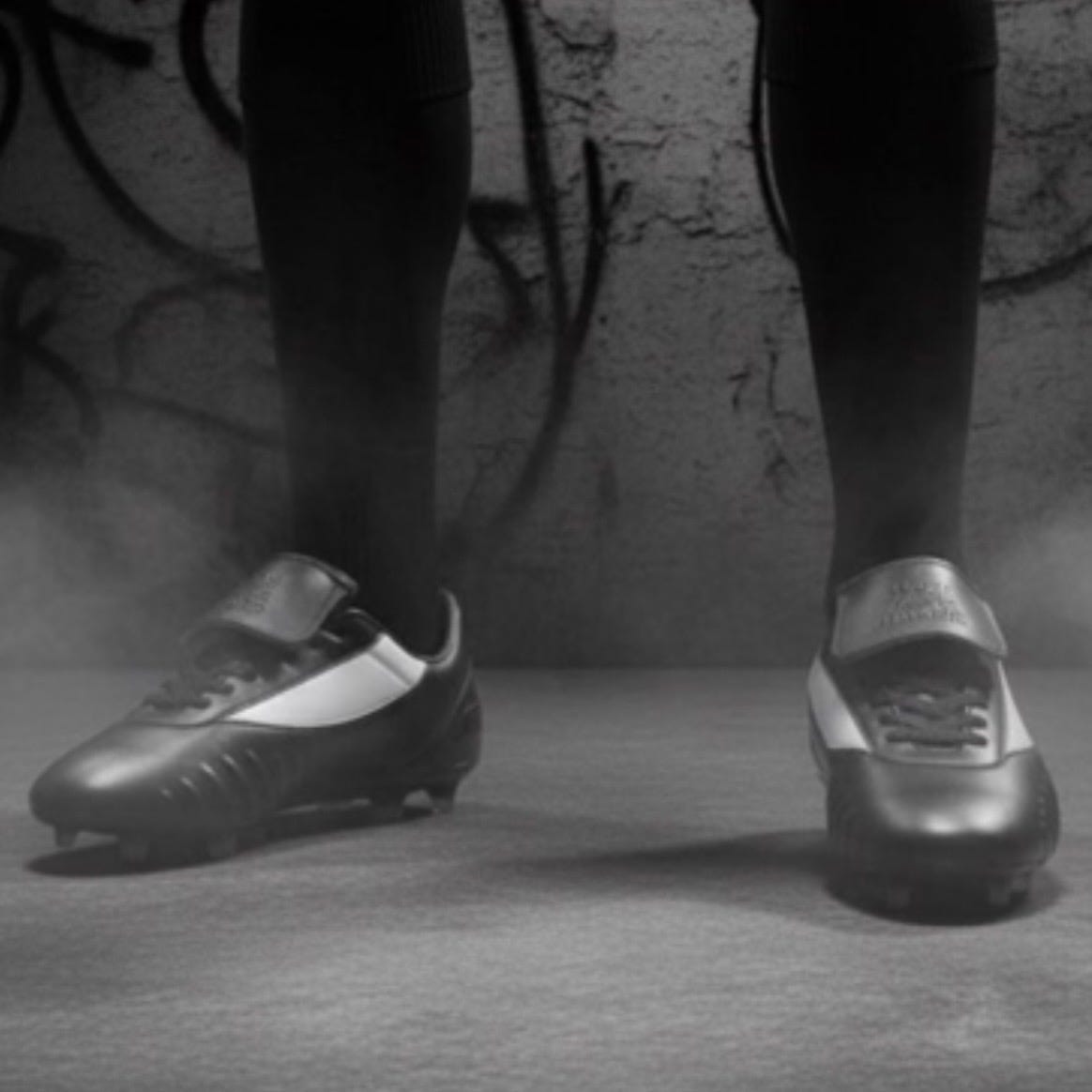
The modern football boot industry became obsessed with weight.
Every gram became a breakthrough.
Every thin synthetic layer was given a scientific name.
Every new colour was presented as progress.
Then you picked some of the boots up.
They felt like plastic bags with studs attached.
Stylo Matchmakers took a different path.
We wanted boots that held the foot, kept their shape and felt ready for football.
That is why the Heirship 17, Heirship 68 and Heirship 74 used different materials.
Each had a purpose.
We did not begin with a marketing story.
We began with the player.
Heirship 17: Japanese microfibre with backbone
The Heirship 17 used high-quality Japanese microfibre.
We chose it because we wanted the consistency of a modern synthetic upper without the flimsy, papery feel of many lightweight boots.
It was strong.
It was structured.
It was thicker than the plastic-like skins appearing across the market.
That mattered because professional football is not played in a laboratory.
Players stop, turn, tackle and get stood on.
The boot has to survive all of it.
Synthetic does not have to mean thin.
It does not have to mean cheap.
The Japanese microfibre gave the Heirship 17 durability, shape retention and a more dependable fit.
It did not collapse around the foot.
It did not soak up water.
It did not need weeks of breaking in.
It was a modern material used with old-fashioned standards.
Heirship 68: proper leather
The Heirship 68 used traditional cow leather.
It gave the boot strength, body and character.
The upper was thicker than the leather later used on the Heirship 74. It softened with wear, but it did not immediately lose its shape.
That made it a dependable boot for players who wanted protection as well as touch.
Leather also changes with the player.
It stretches.
It softens.
It forms around the foot.
You wore the Heirship 68 in.
It became yours.
It was never designed to be the lightest boot in the changing room.
It was designed to be trusted.
Heirship 74: the best boot we ever made
Then came the Heirship 74.
The best football boot Stylo Matchmakers has made.
It used a thinner, softer and more premium leather than the Heirship 68.
The challenge was balance.
Too thick and the player feels separated from the ball.
Too thin and the boot loses structure and durability.
The Heirship 74 found the middle.
Soft enough to wrap naturally around the foot.
Thin enough to feel responsive.
Strong enough to remain a serious football boot.
The touch was clean.
The fit was natural.
The material did the work.
It did not need rubber fins, control zones or a page of invented technology.
You put it on.
You knew.
That is what premium should mean.
Better materials.
Better construction.
Fewer excuses.
Why we refused kangaroo leather
There was one material we deliberately avoided.
Kangaroo leather.
For years, footballers were told it was the ultimate boot material.
Light.
Soft.
Strong.
Professional.
What the advertising rarely showed was how it reached the factory.
Kangaroos are killed in large numbers in Australia for commercial use. Adult animals are shot, and dependent young may be left behind or killed through blunt-force methods.
Football supporters see the finished leather.
They do not see the animal.
They do not see the pouch.
They do not see the joey.
We did not want Stylo Matchmakers to be part of it.
Some defend the trade by saying populations need managing and the process is regulated.
That does not make it acceptable to us.
A licence does not remove the suffering.
A softer football boot does not justify it.
The Heirship 17 proved Japanese microfibre could provide strength and consistency.
The Heirship 68 proved cow leather could provide body and protection.
The Heirship 74 proved premium leather could provide exceptional softness and touch.
We did not need kangaroo leather to make a brilliant boot.
So why use it?
We believe it should be removed from football boots entirely.
Not renamed.
Not excused.
Banned.
A football boot should leave defenders behind.
Not a trail of suffering.
Why we used moulded soleplates
All three models used moulded soleplates.
That was deliberate too.
Traditional screw-in studs made sense when pitches regularly became swamps.
But football surfaces have improved.
Professional pitches are better maintained.
Training grounds are better.
Drainage is better.
Even many Sunday league pitches are firmer than they once were.
For most modern football, a moulded soleplate is the more practical option.
There are no studs working loose.
No missing studs before kick-off.
No spanner in the kit bag.
You put the boots on.
You play.
The Heirship 74 was built for real pitches
The Heirship 74 also used thicker, longer moulded studs.
That gave it more bite on softer and muddier ground.
We did not believe players should need an old-fashioned screw-in system every time Britain remembered how to rain.
The longer studs penetrated further into soft ground and gave dependable traction.
But the boot kept the simplicity of a one-piece soleplate.
No loose parts.
No toolbox.
The Heirship 74 combined premium leather, exceptional touch and proper grip.
That is why it remains the best boot we ever made.
We did not build disposable products
The industry became obsessed with creating the sensation of speed.
Thin uppers.
Weight claims.
Plastic skins.
New colourways every month.
A lighter boot does not automatically make a player faster.
A thinner upper does not automatically improve touch.
An expensive boot is not automatically premium.
Sometimes a thin boot is simply a thin boot.
Stylo Matchmakers chose substance.
We used modern microfibre when it was right.
We used traditional leather when it was right.
We rejected kangaroo leather because some lines should not be crossed.
We used moulded soleplates because they suited the pitches most players actually used.
Every decision had a reason.
The Heirship 74 was the best boot we made.
Soft premium leather.
Longer moulded studs.
No gimmicks.
No kangaroo skin.
It was made for the ball, the foot and the pitch.
That should not sound revolutionary.
It only does because football boots lost their way.